Indian hospitals lack shared benchmarks to buy AI scribes, arXiv study warns
Indian hospitals lack benchmarks to evaluate AI clinical scribes, risking poor performance. Learn why vendor-run tests may fail in noisy, multilingual clinics.
Hannah Vogel ·
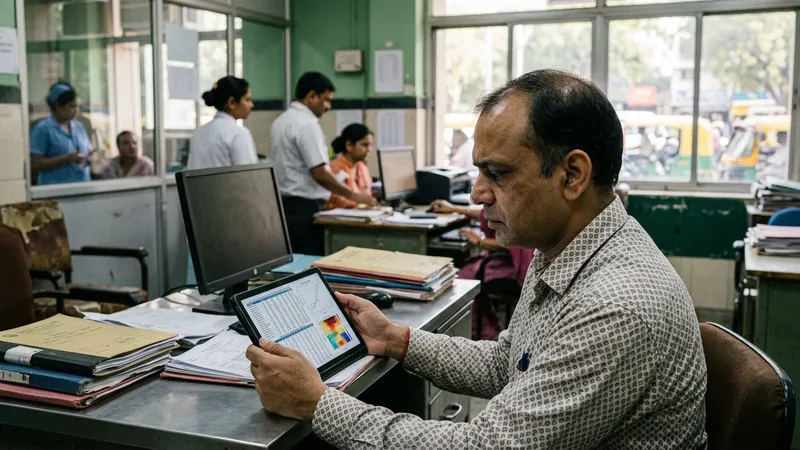
In an arXiv preprint posted in September 2026, the authors say there are no publicly available, large-scale, real-world benchmarks for evaluating ambient clinical scribes (ACS) in India and that deploying organisations have each built proprietary, incomparable evaluation pipelines. This is, so far, single-source — the preprint only, with no independent confirmation — and no one in the reported packet is on the record by name. The paper contends that Indian clinical encounters are brief, triadic, multilingual and code-mixed in low-resource languages, often held in noisy, resource-constrained settings, which raises the likelihood of automatic speech recognition and note-generation errors manyfold compared with Global North contexts. The authors call for a publicly shared, real-world, multilingual benchmark to test safety and reliability before buyers commit at scale. — arXiv: “Evaluating Ambient Clinical Scribes in India: The Need for Multilingual Real-World Clinical Conversation Data.” [S1]
Without real-world, multilingual data, procurement cannot compare vendors on a common basis
The preprint’s central business claim is not about model quality per se but about measurement: Indian hospitals, clinics and state health systems lack an independent, shared standard to judge competing ACS products. According to the preprint, current evaluation practices rely on datasets and consultation styles from the Global North, or synthetic corpora, that diverge from Indian encounters. In practical procurement terms, that means a buyer cannot run a like-for-like bake-off across vendors or write performance-based service levels with confidence that the test approximates real-world workload. The study asserts that deploying organisations in India and Africa have each built proprietary evaluation pipelines, which are not comparable across vendors, leaving purchasers to price risk on vendor terms rather than on a neutral yardstick. [S1]
Synthetic and Global North datasets do not match Indian clinic reality, increasing the odds of misbought tools
The authors report that publicly available patient–clinician conversational datasets are “overwhelmingly synthetic” and that available Global North datasets diverge significantly from the conversational and cultural structures of Indian encounters. If buyers accept benchmarks built on those corpora, they may be purchasing models tuned for longer, two-party, monolingual consultations in quieter rooms — the opposite of the brief, triadic, code-mixed exchanges common in Indian outpatient departments. That mismatch has a direct commercial implication: error rates observed in vendor demos may not transfer to noisy, multilingual wards, exposing hospitals to rework costs, clinician rejection and renegotiations at renewal. The paper’s point is not academic nuance; it is a procurement denominator problem: measure on one domain, deploy in another, and the variance becomes a cost line. [S1]
Fragmented vendor evaluations push risk onto hospitals’ legal and clinical governance teams
The interview component — five organisations building and deploying ACS in India and Africa, per the preprint — suggests each organisation has built bespoke, proprietary evaluation pipelines. For buyers, that fragmentation shows up as contractual ambiguity. Without a public benchmark, hospitals are forced to rely on vendor-run pilots and internal scoring that are not independently replicable, making it harder to specify acceptance criteria, error budgets or remediation timelines in service-level agreements. In environments where clinical documentation feeds billing, claims and medico-legal processes, that ambiguity flows into legal exposure and compliance workload. Procurement teams will find themselves negotiating not only price but the very definition of acceptable performance, a negotiation asymmetrically informed in the vendor’s favour if only vendor-origin tests exist. [S1]
This is a buying-process problem before it is a model-performance problem
The preprint’s authors argue for “a standardized evaluation infrastructure” as a precondition to safe deployment at scale. Translating that into the buying process, it suggests that Indian health systems may need to reorder their steps: require vendors to run on shared, real-world, multilingual tapes under common scoring, then pilot in unit environments, and only then negotiate price against documented risk. Without that, procurement defaults to demos and vendor attestations, which are hard to audit when outcomes underperform on the ward. The claim that “ambient clinical scribes (ACS) are being rapidly deployed at scale across Global South healthcare settings” implies momentum ahead of measurement; if true, renewal seasons will become the first real-world performance review. That is late and expensive. [S1]
The counterargument: field pilots and privacy constraints make shared corpora impractical — but that does not fix comparability
A likely objection is that protected health information and consent constraints make public, real-world corpora hard to assemble, and that field pilots inside each hospital are the only practical path. Vendors can also argue that their internal datasets and on-site pilots are closer to reality than any shared academic set. The preprint anticipates part of this by calling for “a publicly shared, real-world, multilingual benchmark” and outlining properties and policies it would require, implying governance mechanisms for consent and de-identification. Even if pilots remain necessary, a shared baseline corpus still matters: it gives procurement a first-screen that any vendor can be tested against before committing clinician time and institutional data to bespoke trials. Without it, every buyer runs a custom experiment with no external control. [S1]
What changes for sellers and buyers in the next tender cycle
If procurement demands a public benchmark, sellers will have to carry new pre-sales costs: demonstrating performance on a shared corpus, reporting errors broken down by language mix and noise profiles, and accepting error budgets tied to the benchmark’s distributions. Pricing will follow risk: vendors may move from flat per-seat rates to structures that price by encounter type or include remediation credits for high-risk settings. Buyers — especially state systems and large private chains — will begin to separate model evaluation from broader change management, perhaps procuring evaluation services or insisting on certified test results as a precondition to pilot access. The preprint’s finding that current datasets are overwhelmingly synthetic suggests this shift will not happen overnight; it will require a funding source to build and maintain a corpus and a policy layer to govern contributions and access. Until then, expect more conservative RFPs that cap deployment scope or require staged rollouts tied to documented performance in multilingual, code-mixed conditions. [S1]
The financing implication: who pays for the benchmark and how it shows up in price
A shared benchmark is a public good with private beneficiaries. The preprint calls for its creation but does not name a funder. In practice, costs can be recovered via certification fees, vendor memberships or as a requirement embedded in payer contracts. If a national health authority or industry consortium underwrites the corpus and certifies results, vendors will pass those costs through; buyers will see them either as a line item or in headline price. The upside for buyers is reduced evaluation redundancy and a stronger negotiating position on SLAs; the downside is a new layer of compliance cost. Absent a sponsor, the ecosystem will remain fragmented, and buyers will continue to accept vendor-defined evidence — a hidden tax in the form of higher pilot and governance overheads. [S1]
Watch the tender language — and the renewal math
Because this is a single-source preprint, the next proof point will not be academic. It will be the wording in RFPs and renewals. If large Indian hospital chains or state health departments begin to specify multilingual, code-mixed test tapes and common scoring in tenders, the market will have moved. If renewals begin to require error breakdowns by language and context, sellers will have learned the lesson the hard way: demos do not carry over to wards. Conversely, if tenders continue to accept vendor-run evaluations without independent comparators, the procurement equilibrium remains vendor-led — exactly the fragmented landscape the preprint describes. [S1]
Limitations and what the paper does not show
This is a preprint, not peer-reviewed, and rests on a mixed-methods approach the authors describe: a systematic survey of datasets, a quantitative comparison against markers from the Indian clinical-communication literature, and semi-structured interviews with five organisations. The study does not publish a new corpus or name the interviewees; it argues for infrastructure and outlines its properties. That does not diminish the procurement point; it limits the immediate operational playbook. For buyers and sellers, the normative claim is clear; the operational details — consent frameworks, de-identification methods, access policies — remain to be built. [S1]