

IBM Adjusts Quantum Roadmap to Target Dual-Processor Systems by 2027
IBM has updated its quantum roadmap to prioritize a dual-processor system by 2027, moving away from a nine-chip interconnect strategy while focusing on…
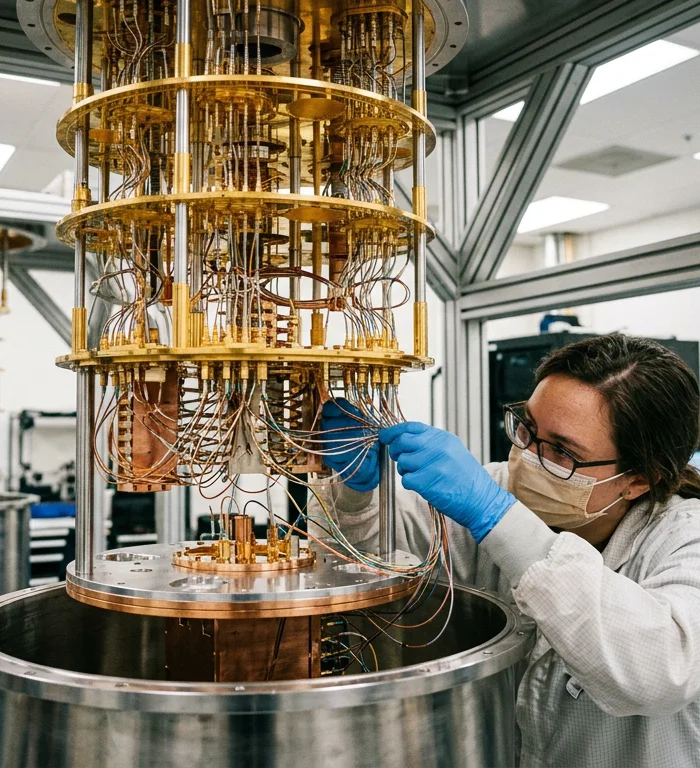
IBM has revised its quantum computing development roadmap, shifting its strategy for scaling processor capacity. The company now intends to deploy a dual-processor system by 2027, utilizing two 520-qubit chips to achieve a total of 1,040 qubits. This represents a significant departure from previous plans, which aimed to reach a similar capacity by interconnecting nine smaller 120-qubit processors.
This strategic pivot suggests a change in the company’s approach to modular scaling and chip-to-chip communication. While the total projected qubit count remains largely consistent with earlier targets, the reduction in the number of linked units indicates a focus on larger, individual monolithic processors rather than complex multi-chip arrays. The company maintains that it has achieved high state-transfer fidelities of 99.4% in testing, approaching its long-term objective of 99.9%.
In the interim, the company is prioritizing performance enhancements through hardware-based qubit resets. Recent iterations of its "Nighthawk" processor incorporate dedicated physical hardware to return qubits to a ground state, which has reportedly accelerated circuit execution speeds by up to 19 times in specific operations. This hardware-centric optimization is intended to improve the reliability of gate operations before error-correction protocols become mandatory.
IBM continues to operate on two parallel development tracks: one focused on the technical requirements of error-corrected hardware and another providing high-performance, general-use processors for algorithm testing. The company remains committed to delivering error-corrected quantum computing capabilities before the end of the decade. Stakeholders should monitor the 2027 deployment as a critical benchmark for the viability of the company’s revised interconnect architecture and its ability to maintain performance gains at higher qubit densities.
More stories
- Europe faces attribution gap after 16 cyber, physical incidents
- PIF backs Grand Theft Auto as Saudi players embrace game
- Signal limits screenshots to curb AI access to messages
- Cognition runs Devin Mac workspaces on EC2 in 6 AWS regions
- Salesforce engineers cut 600-failure triage to 90 minutes
- Türkiye Desk: GTA 6 puts console access and network demand in focus
- Nvidia cloud access prompts Chinese overseas rental talks
- Pomerado targets browser agents with $0.03 task claim
- Kotukh maps quantum side-channel edge to AES-128 rank 2^58.6
- LLM crisis reports capture 5.4%-11.0% of official figures
Latest news
- Trump prepares tariffs on China and other major exporters
- New-car buyers pay record average $50,087 in October
- Banks face ECB reserve debate over liquidity and profits
- Investors see Anthropic debut gains fade below $83 a share
- Iraq orders federal control over Kurdish-area oilfields
- Germans oppose Ukraine aid as poll shows support slipping
- Kim Jong-un receives 10 envoys after constitutional shift
- Ukraine claims Libya strike sinks Russian naval corvette