

China Integrates Foreign Astronaut into Tiangong Space Station Mission
China has launched its first mission with a foreign astronaut to the Tiangong space station, marking a strategic expansion in international cooperation.
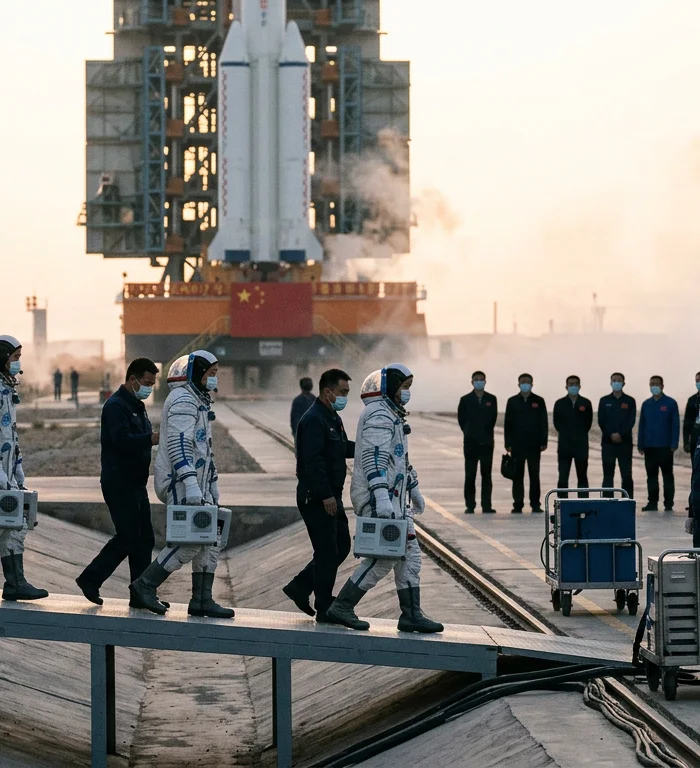
China has finalized the crew for the Shenzhou 24 mission, marking the first instance of a foreign national boarding the Tiangong space station. The mission, scheduled for launch from the Jiuquan Satellite Launch Center, includes Pakistani astronaut Muhammad Zeeshan Ali alongside Chinese crew members Tang Hongbo and Wu Yi.
This deployment follows a bilateral space cooperation agreement signed between China and Pakistan in February 2025. The mission is categorized as a short-term assignment, with the Pakistani payload specialist tasked with conducting four scientific projects focused on biotechnology and materials science, including experiments on photosynthetic microorganisms.
From a strategic perspective, this mission serves as a test case for China’s ability to integrate international partners into its independent orbital infrastructure. The inclusion of a foreign astronaut signals a shift in China’s space diplomacy, potentially positioning the Tiangong station as an alternative platform for nations excluded from or seeking to diversify beyond the International Space Station (ISS) framework.
Jiuquan Satellite Launch Center
Tang Hongbo, a veteran of two previous missions, will lead the crew, becoming the first astronaut to visit the Tiangong station three times. This continuity in leadership suggests a focus on operational efficiency as China scales its manned space program toward its stated goal of a crewed lunar landing by 2030.
The mission occurs within the context of intensifying competition between China and the United States for lunar and orbital dominance. While NASA maintains a target for a crewed lunar landing by 2028, China’s ability to execute complex joint missions demonstrates a maturing logistical and technical capability. Observers should monitor whether this model of bilateral space cooperation expands to other regional partners, as it provides China with significant soft power leverage and technical validation in the aerospace sector.
More stories
- Europe faces attribution gap after 16 cyber, physical incidents
- PIF backs Grand Theft Auto as Saudi players embrace game
- Signal limits screenshots to curb AI access to messages
- Cognition runs Devin Mac workspaces on EC2 in 6 AWS regions
- Salesforce engineers cut 600-failure triage to 90 minutes
- Türkiye Desk: GTA 6 puts console access and network demand in focus
- Benchmark shows Chinese AI closing gap in bug hunting
- Meta bets on CRED as WhatsApp Pay seeks UPI share
Latest news
- Trump prepares tariffs on China and other major exporters
- New-car buyers pay record average $50,087 in October
- Banks face ECB reserve debate over liquidity and profits
- Investors see Anthropic debut gains fade below $83 a share
- Iraq orders federal control over Kurdish-area oilfields
- Germans oppose Ukraine aid as poll shows support slipping
- Kim Jong-un receives 10 envoys after constitutional shift
- Ukraine claims Libya strike sinks Russian naval corvette