Chi pushes Chinese rocket engine test program to 2,000s
Mega Engine Technology's Chi kerolox engine logged 1,000 seconds at rated conditions. Reusable, throttleable design for medium/small launchers.
Jason Kwon ·
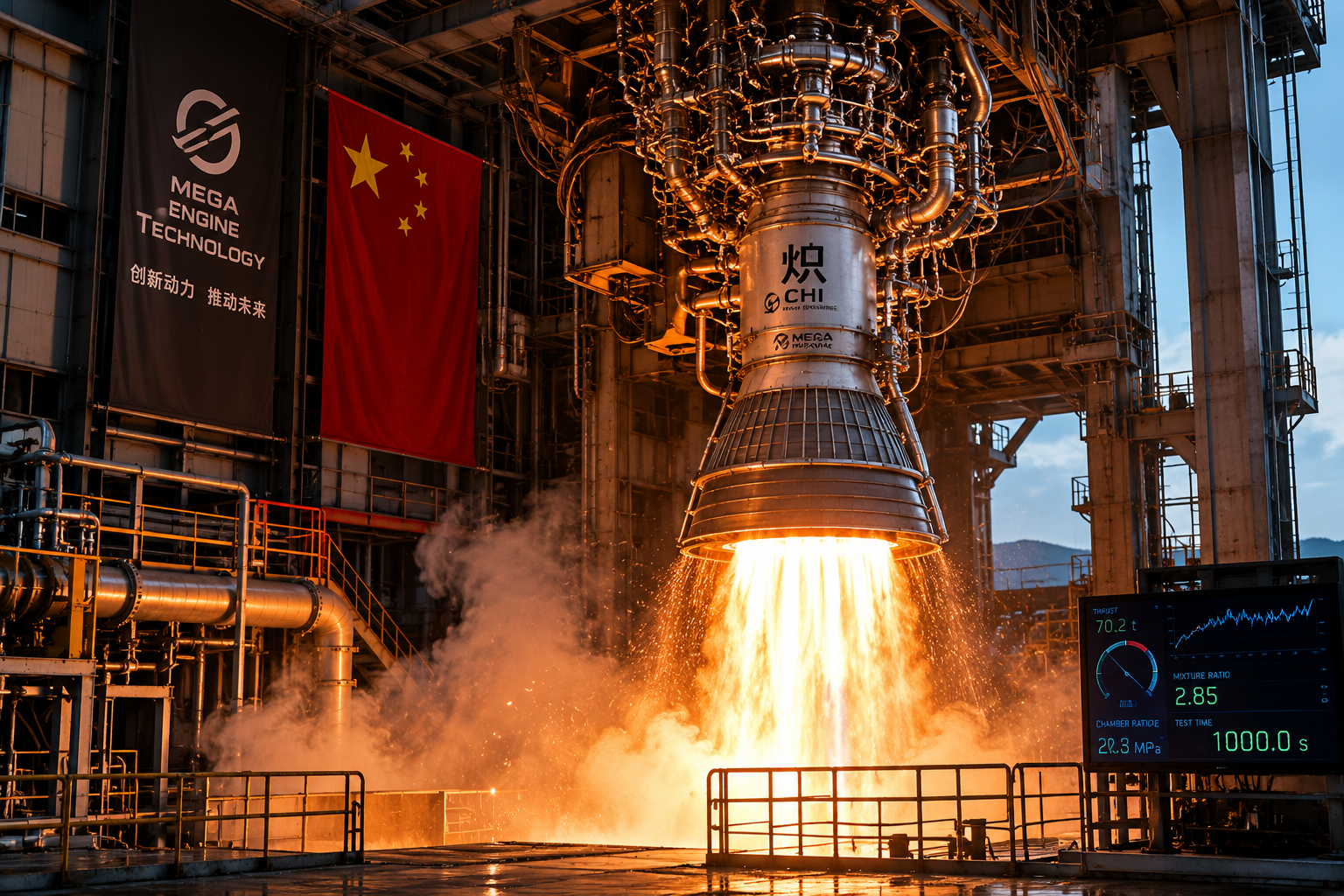
Chinese rocket engine startup Mega Engine Technology completed a long-duration hot-fire of its Chi kerolox unit. One run hit 1,000 seconds at rated conditions; total testing reached 2,000 seconds.
Key run time and test disclosure
The Xi’an-based company announced the results on May 25 via a Chinese social media post, flagging a successful long run under rated settings for a single engine. Across the program, accumulated time now stands at 2,000 seconds, indicating multiple tests beyond the headline sequence.
Mega Engine said the engine achieved quick ignition and steady operation. Post-test inspection reportedly found the hardware intact, a necessary step before pushing into reliability and reuse cycles.
Cycle, thrust envelope, and efficiency metrics
Chi is a closed-cycle engine burning kerosene and liquid oxygen, using staged combustion with an oxygen-rich preburner. That architecture typically trades higher performance for added complexity and thermal stress management.
Sea-level thrust is designed to throttle between 35 and 75 tons, with a vacuum figure at 87 tons, according to the company. Specific impulse is listed at 302 seconds at sea level, rising to 350 seconds in vacuum—numbers that position the unit in a competitive range for kerolox propulsion.
Mega Engine emphasized variable thrust and multiple restarts, consistent with a reusable profile. The company describes Chi—whose name translates to “blazing”—as suitable for high-altitude propulsion on medium and large launchers, as well as a first-stage option for small and medium-sized vehicles.
Reusability claims and market positioning
The reuse angle matters: throttle authority and restart capability can widen mission profiles and support recovery regimes, but they also demand rigorous cycle-life validation. Long-duration ground time is a positive indicator, yet it is not a substitute for flight heritage or demonstrated turnaround.
China’s commercial launch ecosystem continues to add propulsion options, and closed-cycle kerolox with oxygen-rich staging is a high bar technically. If the company can translate these bench results into repeatable flight performance, it would give domestic providers another workhorse engine class to integrate.
Mega Engine did not disclose additional parameters such as verified restart counts in a single test article or refurbishment requirements between runs. Those data points, along with integrated stage tests, will be critical for benchmarking reliability and operational cadence against industry norms.
Applications and next steps
By advertising both upper-stage suitability and first-stage applicability, Mega Engine is signaling a bid for versatility across vehicle classes. That flexibility could lower integration risk for prospective partners if the engine’s throttle band and restart behavior hold across environments.
The path from hot-fire to qualification typically moves through extended duty-cycle testing, vibration and thermal profiling, and then integrated stage firings. Watch for disclosures on cumulative restart numbers, acceptance testing plans, and any indications of a demo flight timeline as the program matures.