Nvidia targets PCs with RTX Spark Arm superchip rollout
Nvidia will ship RTX Spark Arm-based PC superchips this fall with Dell and Lenovo, challenging Intel’s dominance and bringing Blackwell GPUs and shared…
Jason Kwon ·
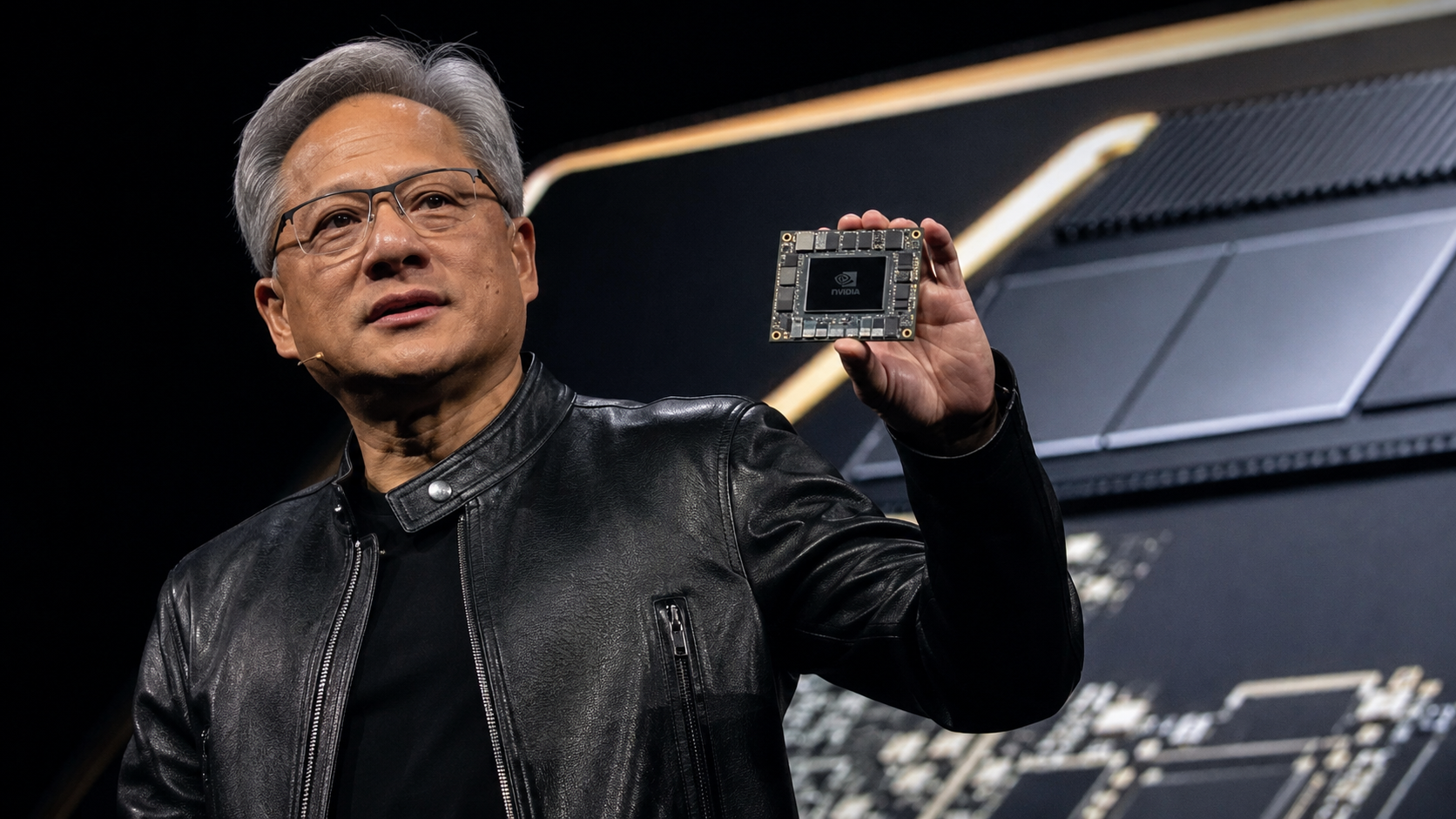
Nvidia is pushing into PCs with the RTX Spark Superchip this fall, aiming to loosen Intel’s grip and bring AI-ready hardware to Windows laptops and desktops.
Arm-based push into premium PCs
Chief Executive Jensen Huang unveiled the RTX Spark Superchip at Computex in Taipei, saying Dell Technologies Inc. (DELL) and Lenovo Group Ltd. (0992.HK) will ship laptops and desktops starting this fall. The design pairs a CPU and GPU in one package and runs Microsoft Corp.’s (MSFT) Windows for Arm, with development support from Taiwan’s MediaTek Inc. (2454.TW).
Nvidia said initial systems will target the premium tier, promising thin-and-light machines without performance trade-offs. Broader price points are planned over time as the platform matures.
Data center DNA, PC form factor
The RTX Spark Superchip integrates a central processor with up to 20 cores and a Blackwell-generation GPU offering 6,144 cores. Shared on-package memory and Nvidia’s NVLink interconnect aim to accelerate large AI models and high-end gaming workloads on consumer devices.
Manufacturing will be handled by Taiwan Semiconductor Manufacturing Co. (TSM) on its 3N process, bringing leading-edge foundry tech to the Windows-on-Arm ecosystem. The company positions Spark as a bridge between its data center expertise and everyday AI use on personal computers.
Market structure and competitive stakes
Nvidia’s move comes from a position of strength: its latest quarterly sales roughly matched the combined full-year 2023 revenue of Intel Corp. (INTC) and Advanced Micro Devices Inc. (AMD). Even so, the stock has trailed the Philadelphia Stock Exchange Semiconductor Index (SOX) this year, leaving room for investors to favor expansion into client devices that deliver AI to end users.
The push puts Nvidia alongside Qualcomm Inc. (QCOM), whose Snapdragon line targets Windows on Arm PCs, in challenging x86 incumbents. For Microsoft, more performance-competitive Arm systems could broaden Windows device diversity while advancing on-device AI.
Huang framed Spark as part of a broader strategy to keep Nvidia central to AI development and consumption across data centers and endpoints. MediaTek’s role underscores a mobile-to-PC crossover, aligning Arm efficiency with discrete GPU-class acceleration and interconnect features borrowed from servers.
What changes for buyers and builders
For OEMs, a power-efficient CPU/GPU combo could unlock premium designs that stay portable while running heavier models locally. Nvidia said early machines will focus on top-tier specs, with subsequent iterations expanding the lineup’s price range.
Key questions now shift to battery life, thermals, and Windows for Arm app compatibility as OEMs finalize configurations. Performance disclosures, independent benchmarks, and pricing from Dell and Lenovo will set early expectations ahead of the fall launch window.
If execution matches the brief, PCs could inherit slices of data center architecture—shared memory and high-bandwidth links—for everyday AI tasks. The next checkpoints are OEM reveals, software support, and how Intel and AMD position responses in the premium laptop and desktop tiers.