

Burnham’s Scotland push tests SNP independence case
Labour can challenge the SNP’s devolution ground as EU ties ease independence barriers. Burnham met Scottish and Welsh leaders to discuss policy.
Prime Minister Andy Burnham used an Oct. 16 speech in Motherwell to offer cooperation on more Scottish devolution, 50 years after a 1976 Scottish Labour breakaway, a Guardian opinion column said.
The immediate risk for the Scottish National party is political competition on home rule, while England’s population is about 10 times Scotland’s, Rory Scothorne wrote in the Nov. 1 article.
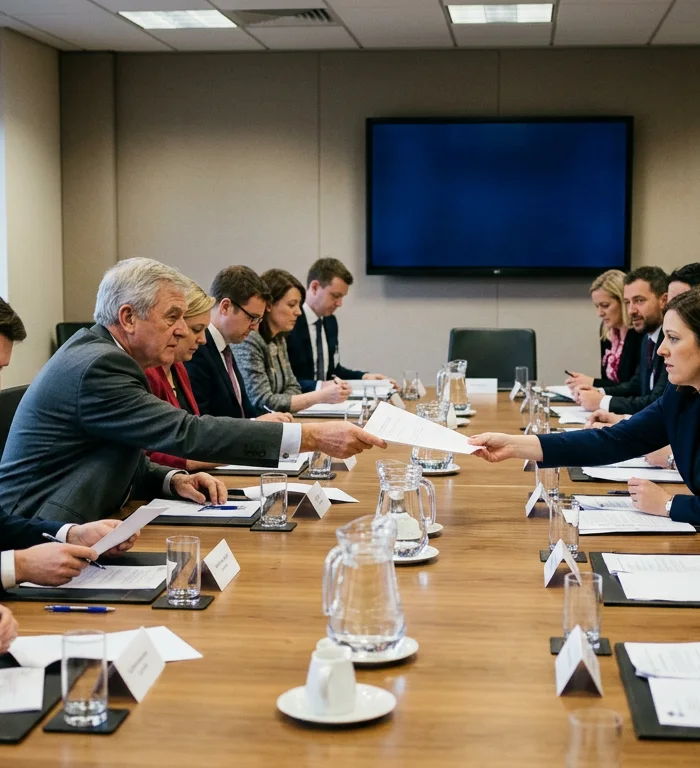
Burnham also met Scottish First Minister John Swinney and Welsh First Minister Rhun ap Iorwerth at a National Economic Council meeting on Friday. Scothorne said the meeting pointed to a shared programme built around devolved authority and industrial renewal.
That agenda pushes into ground the SNP has long used: the argument that Scotland needs more control to protect jobs, services and closer international ties. Burnham’s appeal includes promises of “regional empowerment,” the article said.
Scothorne’s argument is that the same approach could also help the independence movement if Burnham rebuilds Britain’s links with Europe. Atlas360 reported in October that a Guardian Politics Weekly UK video said Burnham wanted to revisit free movement while ruling out the euro and Schengen.
The article placed Burnham’s pitch in a longer Scottish political history. In 1976, leftwing Scots gathered in Stirling for the first conference of the Scottish Labour party, which had split from Labour over its proposals for a Scottish assembly.
Jim Sillars, then MP for South Ayrshire, led the breakaway and later entered the SNP, becoming its deputy leader in 1991. Scothorne wrote that Sillars helped bring the formula of “independence in Europe” into Scottish nationalism.
The SNP had opposed European Economic Community membership in 1975 with the slogan “No voice, no entry.” By the 1990s, it had moved to a pro-European position as the European Union gave more attention to small nations and minority cultures.
Europe later became central to both sides of the independence argument. Scots rejected independence in 2014 partly because a new Scottish state would have needed to apply to join the EU. In 2016, Scotland voted to remain in the EU, while the UK voted to leave.
The unresolved issue is trade. If an independent Scotland rejoined the EU, Scothorne wrote, it could face a hard border with the rest of the UK, which buys more Scottish exports than all other countries combined, including the EU.
Some nationalists argue Scotland could seek a Northern Ireland-style arrangement between UK and EU markets. Scothorne wrote that the comparison is weak because Northern Ireland’s special treatment reflects the security legacy of partition, while Scottish nationalism is peaceful and democratic.
Current polling leaves yes and no support roughly level, the article said. That makes Burnham’s record on devolution, industry and Europe central to how the SNP frames any future campaign.
Source: opinion column, The Guardian – Europe, Nov. 1, 2026; Atlas360 background, Oct. 28-30, 2026.
More stories
- Russian state-affiliated media raise UK posts 15% in September
- Delhi protests demand election chief quit over voter rolls
- US tip-off in Moscow case points to security cooperation
- US tip-off in Moscow case points to security cooperation
- Türkiye seeks 30% OIC trade share after $108bn nine-month flow
- Turkey's OIC trade reaches $108bn in first nine months
- Indian refiners lift crude imports to record 5.6m bpd
- France Braces for Third Weekend of Protests as Youth Movements Gain Momentum Across Europe
- US official denies Trump Starshield restriction directive
- Norway panel backs nuclear arms exception for $2.2tn fund
Latest news
- Indian banks cite up to 50% gains from AI systems
- Acemoglu urges Democrats to rebuild working-class appeal
- Senate contests put Trump's remaining agenda on the line
- Rubio says Trump remains open to another meeting with Kim
- Binance withdrawals resume after $6 billion-plus cyber theft
- AI-displaced workers face one-month rehiring lag