Bharat Forge and Pratt & Whitney collaboration pushes UAV costs into long‑term support
The Economic Times reported on Sept. 15 that Bharat Forge and Pratt & Whitney Canada will collaborate to evaluate an advanced turboprop engine for a…
Hannah Vogel ·
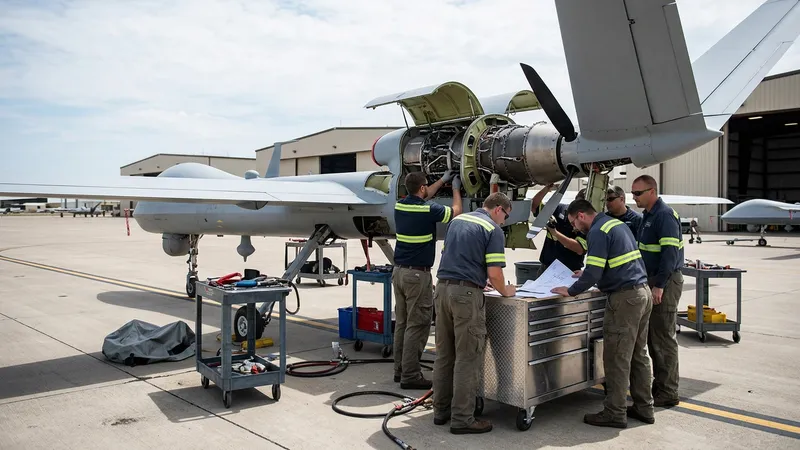
The Economic Times reported on Sept. 15 that Bharat Forge and Pratt & Whitney Canada will collaborate on a high‑altitude unmanned aerial vehicle designed by India’s Defence Research and Development Organisation, evaluating an advanced turboprop engine and assigning engine–airframe integration leadership to Bharat Forge. This is, so far, single‑source — The Economic Times only, with no independent confirmation. No program quantities, contract value, engine model, certification pathway or delivery timeline were disclosed in the report.
The report describes an engineering evaluation, not a production order
Read literally, the signal is a scoping step: evaluate the integration of a turboprop powerplant into a DRDO airframe, with Bharat Forge coordinating the physical and digital join between engine, nacelle, mounts, controls and the rest of the vehicle. An evaluation is different from a selection, and a selection is different from a funded development and a production commitment. In procurement terms, this delineates responsibilities for an integration work package rather than confirming a down‑select to a single engine supplier with a production baseline. For vendors and investors, the distinction matters: revenue recognition in such programs tends to lag headline announcements by quarters, sometimes years, and early milestones often book as cost‑intensive engineering services long before higher‑margin spares begin to flow.
Why the commercial risk moves from the hangar floor to the parts bin
If the collaboration proceeds to a formal down‑select and low‑rate initial production, the profit pool concentrates not in the initial engine–airframe integration but in the multi‑year support and spares tail. That is where availability guarantees, hot‑section inspections, overhaul cycles, digital maintenance subscriptions and fleet‑wide reliability improvements convert into margin. For operators, that also means the largest share of cash outlay arrives after delivery and is sensitive to utilization rates; for the engine OEM and its local partner, annuity‑like spares income can outweigh integration fees several times over the life of the fleet. Procurement teams reading the Economic Times item should therefore push beyond engineering scope and ask for a draft power‑by‑the‑hour or equivalent support construct to understand lifetime cost of ownership, inventory obligations and turnaround guarantees before integration choices harden.
India’s indigenisation push meets foreign powerplant realities
The article frames the tie‑up as a contribution to India’s indigenous aerospace and defence capabilities by placing engine–airframe integration leadership with Bharat Forge. That is a meaningful shift in workshare toward a domestic industrial prime for the propulsion integration stack—fixtures, mounts, systems interfaces, and potentially local manufacture of selected line‑replaceable units. But the core of any turboprop—hot section materials, turbine design, FADEC software—remains the engine OEM’s intellectual property. The operational risk for Indian buyers is not whether metal gets cut locally; it’s whether the chosen architecture commits the program to a single source for critical parts and software updates for decades, with price and availability governed by export approvals and the OEM’s global queue. Those are manageable constraints, but they must be priced and governed upfront or they become renewal‑time surprises.
What Bharat Forge is actually signing up for if this moves forward
Leading engine–airframe integration sounds like bracketry and test stands. In practice, it also means system‑level accountability for vibration, thermal, control‑law and inlet/efflux interactions across operating envelopes, followed by conformity builds, ground runs and flight test instrumentation. This is capex‑heavy work that ties up talent and rigs, and carries schedule risk if a single parameter drifts outside certification limits. For a first‑of‑type or high‑altitude UAV where endurance and service ceiling push the envelope, intake icing, fuel control at altitude, and gearbox thermal management will be program risks to retire. If Bharat Forge carries the integration lead, it also inherits a portion of the variance risk—absorbed either through change orders or through margin if milestones are fixed‑price. That makes the commercial model—cost‑plus development versus milestone‑based fixed fees—a central variable for both partners.
The uncomfortable denominator: no quantities, no engine model, no timeline
The Economic Times report does not name the engine, the targeted thrust class, the intended service entry, or the number of air vehicles contemplated. Without those denominators, claims of capability advancement are unfalsifiable by operators. A bespoke integration for a small prototype fleet has a different business logic than a scalable architecture for a triple‑digit production run with training systems and depot‑level maintenance. Similarly, a six‑ to nine‑month engineering evaluation differs materially from a three‑year development with full qualification and climate testing. Procurement will need those denominators before it can test true total‑cost‑of‑ownership scenarios or enforce availability SLAs with meaningful penalties.
The skeptic’s read: export controls and certification gate the real schedule
Any foreign turboprop in a defence‑linked UAV will trigger export‑control and end‑use review regimes. Even absent broader geopolitical headwinds, the approvals sequencing and technical‑assistance limits can elongate schedules, particularly where software updates and digital twin models cross borders. Add the certification or military airworthiness process for a high‑altitude unmanned platform—often a multi‑agency exercise—and the gating path is clear: engineering prowess alone will not pull the schedule left if paperwork lags. A rational skeptic looking at this single report would discount early revenue expectations and treat calendar‑year 2026–2027 as a period of engineering outflows, not inflows, unless and until a formal engine selection, support framework and export approvals are all on file.
What changes now for Indian Tier‑2 suppliers and for rival engine OEMs
For Indian machining, casting, harness and systems suppliers adjacent to Bharat Forge, the near‑term change is an on‑ramp: aero‑grade quality systems, tighter PPAP‑like processes, non‑destructive testing capabilities and documentation rigor. That will require cash and discipline. But it also hedges these firms into higher value‑add work beyond commodity forgings if they can clear the quality bar. For rival engine OEMs, the signal is narrower but still material: unless The Economic Times report is followed by a competitive request for proposal naming multiple engine candidates, they must assume the inside track is now occupied. The realistic play in that case becomes offering a counter‑proposal framed around lower lifetime support costs, local MRO workshare and availability guarantees rather than headline thrust or fuel‑burn advantages alone.
The budget and governance questions procurement should force now
Before engineering teams fall in love with a configuration, the buyer should drag lifetime cost and governance specifics into the daylight. Who owns the digital condition‑monitoring data and can third‑party MROs access it? What are the price‑escalation clauses for spares, and are there caps tied to inflation indices? Which components and software are eligible for local manufacture or maintenance, and which are bound to the OEM’s plants? What is the guaranteed turnaround time for engines and LRUs sent abroad, and what penalties apply if missed? Without these, any early ‘indigenous capability’ win can morph into a dependence that shows up only when the fleet is grounded awaiting parts.
Signals that would show this is moving from evaluation to contract
Investors and suppliers do not need inside information to gauge momentum. Three public signals would do: a Ministry of Defence or DRDO document naming the selected engine and a funded development phase; a disclosed support framework—power‑by‑the‑hour, availability guarantees, or equivalent—with named local MRO workshare; and a calendar of ground and flight test milestones with an airworthiness pathway identified. In their absence, assume this remains an engineering collaboration with limited near‑term revenue impact.
This piece relies on a single media report from The Economic Times; no one in the reported packet is on the record in the material we have, and no independent confirmation was available at time of writing.