Toyota sales drop for second month on China slowdown risk
Global deliveries fell 6.4 per cent in August. A drop of nearly a quarter in China and weak Middle East demand outweighed a strong home market.
Raj Patel ·
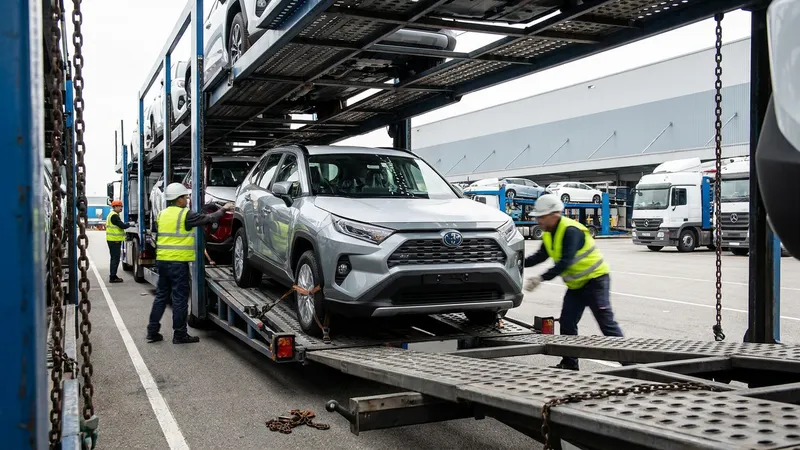
Toyota sales fell 6.4% in August to 790,743 vehicles, a second monthly decline as the automaker cited weak China demand. Output also slipped. Toyota said September 29 that global production dropped 5.9% from a year earlier to 700,860 vehicles, also down for a second straight month. The company attributed the production decline partly to fewer operating days in some countries.
China weighs on August total
The demand split was clearest outside Japan, where Toyota's overseas sales fell 8.4% from a year earlier to 685,676 vehicles, the seventh consecutive monthly decrease. In China, sales dropped 22.8% to 118,449 units, making the market the main drag in the regional data Toyota released.
Toyota linked the China weakness to a sluggish gasoline vehicle market, including gasoline-powered and hybrid cars. The company said higher gasoline prices tied to the Middle East conflict weighed on demand in that market.
The United States provided less severe but still negative data, with Toyota sales down 4.4% from a year earlier to 215,556 vehicles. Europe moved in the opposite direction, rising 2.6% to 78,527 vehicles compared with the same month last year.
Japan and Europe diverge
Japan remained Toyota's strongest positive region in the August release. Domestic sales rose 9.1% from a year earlier to 105,067 units, marking a fifth consecutive monthly increase and contrasting with declines in China, the United States and the broader overseas total.
The company cited demand for newer models as a support for Japan sales. The list included the RAV4 sport utility vehicle, the bZ4X electric vehicle and the Land Cruiser FJ, giving Toyota a domestic offset while overseas volumes weakened.
The regional contrast matters for Toyota's product planning because Japan's improvement came from model momentum rather than a broad global lift. If the China decline persists, the company may have to lean harder on markets where new vehicles are still adding volume.
Middle East sales and exports split
The Middle East recorded the steepest regional decline in the figures Toyota disclosed, with sales down 37.5% from a year earlier to 32,600 vehicles. At the same time, Toyota's exports from Japan to the region rose 31.0% to 24,411 vehicles, the second straight monthly increase.
Toyota said the export rebound indicated that the effect of escalating tensions in the region appeared to have eased. That creates a split signal: end-market sales remained weak in August, while shipments from Japan improved from the recent pattern.
For Toyota, the August data point to pressure in high-volume overseas markets rather than a uniform global contraction. Production at 700,860 vehicles was below last year's level, and weaker overseas sales left Japan carrying more of the positive momentum.
If China's gasoline vehicle market remains soft, Toyota's global volume could stay under pressure through the overseas sales channel. If exports to the Middle East continue to recover, the company may regain some shipment stability even before regional retail demand normalizes.
For the wider auto industry, the mechanism is fuel cost sensitivity meeting regional product mix. Hybrids and gasoline models remain central to Toyota's global scale, so shifts in fuel prices and operating schedules can move both sales and production across several markets.