

Baoshan Song proposes sub-microsecond robotics optimality check
The unreviewed robotics paper targets sensor-degenerate settings where standard semidefinite relaxations can expand rank and break rounding.
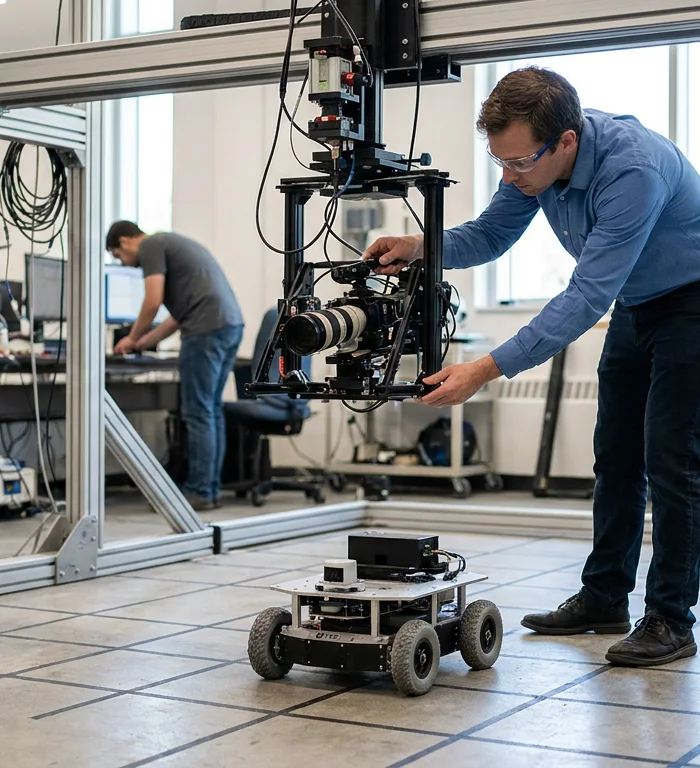
Baoshan Song proposed a robotics state-estimation certification framework with dual multiplier recovery taking less than 1 microsecond per recovery step in an arXiv preprint submitted Oct. 14, 2026.
The Oct. 14 arXiv v1 preprint matters because Song says the method avoids direct semidefinite solving under severe sensing degeneracy while keeping each recovery below 1 microsecond, or one-millionth of a second.
State estimation is the process of inferring a robot’s state from sensor measurements. Certifiable optimization seeks global guarantees for non-convex problems, in contrast with ordinary local searches that can stop at a local answer rather than a global one.
Song’s paper addresses observability degeneracy, a condition in which sensors provide fewer independent constraints than are needed to identify all state variables. The abstract says this degeneracy can enlarge the primal solution set into a flat equal-cost region while leaving cost tightness and multiplier recovery usable for verification.
The proposed approach combines observability-aware local search with solution remapping and a closed-form procedure for recovering dual multipliers. Song also derives an adaptive safety threshold tied to the smallest non-zero eigenvalue of the observable Hessian, compared with remaining residual leakage, according to the preprint.
The work is an arXiv v1 preprint and has not been peer reviewed. The validation described in the abstract is limited to robust registration under degenerate measurements; the supplied material does not provide benchmark results, code availability or comparisons with deployed robotics systems.
Source: arXiv preprint, Oct. 14, 2026
More stories
- Kotukh maps quantum side-channel edge to AES-128 rank 2^58.6
- LLM crisis reports capture 5.4%-11.0% of official figures
- Türkiye Desk: Tencent’s Flow Games move tests Türkiye’s mobile thesis
- Rockstar plans GTA 6 PC release by March 2027, GamesBeat says
- Loadout’s $LOAD launch tests funding model for 40 games
- Robotics at Amazon tests balance between speed and safety
- Microsoft Maps AI Job Risk: Knowledge Work Sits at the Top
- OpenAI misses sales targets as competition from Anthropic and Google intensifies globally
Latest news
- Jio Platforms sets ₹1,065-₹1,119 IPO price band
- Leo XIV faces Nov. 6-17 trip doubts after cancer diagnosis
- Norway panel backs nuclear arms exception for $2.2tn fund
- IMF lifts Africa growth forecast to 4.5%, warns on debt
- McKinsey partner Bradley exits nonprofit as dispute widens
- AI stocks extend losses as CoreWeave drops 6% in premarket
- Trump's Iran war pledge links military claims to oil costs
- Javier Milei backs Flavio Bolsonaro in Brazil's run-off