Astronomers Discover Distant 'Gigamaser' Signal
Astronomers detected a 'gigamaser' signal 8 billion light-years away using the MeerKAT telescope, the most distant and luminous hydroxyl maser ever observed.
Jason Kwon ·
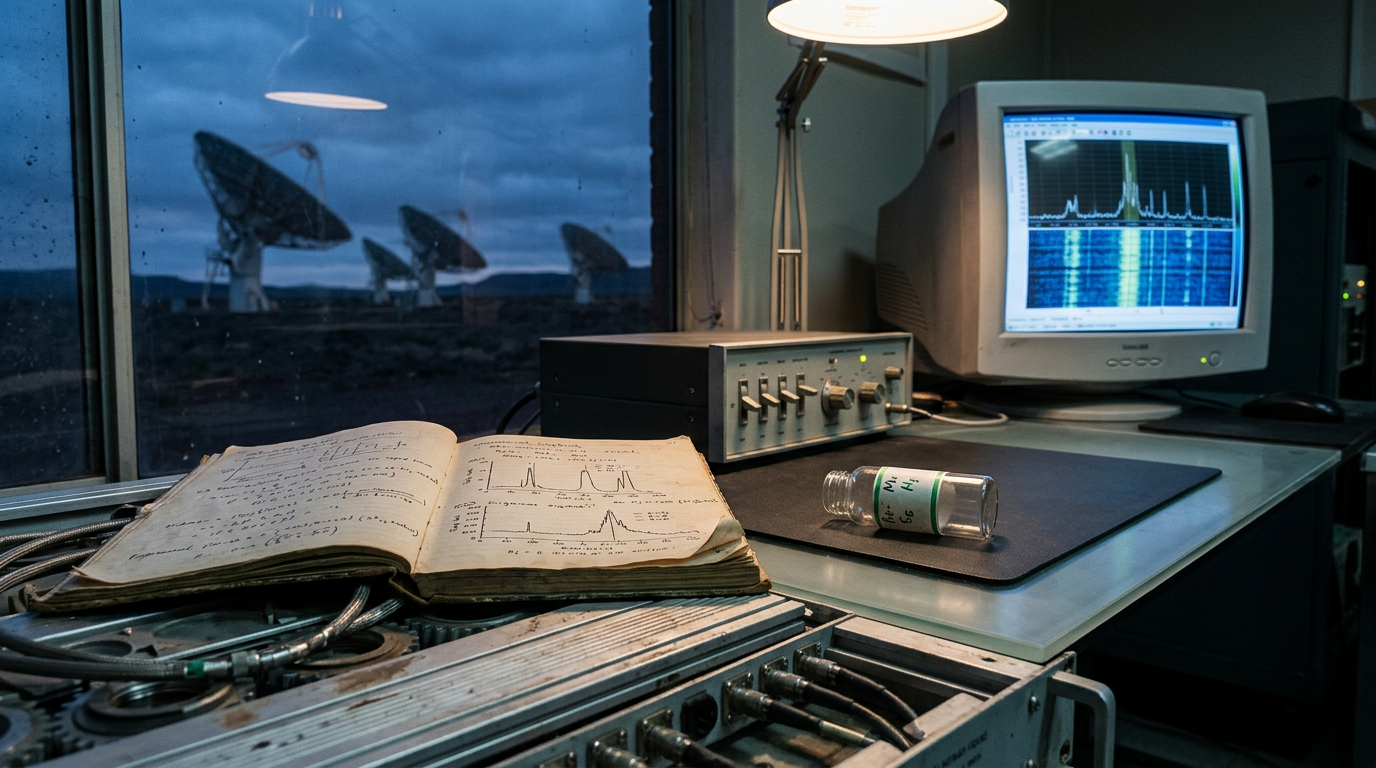
Astronomers have identified an exceptionally powerful hydroxyl maser signal, now termed a 'gigamaser,' originating from a galaxy system approximately 8 billion light-years from Earth. This discovery, made using the MeerKAT radio telescope in South Africa, marks the most distant and luminous hydroxyl megamaser ever observed. The signal, designated HATLAS J142935.3–002836, provides new insights into extreme astrophysical phenomena.
The detection was detailed in a research paper published on arXiv. Researchers observed the signal at an 18-centimeter wavelength, characteristic of hydroxyl molecules (OH) emitting at frequencies of 1667 MHz and 1665 MHz. This specific wavelength and frequency signature confirms the presence of hydroxyl, which acts as a natural cosmic laser.
### Origin of the Gigamaser
The extraordinary brightness of this signal, observed at a redshift of z = 1.027, is attributed to a dual mechanism. Firstly, a violent merger between two galaxies creates the dense, turbulent gas environments necessary to amplify the hydroxyl emission. Such mergers are known to trigger intense star formation and energetic processes.
Secondly, a foreground galaxy acts as a strong gravitational lens, magnifying the signal as it travels across vast cosmic distances towards Earth. This lensing effect is crucial, as without it, the signal would likely be too faint for current telescopes to detect. Gravitational lensing, predicted by Einstein's theory of relativity, bends light and other electromagnetic radiation around massive objects, effectively acting as a cosmic magnifying glass.
### MeerKAT Telescope's Role
The sensitivity of the MeerKAT radio telescope was instrumental in this groundbreaking observation. Located in the Karoo desert, MeerKAT's advanced capabilities allowed astronomers to capture the faint, distant signal that would otherwise remain undetected. Its array of 64 dishes provides unparalleled resolution and sensitivity for radio astronomy.
### Implications for Early Universe Studies
This discovery offers a unique window into the conditions within merging galaxies during the early universe. Understanding these powerful maser emissions can help scientists unravel the processes of galaxy evolution, star formation rates, and the distribution of molecular gas in distant cosmic environments. The 'gigamaser' classification highlights the extreme nature of this particular phenomenon, pushing the boundaries of what was previously understood about cosmic masers.
Further observations of such distant and luminous masers could refine models of galaxy formation and the role of mergers in shaping the universe. The combination of intrinsic luminosity from galactic mergers and magnification from gravitational lensing presents a new avenue for studying the most energetic events in the cosmos, providing data from an epoch when the universe was significantly younger and more active.
Implications
Country Impact: This discovery, made with the MeerKAT telescope in South Africa, reinforces the country's position as a significant contributor to global radio astronomy and scientific research infrastructure.
Industry Impact: The field of astrophysics and cosmology benefits from new data points on extreme cosmic phenomena, potentially leading to advancements in telescope technology and data analysis techniques for distant object detection.
Market Impact: While direct market impact is minimal, advancements in fundamental science can indirectly drive innovation in related technological sectors, such as signal processing and large-scale data management.