Apple AI server plan puts Nvidia links back in play by 2029
Apple is considering an AI server using planned M8 Ultra chips and Nvidia networking, a reported 2029 project that would mark an enterprise hardware return.
Jason Kwon ·
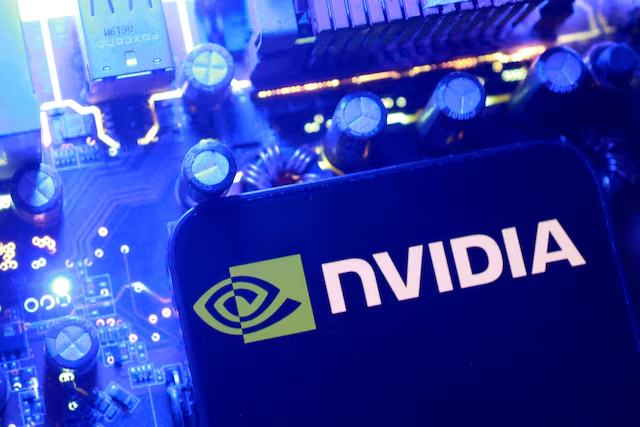
Apple AI server work could pair planned M8 Ultra chips with Nvidia networking for a possible 2029 enterprise hardware return, according to a report.
The project would move Apple beyond Macs, iPhones and consumer devices into dedicated enterprise server hardware for the first time since it ended Xserve in 2011. The plan remains preliminary: the server is not expected before 2029 and could still be canceled or released without Nvidia technology, the report said.
M8 Ultra chips anchor plan
Apple is developing the server around either two or four planned M8 Ultra processors, described in the report as its highest-performance chips. The configuration would place Apple’s own silicon at the center of a system aimed at running artificial intelligence workloads inside data centers.
The reported timing follows Apple’s latest Mac chip refresh, which included M6, M5 Pro, M5 Max and M5 Ultra processors. Apple said the 2-nanometer M6 offers up to four times faster AI performance than the prior generation, while the higher-end chips are aimed at developers and professional AI tasks.
NVLink role remains uncertain
Apple is considering Nvidia’s NVLink Fusion technology to connect the planned M8 chips, according to the report, which cited people familiar with the matter. Some Apple staffers see Nvidia’s connectivity tools as the strongest available option for the project, the report said.
NVLink Fusion gives chipmakers connectors and specialized memory that allow custom AI chips to operate inside Nvidia’s broader data-center systems. For Apple, that would mean using its own processors while relying on Nvidia’s networking layer, a structure that could reduce the burden of building every part of the server stack internally.
Enterprise return faces 2029 test
The project would revive an Apple hardware category that has been absent for nearly two decades. Apple discontinued Xserve in 2011 after shifting its server customers toward standard Mac hardware and concentrating its product strategy around consumer devices.
The report also described the possible Nvidia collaboration as a thaw in a relationship strained by earlier disputes over graphics chips used in MacBooks. Apple and Nvidia have not publicly commented on the reported server effort, leaving the project’s scope, commercial model and customer targets unconfirmed.
The industry context is the shift from training large AI models to running them repeatedly, known as inference. If enterprise demand keeps moving toward inference, Apple could try to position its server as a tightly integrated system for customers that already use Apple software, developer tools or custom chips.
If the 2029 plan holds and Nvidia remains involved, the macro effect would come through data-center capital spending and demand for AI networking rather than near-term consumer device sales. Apple would gain a new enterprise hardware lane, while Nvidia would extend its role as a connector between custom chips and large-scale AI infrastructure.
If Apple drops Nvidia technology, the company would need another way to link multiple high-performance chips at data-center scale. That path would preserve more control for Apple but could slow adoption if buyers want systems that plug easily into existing Nvidia-centered infrastructure.
If the project is canceled, Apple’s AI strategy would remain centered on devices, chips and software services rather than enterprise servers. The main open question is whether Apple can turn its in-house silicon advantage into a product that corporate buyers will trust for long-lived AI workloads.