

AI Integration Enhances Precision of Visual Cortical Prostheses
AI researchers have improved brain implant precision for restoring sight by predicting and controlling neural responses to electrical stimulation.
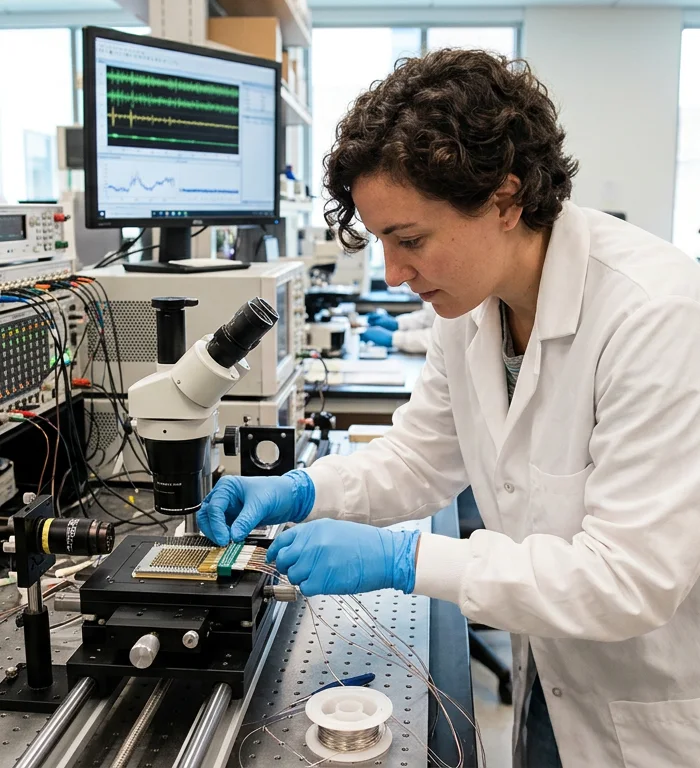
Researchers have demonstrated that artificial intelligence can significantly improve the accuracy of visual cortical prostheses, commonly referred to as bionic eyes. By utilizing deep learning models to analyze neural responses, the technology allows for more precise electrical stimulation of the visual cortex. This development addresses a primary technical hurdle in neuro-prosthetics: the inconsistency of visual sensations, or phosphenes, produced by brain implants.
The study involved a 27-year-old participant with a 96-electrode array implanted in the visual cortex following a traumatic brain injury. The AI system was trained to predict how the brain would respond to specific electrical inputs, accounting for the participant's resting neural state. This predictive capability enabled researchers to identify signal combinations that reliably generated intended visual patterns, outperforming traditional, predetermined stimulation methods.
Visual cortical prostheses function by bypassing damaged eyes and optic nerves to deliver signals directly to the brain. This approach is intended for individuals with blindness resulting from strokes, neurodegenerative diseases, or traumatic injuries. Unlike retinal implants, which rely on the integrity of the eye, cortical devices offer a potential pathway for restoration in patients whose visual pathways are entirely compromised.
This research was supported by a $2 million grant from Institutes of Health, awarded in 2022 to advance the predictability and effectiveness of artificial vision systems. The successful proof-of-concept trial indicates a shift toward personalized neuro-prosthetics that adapt to individual brain responses rather than relying on static configurations. Future development will focus on refining these models to improve the resolution and consistency of the visual information provided to users.
More stories
- Europe faces attribution gap after 16 cyber, physical incidents
- PIF backs Grand Theft Auto as Saudi players embrace game
- Signal limits screenshots to curb AI access to messages
- Cognition runs Devin Mac workspaces on EC2 in 6 AWS regions
- Salesforce engineers cut 600-failure triage to 90 minutes
- Türkiye Desk: GTA 6 puts console access and network demand in focus
- Microsoft plans Project Helix as Xbox console for PC games
- OpenAI buys travel startup Odessia
- Chinese AI models match U.S. rivals in bug-finding tests
- Polymarket draws bipartisan calls for federal investigation
Latest news
- Trump prepares tariffs on China and other major exporters
- New-car buyers pay record average $50,087 in October
- Banks face ECB reserve debate over liquidity and profits
- Investors see Anthropic debut gains fade below $83 a share
- Iraq orders federal control over Kurdish-area oilfields
- Germans oppose Ukraine aid as poll shows support slipping
- Kim Jong-un receives 10 envoys after constitutional shift
- Ukraine claims Libya strike sinks Russian naval corvette