

Discovery of Fundamental Space-Time Limit May Enable Ultrafast Electronics
Scientists have identified a quantum limit on tracking electron movement, a discovery that could enable electronics 100,000 times faster than today.
Researchers have identified a fundamental physical constraint, termed the "space-time limit," which restricts the simultaneous measurement of an electron's location and its temporal behavior. This discovery establishes that electron movement cannot be tracked with arbitrary precision in both space and time, a limitation inherent to quantum mechanics rather than instrumentation failure. The finding provides a new framework for understanding quantum tunneling, where electrons traverse energy barriers as waves rather than particles.
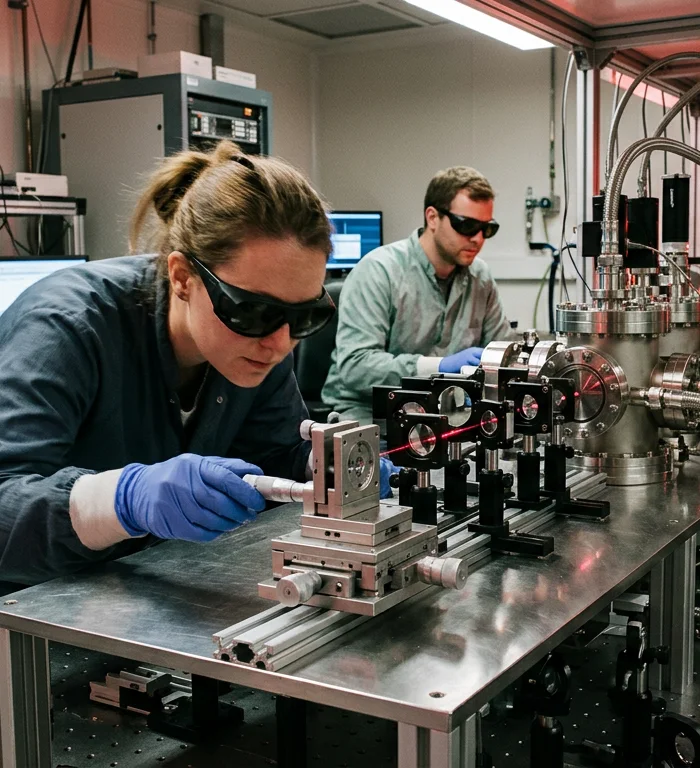
This research, conducted through an international collaboration, utilized advanced laser systems to observe electron motion at the attosecond scale—one-billionth of a billionth of a second. By employing dual-pulse laser technology, the team successfully measured electron tunneling between a metal tip and a silver surface. The experiments revealed a measurable delay in electron response, confirming that quantum wave packets are subject to specific, quantifiable constraints when observed at atomic distances.
The identification of this limit is significant for
The identification of this limit is significant for The identification of this limit is significant for the development of next-generation electronic and quantum computing architectures. Current electronic devices are constrained by the speed at which electrons can be manipulated; understanding these fundamental boundaries could theoretically facilitate the development of electronics operating at speeds 100,000 times faster than existing technology.
Beyond consumer electronics, the ability to resolve electron movement at these timescales has direct implications for artificial intelligence hardware and clean energy research. By enabling the observation of chemical reactions and light-matter interactions at the attosecond level, this discovery provides the foundational data necessary to engineer materials with unprecedented control over quantum states. Future applications will likely focus on integrating these findings into high-speed switching components and advanced computational systems.
More stories
- Europe faces attribution gap after 16 cyber, physical incidents
- PIF backs Grand Theft Auto as Saudi players embrace game
- Signal limits screenshots to curb AI access to messages
- Cognition runs Devin Mac workspaces on EC2 in 6 AWS regions
- Salesforce engineers cut 600-failure triage to 90 minutes
- Türkiye Desk: GTA 6 puts console access and network demand in focus
- Nvidia opens board inquiry into alleged foreign targeting
- Nvidia opens board inquiry into alleged foreign targeting
- Polymarket draws bipartisan calls for federal investigation
- Australia social media ban: fines lifted to A$99m cap
Latest news
- Trump prepares tariffs on China and other major exporters
- New-car buyers pay record average $50,087 in October
- Banks face ECB reserve debate over liquidity and profits
- Investors see Anthropic debut gains fade below $83 a share
- Iraq orders federal control over Kurdish-area oilfields
- Germans oppose Ukraine aid as poll shows support slipping
- Kim Jong-un receives 10 envoys after constitutional shift
- Ukraine claims Libya strike sinks Russian naval corvette