World Cup final chase tests England and Argentina nerve
World Cup semi-finalists France, Spain, Argentina and England enter the final week with contrasting strengths and clear tactical risks.
Atlas Newsdesk ·
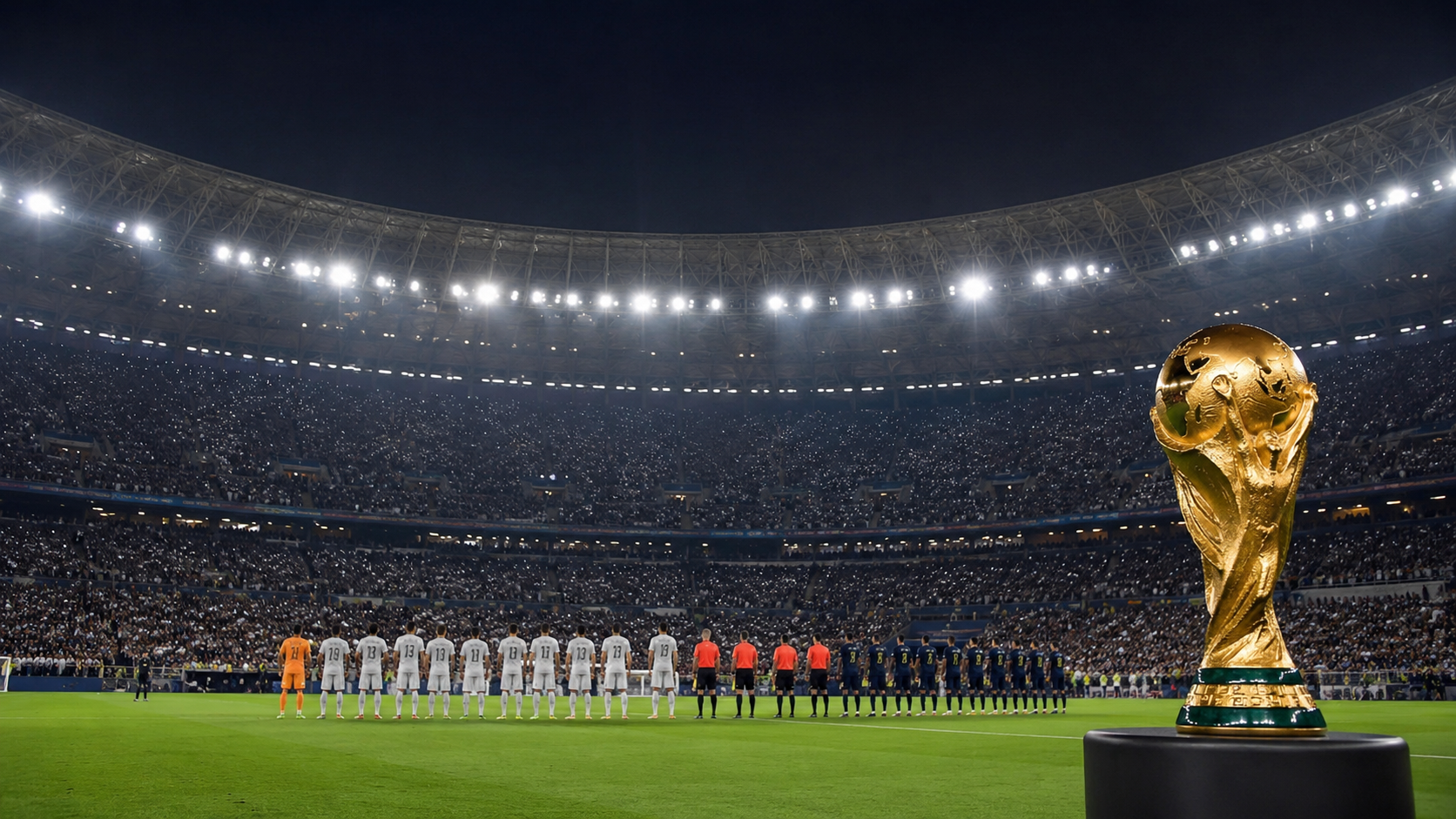
World Cup semi-finalists France, Spain, Argentina and England enter the final week with contrasting strengths and clear tactical risks.
The tournament has reached a rare alignment: the remaining bracket contains the top four teams in FIFA's rankings, with France first, Argentina second, Spain third and England fourth. France face Spain on Tuesday, while Argentina meet England for the other place in Sunday's final in New York.
Top four rankings remain
The semi-final field gives the final week a clean competitive frame. France have the ranking edge and the deepest attacking pool, Argentina carry the authority of holders, Spain bring the most possession-oriented case, and England arrive with two headline match-winners in Harry Kane and Jude Bellingham.
The central tactical question in France against Spain is whether Spain can limit transition chances. Spanish journalist Guillem Balague framed Spain as the best collective side, but said their route depends on controlling the ball, slowing France's counter-attacks and improving their finishing.
That matchup also puts Lamine Yamal under a sharper spotlight. Supporters quoted in the source described Spain as balanced in attack and defence, while also pointing to Pedri's limited experience at this level as a possible concern.
France attack sets the benchmark
France's case rests heavily on Kylian Mbappe and the runners around him. English football writer Phil McNulty argued that France look best placed to correct the disappointment of losing the 2022 final to Argentina, citing Mbappe, Ousmane Dembele, Michael Olise and Desire Doue as part of a forward line that has stretched opponents.
France's depth has become part of the story. Bradley Barcola and Rayan Cherki were listed as substitutes in the quarter-final win over Morocco, giving Didier Deschamps options to alter tempo late in matches.
The timing adds a national layer in France. Abdoul-Karim, a French journalist, said the Spain match falls on Bastille Day and that some cities have delayed fireworks, tying public celebration to the possibility of another final appearance.
There is still a clear risk for France. If Spain deny Mbappe space and force France to build attacks more slowly, the favourite's advantage narrows and the match could turn on efficiency rather than volume of chances.
England and Argentina measure control
Argentina's route is different. Santi Sciola, an Argentine journalist, said France look a step above the field in football terms, but he also described Argentina as a side driven by heart and capable of surviving difficult games.
Against England, Argentina are expected to value rhythm control and moments from Lionel Messi or Julian Alvarez. Balague suggested Argentina may try to make the game quiet, then wait for one decisive action from their best attackers.
England's opportunity is tied to star output rather than total fluency. The source's fan reaction repeatedly returned to Bellingham and Kane, even as some England supporters raised concerns about injuries, fitness and the physical cost of their previous match against Norway.
The historical weight is plain: England have not won the World Cup since 1966, while Argentina are trying to become only the third team to defend the men's title. Those records do not decide semi-finals, but they shape the pressure around both squads.
Scenarios narrow before Sunday
If France beat Spain by turning possession losses into fast attacks, the global final narrative becomes a test of whether anyone can absorb their pace. For France, that would validate Deschamps' squad depth; for the wider tournament, it would reinforce transition football as the defining weapon of the final week.
If Spain control territory and make the match slower, the global story shifts toward technical dominance over individual speed. For Spain, Yamal and Pedri would become symbols of a younger core; for other elite teams, the lesson would be that pressure resistance can still beat direct power.
If Argentina advance, the holders' model would again reward game management, set-piece discipline and elite decision-making in tight moments. If England go through instead, Kane and Bellingham would carry a team still searching for a settled identity into the country's first final since 1966.
The open questions are concrete: whether Spain can protect against France's counters, whether Mbappe's supporting cast keeps producing, whether Messi still decides low-event games, and whether England's fitness holds. By Sunday in New York, one of those answers will define the tournament.