WEF chair search puts Lagarde’s ECB term under scrutiny
WEF chair talks over Christine Lagarde have continued, with Klaus Schwab’s exit shaping the ECB president’s calculus before 2027.
Atlas Newsdesk ·
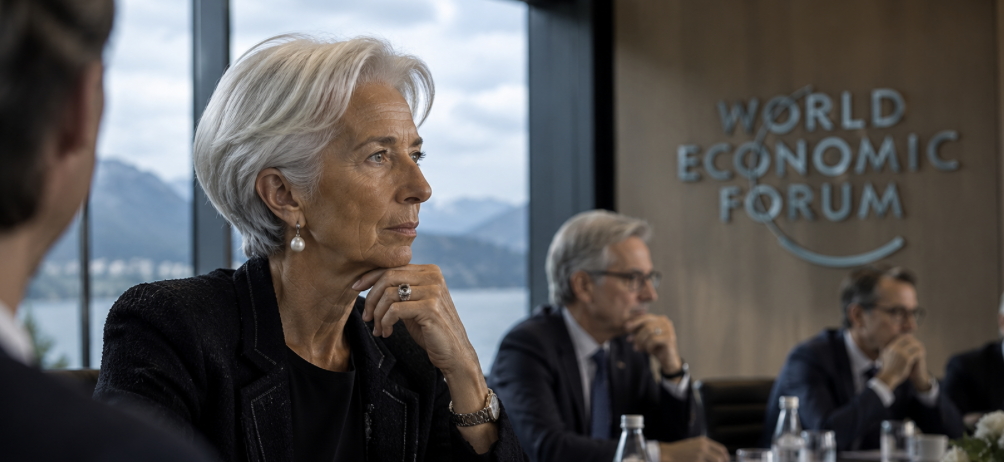
WEF trustees discussed Christine Lagarde as next WEF chair this week, people familiar with the matter said, putting ECB succession before 2027 in focus.
The European Central Bank president appears ready to take the role, according to the people, who requested anonymity to discuss internal business. One person said Lagarde wants assurance that tensions between the World Economic Forum and founder Klaus Schwab have been fully resolved before she commits.
Lagarde waits on Schwab strains
The European Central Bank declined to comment on the matter. A WEF spokesperson said the organization does not comment on confidential board meetings.
Schwab’s April 2025 departure from the chairmanship changed the succession stakes at the Geneva-based organization. He left during an investigation into alleged financial misconduct and was later cleared of wrongdoing, though strains between Schwab and the forum have lingered, according to the people.
Lagarde has been linked to the WEF post for some time, but the discussion has become more consequential since Schwab’s exit. The unresolved governance issue matters because any appointment would involve both the leadership of a global convening body and the timetable at one of the world’s major central banks.
An ECB term to 2027
Lagarde’s current mandate at the European Central Bank runs until October 2027. She has not committed publicly to serving the full term and has often sidestepped questions about whether she could leave early.
An early departure would move the ECB succession process ahead of its scheduled date. That would bring euro-area governments and European Union institutions into a leadership negotiation while monetary policy remains central to borrowing costs, bank funding and investment plans across the currency bloc.
The ECB role gives the WEF discussions a wider market dimension than a normal board search. Investors and policymakers would watch whether any transition plan preserves continuity at the central bank, especially if the debate over interest-rate settings remains active when a decision is made.
Trustees meet near Geneva
The WEF board of trustees held an in-person meeting Tuesday at the organization’s headquarters near Geneva, according to people familiar with the matter. Lagarde is herself a trustee, adding a governance complication to any discussion of her possible appointment.
The forum is currently led at board level by two co-chairs: Roche Holding AG Vice-Chairman Andre Hoffmann and BlackRock Inc. Chief Executive Larry Fink. Their roles have provided an interim leadership structure after Schwab’s exit, while the organization considers a permanent chair.
For the WEF, choosing Lagarde would attach the organization to a former International Monetary Fund managing director and sitting ECB president. It would also bring scrutiny over timing, since the forum’s internal settlement with Schwab remains part of Lagarde’s decision calculus, according to one of the people.
Three paths for Lagarde
If Lagarde accepts after the Schwab dispute is judged settled, the global macro effect would run mainly through the ECB transition mechanism rather than WEF policy. Markets would focus on how quickly euro-area governments align behind a successor, while the forum would gain a chair with central-bank and IMF credentials.
If the tensions with Schwab remain unresolved, Lagarde could delay or decline the role, leaving the ECB timetable unchanged through October 2027. That path would extend the WEF search and keep leadership uncertainty inside the policy-conference sector, where credibility depends on the neutrality and stability of convening institutions.
If Lagarde signals interest without setting a departure date, both institutions would operate under a longer period of ambiguity. The main open question is whether the WEF can close its governance dispute before the ECB succession calendar becomes a formal issue for European policymakers.