US yield rise and Iran risk weigh on Manila stocks, testing Washington’s Asia calculus
The PSEi fell 0.87% to 5,738.40 as higher US Treasury yields and US-Iran tensions fed a risk-off move.
Lauren Collins ·
US yield rise and Iran risk weigh on Manila stocks, testing Washington’s Asia calculus
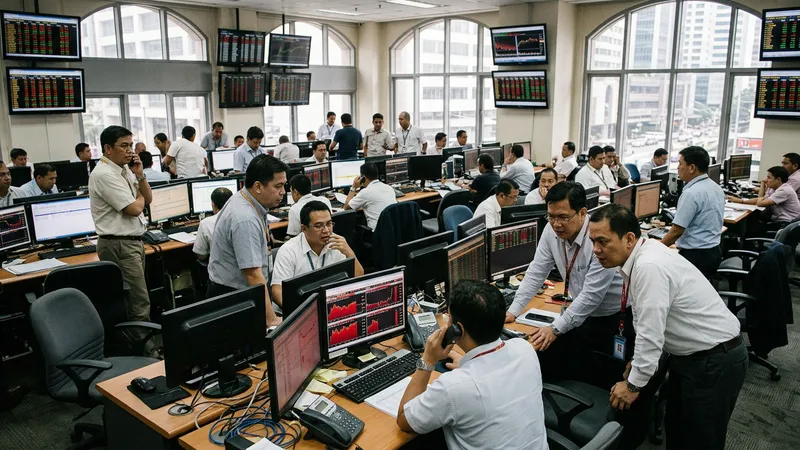
Washington-facing risks reached Manila’s equity market on Tuesday, with the Philippine Stock Exchange Index falling 0.87%, or 50.47 points, to close at 5,738.40. The drop extended a slide in local stocks as higher US Treasury yields and US-Iran tensions weighed on investor appetite.
The move gives US officials a compact version of a broader problem: when US yields rise and Middle East energy risks flare, emerging markets can absorb the shock before Washington changes any formal Asia policy. For the Philippines, a US treaty ally trying to balance security cooperation, inflation control and investor confidence, the pressure point is financial as much as diplomatic.
Rising US Treasury yields matter for emerging markets because they change the return investors can earn in the world’s deepest government bond market. When those yields climb, some global capital has less reason to stay in riskier equities and currencies, especially in markets where liquidity is thinner and foreign flows can move prices quickly.
That channel is watched closely in Washington because it links Federal Reserve expectations, Treasury market pricing and US diplomacy. The White House does not set interest rates, and the Fed is independent, but higher US yields can still shape the operating environment for economic statecraft by strengthening dollar demand, tightening external financing conditions and making allied economies more sensitive to global risk swings.
Philippine Stock Exchange Index
The Iran angle adds a security overlay. Tensions involving the United States, Iran and the Strait of Hormuz matter to Asian economies because the waterway is one of the world’s key energy transit routes; any disruption risk can feed into oil-price volatility, shipping costs and inflation expectations. Even talk of de-escalation can move sentiment if investors believe energy flows will remain open.
For Manila, the market reaction sits at the intersection of those two forces. The Philippines is not the center of US-Iran diplomacy or US bond-market pricing, but it is exposed to both through imported energy costs, foreign portfolio flows and the broader dollar cycle. A weaker risk backdrop can pressure equities and complicate the central bank’s room to support growth while guarding against inflation and currency weakness.
Washington also has a strategic reason to watch the Philippine reaction. The United States has deepened defense cooperation with Manila as competition with China has intensified in the South China Sea. If external financial stress builds, Philippine policymakers may face a tighter trade-off between funding domestic priorities, maintaining market confidence and sustaining the pace of security cooperation with the US.
The Pentagon and State Department usually view the Philippines through alliance access, maritime security and regional deterrence. Markets are a different signal, but not a separate one. A risk-off move in Manila can become relevant to Washington if it points to a wider emerging-market squeeze that limits allied governments’ fiscal and political bandwidth.
The immediate market number was modest in daily terms, but the mechanism matters. A 0.87% decline in the PSEi does not by itself change the US posture in Asia. It does show how quickly US rate expectations and Middle East risk can combine in a market far from both Washington and Tehran.
Congress may also enter the picture if energy prices or regional instability become more visible. Lawmakers have already treated Iran policy, sanctions enforcement and Indo-Pacific security as connected parts of US strategy. A market channel running through allies such as the Philippines would give that debate another economic dimension.
Think tanks and policy advisers in Washington are likely to focus on whether this is a passing adjustment or the start of a broader emerging-market repricing. The difference matters. A short-lived equity pullback is a market event; a sustained rise in yields alongside energy-risk premiums can become a policy constraint for partners that depend on stable capital conditions.
There are limits to what can be inferred from one session. The source material attributes the PSEi decline to rising US yields and persistent US-Iran tensions, but it does not provide fund-flow data, peso moves, oil prices or Treasury yield levels. Without those figures, the signal should be read as an early stress marker rather than proof of a larger regional shift.
By December 28, 2026, the test is whether higher US yields and Middle East risk remain visible in emerging-market pricing rather than fading as one-day noise. If US yields stay elevated, energy-route tensions persist and Philippine equities or the peso weaken alongside broader emerging-market outflows, the Washington-facing macro-risk thesis is supported; if yields retreat, Iran diplomacy cools, energy prices ease and Manila assets stabilize, the signal weakens.