Uber robotaxis start London rides with Wayve AI car pilot
Uber robotaxis launched in London with Wayve AI, fewer than 20 Ford Mustang Mach-E cars and safety operators before any fully driverless service.
Jason Kwon ·
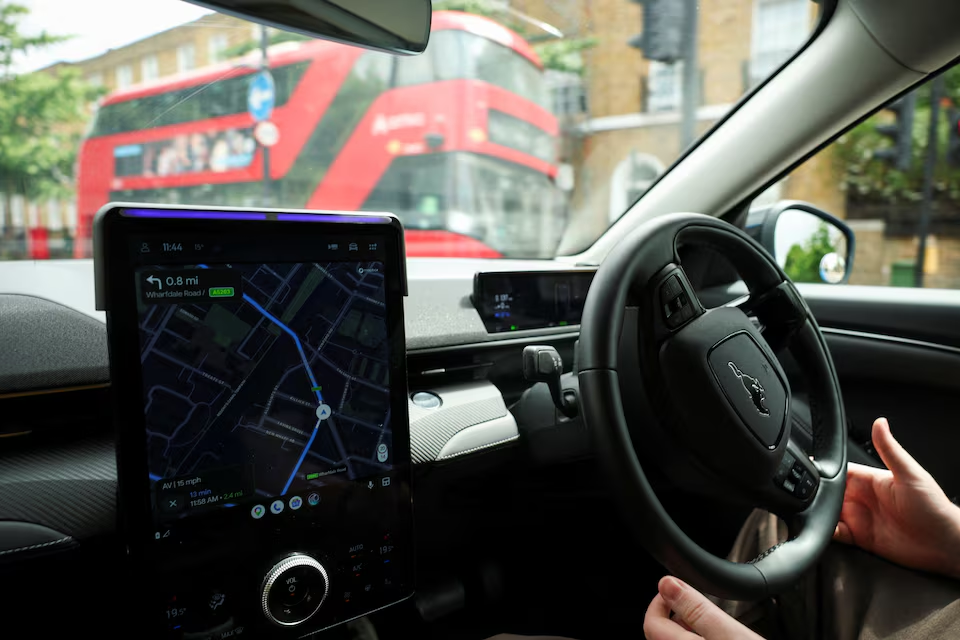
Uber robotaxis began taking London riders Thursday with Wayve AI and a safety operator onboard. The pilot starts with fewer than 20 cars.
Uber and Wayve said London is the second European city after Zagreb where Uber offers autonomous rides. The service remains supervised for now, with a licensed operator in each vehicle before any fully driverless rollout.
Fewer than 20 Ford EVs
Riders requesting UberX, Uber Comfort or Uber Electric may be matched with a Wayve-powered Ford Mustang Mach-E, the companies said. The ride will carry no additional charge compared with the selected Uber service class.
The small fleet limits the near-term effect on London’s ride-hailing market. It also gives Uber and Wayve a public test of whether regular passengers will accept autonomous driving technology in one of Europe’s busiest urban road networks.
A launch with a driver
The operator onboard is the clearest sign that the London service is not yet a fully driverless commercial network. Uber and Wayve said the safety role will remain in place before unsupervised operations begin at an unspecified future date.
Regulatory clearance remains the central constraint. The companies pointed to remaining barriers before full driverless services can start in London, including the authorization process involving Transport for London.
Wayve’s London test case
Wayve’s system, called AI Driver, is designed to learn from driving experience and adapt to unfamiliar roads, vehicles, weather and cities, the companies said. That approach differs from systems built mainly around pre-mapped areas and fixed driving rules.
Uber partnered with Wayve in 2024 and made an investment in the British artificial intelligence company as part of a plan to use Wayve-powered vehicles in several markets. The London launch gives both companies a consumer-facing deployment in Wayve’s home city.
Sarfraz Maredia, Uber’s Global Head of Autonomous Mobility, said the service would "build credibility with consumers as well as with the government." Alex Kendall, CEO and co-founder of Wayve, said: "We're proud to introduce the Wayve AI Driver to the public for the first time right here in London, our home city and one of the most complex driving environments in the world."
Ministers back British software
British Transport Secretary Heidi Alexander framed the pilot as a domestic technology milestone. "This is a major milestone for the future of transport in London, as British innovation brings this technology onto our roads and gives passengers more choice," she said.
For Uber, the London deployment extends its autonomous ride strategy beyond Zagreb while avoiding an immediate jump to driverless service. For Wayve, the pilot puts its AI software into paid ride-hailing journeys rather than closed demonstrations or limited trials.
Approval path sets the pace
If Transport for London and other authorities move toward broader authorization, Uber could add more Wayve-powered vehicles and test whether autonomous rides reduce labor dependence in high-cost urban markets. That path would give Wayve a stronger case with automakers and fleet partners, while the wider robotaxi sector would gain another European proof point.
If approvals take longer, the London service is likely to remain a supervised pilot with limited passenger exposure and little immediate effect on transport capacity. That outcome would slow Uber’s local autonomy ambitions, keep Wayve focused on proving safety and reliability, and leave the broader industry facing a familiar constraint: public-road deployment depends as much on regulators as on software.