Turkey-Saudi-Pakistan defense talks test Washington's Gulf security calculus
Turkey, Saudi Arabia, and Pakistan hold emergency defense talks in Riyadh following Houthi attacks. Could this shift regional security dynamics?
Lauren Collins ·
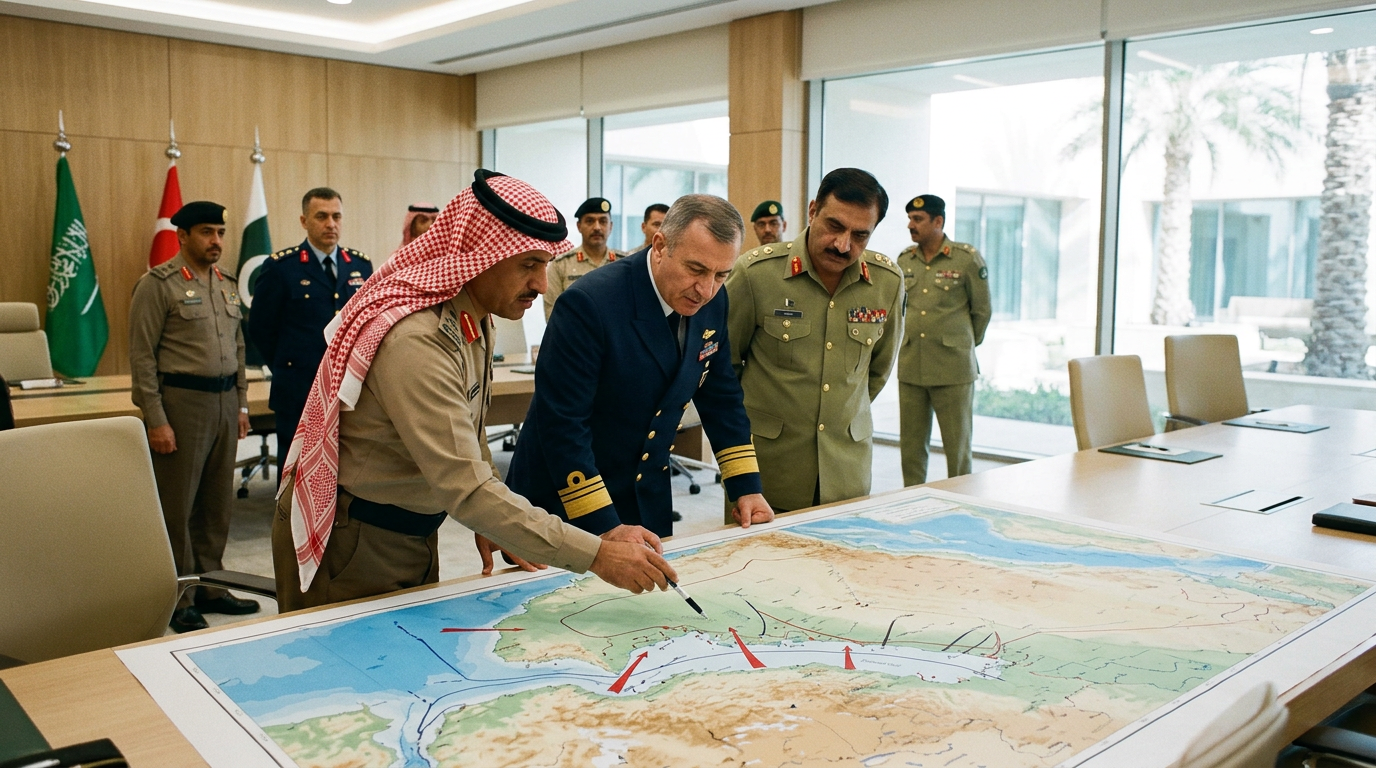
Turkey-Saudi-Pakistan defense talks test Washington's Gulf security calculus
The Trump administration faces a new Gulf security variable on September 25, 2026, as Turkey, Saudi Arabia and Pakistan prepare emergency defense talks in Riyadh after reported Houthi missile and drone attacks on Saudi Arabia. The meeting is expected to bring together the three countries' military chiefs, including Turkish Chief of General Staff Selçuk Bayraktaroğlu, under what the Turkish report described as the Mekke Joint Defense Agreement framework.
The Trump
For Washington, the immediate question is less whether three U.S. partners talk to one another than whether the talks produce a defense mechanism that plugs into American deterrence planning against the Houthis and Iran, or develops outside it. Saudi Arabia remains central to U.S. Gulf policy, Turkey is a NATO ally with an increasingly independent regional posture, and Pakistan has long-standing defense ties with Riyadh.
The reported Riyadh meeting follows a period in which the Houthis have used missiles and drones to pressure Saudi Arabia and the wider Red Sea security environment. The group, based in Yemen and aligned with Iran, has shown that relatively low-cost strike systems can impose high defensive costs on Gulf states and on the shipping routes Washington treats as core economic infrastructure.
Saudi Arabia has spent years building layered air and missile defenses with U.S. support, but the Houthi threat has tested the limits of expensive interceptor systems against repeated drone and missile launches. That gives Riyadh an incentive to widen defense coordination beyond its traditional bilateral channels with Washington, especially if it can add intelligence-sharing, training or procurement options with other Muslim-majority military powers.
Turkey's role is the most politically sensitive piece for U.S. officials. Ankara has tried to repair ties with Gulf capitals after years of rivalry, while expanding its defense export profile through drones, naval systems and military training. A Turkish seat at a Saudi-led emergency defense table could help Washington if it reinforces burden-sharing, but it could also make U.S. planners account for a NATO ally that is coordinating Gulf security on its own terms.
Pakistan brings a different weight. Islamabad has deep military links with Saudi Arabia, including training and advisory relationships, and it has a large conventional military with experience in air defense, counterinsurgency and nuclear command structures. Its participation gives Riyadh another security partner outside the U.S.-Gulf Cooperation Council format, even if the practical commitments remain unclear.
The Mekke Joint Defense Agreement, as described in the Turkish report, appears to be the organizing framework for the meeting. The public record available from the supplied material does not establish its full legal obligations, founding text, signatories or enforcement mechanism. That uncertainty matters in Washington because a dialogue forum, a joint planning cell and a mutual defense pledge would carry very different implications for U.S. policy.
The White House and National Security Council would likely view the talks through three files: Yemen, Iran and the future division of labor in Gulf security. The State Department would focus on whether the format supports de-escalation or hardens regional blocs. The Pentagon would care most about operational details: air defense integration, intelligence channels, maritime security and whether any new commitments overlap with U.S. basing, arms sales or command arrangements.
Congress adds another constraint. Lawmakers have repeatedly scrutinized U.S. support for Saudi military operations connected to Yemen, while also pressing administrations to deter Iranian-backed groups. If Riyadh uses the talks to seek new equipment, expand air defense networks or formalize a broader anti-Houthi posture, the administration may have to brief Congress on whether the arrangement reduces U.S. exposure or pulls Washington toward another escalation cycle.
The meeting also comes as regional states look for insurance against shifting U.S. priorities. Gulf leaders have watched successive U.S. administrations debate how much military risk to carry in the Middle East while trying to focus on China, Russia and domestic political constraints. A Turkey-Saudi-Pakistan track would fit a broader pattern: partners want American backing, but they also want options if Washington moves slowly or sets limits.
The most useful outcome for the United States
would be a narrow, practical arrangement.
If the three countries announce information-sharing on Houthi launch patterns, joint air defense exercises or technical cooperation that complements existing U.S. systems, Washington could present the talks as regional burden-sharing. That would let the administration argue that partners are doing more while the United States keeps a central coordinating role.
A more difficult scenario would involve a political declaration with vague defense language and no operational detail. That could raise expectations in Riyadh, Ankara and Islamabad without giving U.S. planners a clear picture of who would act in a crisis. Ambiguity is not always destabilizing, but in missile defense and maritime security it can produce delays, duplicated channels and misread signals.
The hardest case for Washington would be a bloc that treats autonomy from the United States as part of its appeal. If Ankara uses the format to market Turkish defense systems and regional influence, and Pakistan deepens its Saudi role without clear U.S. coordination, Washington's leverage over escalation management could narrow. The effect would be felt first in Yemen policy, then in Iran deterrence planning, and finally in the U.S. defense-industrial relationship with Gulf buyers.
The forward test is whether Turkey, Saudi Arabia and Pakistan issue a public communiqué by December 24, 2026, that names concrete steps such as joint drills, intelligence-sharing protocols or coordinated air defense procurement. If that happens and U.S. officials publicly connect the effort to a coordinated Yemen and Iran deterrence strategy, the meeting will look like a burden-sharing gain for Washington, with modest macro support for Red Sea trade confidence, more room for Saudi defense coordination and new openings for regional defense suppliers. If no concrete steps emerge, or if Turkey pursues a visibly separate track that sidelines U.S.-Gulf arrangements, the talks will instead point to a more fragmented security order, with less predictable escalation management for Washington, more strategic optionality for Riyadh and sharper competition across the regional defense industry.