Trump's AI Jesus Post, Pope Fight Spark Growing Backlash
Trump removed an AI-generated Jesus-like image from Truth Social after criticizing Pope Leo XIV, drawing backlash and scrutiny from religious voters.
Lauren Collins ·
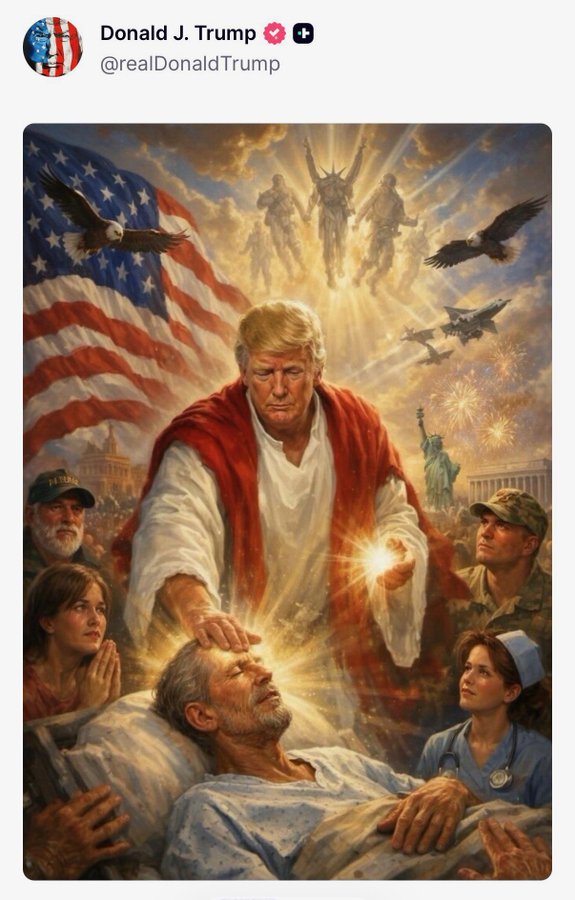
Donald Trump faced renewed backlash after sharing an artificial intelligence-generated image that appeared to cast him in a messianic role, according to the account of the episode described in the source material. The image was posted on Trump’s Truth Social platform and was later removed. After it came down, Trump said he believed the image was intended to show him as a doctor helping a patient, rather than as a religious figure.
The controversy over the AI image unfolded alongside a separate public dispute involving Pope Leo XIV . The source material says that only hours before the image appeared, Trump published a lengthy message criticizing the Pope, intensifying an ongoing war of words between the former president and the head of the Catholic Church. Taken together, the two episodes placed Trump’s relationship with religious constituencies under sharper scrutiny.
Officials were not cited in the source material, but it describes the political sensitivity of a direct clash with a papal figure as unusual for a US politician. The account notes that such a confrontation can be particularly risky for a candidate who depends on a broad coalition of Christian voters, including Catholics. The AI image, which evoked themes associated with healing, reportedly drew criticism even from some of Trump’s dedicated supporters, who viewed the comparison as inappropriate.
The source material frames the reaction as an example of how quickly religious symbolism can become politically combustible when deployed in campaign-style communication. It also says the dispute could complicate outreach to more moderate or traditional religious audiences, especially Catholic voters who may be unsettled by direct criticism of the Pope. The episode, as described, highlights the tension between energizing a core base and avoiding actions that alienate adjacent constituencies.
Beyond domestic politics, the incident is presented as part of a broader shift in how political narratives are created and spread. The source material points to the growing role of AI in political discourse, emphasizing how rapidly produced, digitally altered images can shape public perception and accelerate controversy.
It also notes that Truth Social served as the channel for both the AI image and the message criticizing Pope Leo XIV, reflecting Trump’s preference for direct communication that bypasses traditional media filters.
At the same time, the source material underscores an uncertainty: the longer-term political consequences are not yet clear and depend on how Trump’s base and the wider electorate interpret the events. Internationally, a high-profile dispute involving the Pope can draw attention beyond US borders because the Catholic Church is a global institution, potentially widening the audience for the controversy even if the immediate political stakes remain centered on US voters.