Slok says diesel prices may complicate Fed inflation view
Diesel prices at $6.50 a gallon have prompted Apollo's Torsten Slok to warn that freight costs may feed core inflation.
Cuneyd Erdogan ·
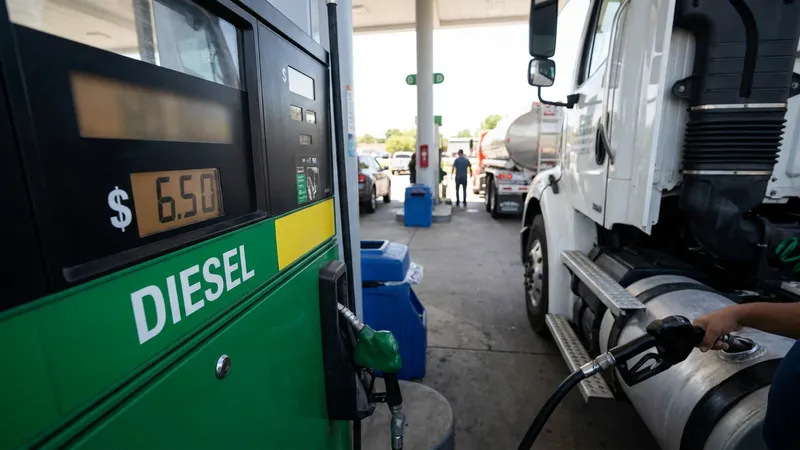
Diesel prices jumped 83% this year to $6.50 a gallon, prompting Apollo's Torsten Slok to warn that freight costs may feed core CPI.
Slok, Apollo Global Management Inc.'s chief economist, said Friday that the Federal Reserve may be underestimating how diesel moves through the inflation basket. His warning comes as the central bank weighs policy after its first interest-rate increase since 2023, with inflation still above its 2% target.
$6.50 diesel hits freight
The average US diesel price reached $6.50 a gallon through Thursday, according to figures cited by Slok. That 83% rise this year compares with a 59% increase for gasoline, creating a wider cost shock for companies that move goods, materials and equipment.
Gasoline prices mainly affect motorists at the pump, while diesel is tied to trucking, distribution, construction and power-intensive industrial activity. Slok said that distinction matters for inflation measures that exclude energy prices but still capture the goods and services affected by transportation costs.
"When diesel prices go up, that is really entering elsewhere in the CPI basket than in the energy line," Slok said Friday in a television interview. The comment framed diesel as a channel into core inflation rather than a narrow fuel expense.
Core CPI problem for Powell
Core consumer inflation strips out energy and food to reduce volatility in the data the Fed uses to judge underlying price pressure. Slok's argument is that diesel costs do not stay inside the energy category when shippers and suppliers pass higher transport bills to businesses and households.
He described diesel demand as highly inelastic, since moving goods remains necessary across retail supply chains, construction projects and data-center development. If that demand holds while prices rise, the cost pressure can travel from freight invoices into store shelves, project budgets and service contracts.
That is the policy complication. If officials treat the diesel increase as a temporary energy move, Slok said they risk missing a pathway that can keep core inflation elevated even after direct fuel costs are excluded from the index.
AI spending keeps demand firm
Slok also pointed to artificial intelligence investment as a support for US growth despite higher borrowing costs. He estimated that AI-related activity is adding roughly 1 percentage point to GDP growth, or about half of the current expansion he described.
That estimate covers data-center construction, power demand, software spending and the wealth effect from elevated equity prices, according to Slok. The same buildout can also sustain demand for diesel-linked transportation and construction services, tying the AI capital cycle to the inflation debate.
For Apollo, the issue is not only a macro call but a credit and valuation question. Higher-for-longer rates would affect financing costs, discount rates and portfolio assumptions across private credit, infrastructure and real estate assets.
Scenarios turn on fuel pass-through
If crude-flow disruptions ease and diesel prices retreat, the Fed would have more room to view the fuel shock as temporary, in the scenario Slok described. That path would reduce pressure on global goods inflation, ease cost assumptions for Apollo clients and give freight, retail and construction firms a cleaner margin backdrop.
If diesel stays near current levels and companies keep passing costs through, the mechanism moves in the other direction. Core inflation would be harder to slow, Apollo's rate-sensitive markets would face tighter financial conditions, and logistics-heavy sectors would have to absorb or transfer higher transport costs.
A third path is a demand adjustment rather than a fuel-price reversal. If higher borrowing costs slow construction, data-center expansion or consumer demand, diesel consumption could soften, with weaker macro growth doing part of the Fed's inflation work while raising pressure on cyclical companies and transport volumes.
The main open question is how long diesel remains elevated and how much of the increase reaches core categories. Slok's warning puts freight costs back into the Fed debate at a point when policymakers are trying to separate temporary energy moves from inflation that becomes embedded in the broader economy.