Lab Breakthrough: Solar Cells Exceed 100% Efficiency
Solar cell researchers in Japan and Germany report ~130% lab efficiency, outlining a method to capture blue light and exceed the SQ limit.
Jason Kwon ·
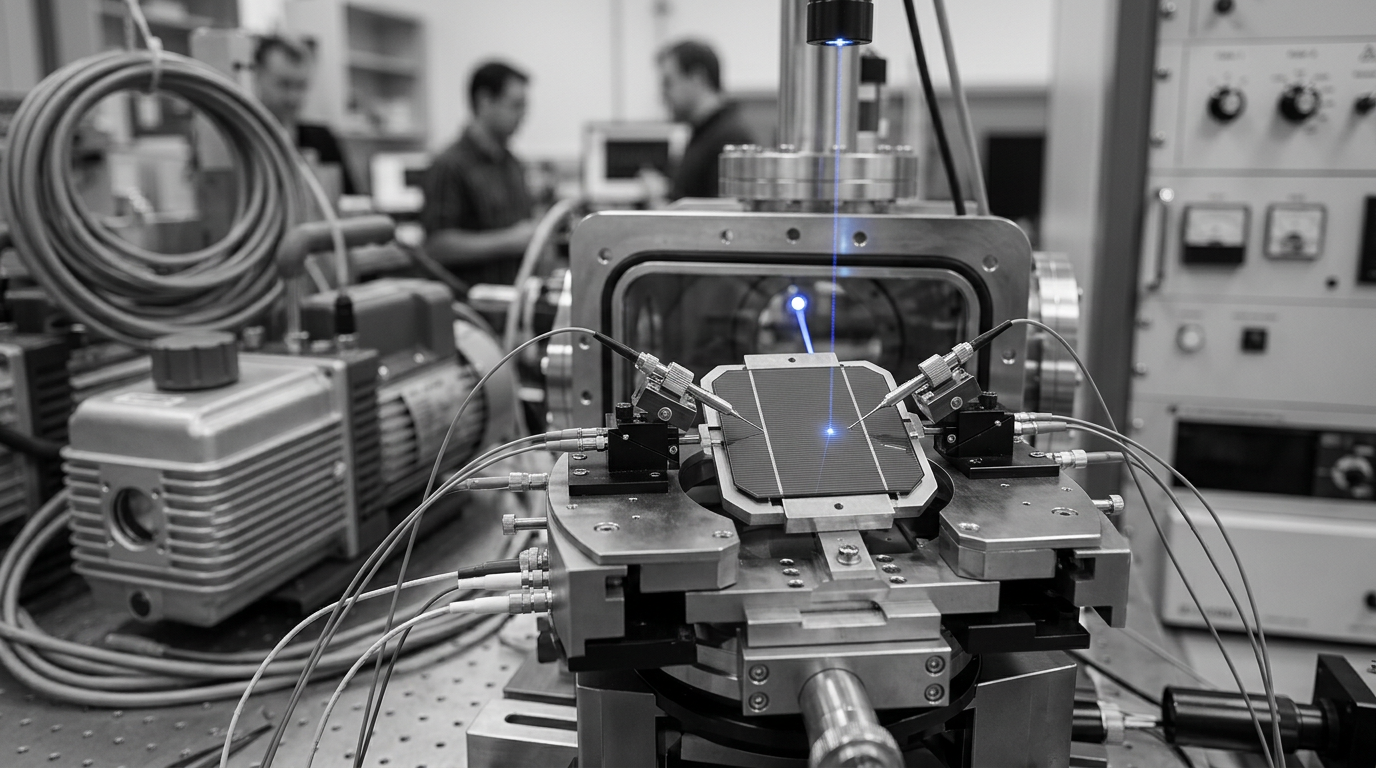
Scientists in Japan and Germany reported a laboratory technique that they said could lift solar energy conversion beyond a long-cited theoretical ceiling for conventional designs. The work was published in the Journal of the American Chemical Society and describes an approach that reached approximately 130 percent energy conversion efficiency under lab conditions.
The researchers focused on a persistent loss mechanism in solar devices: high-energy blue light that is often not fully converted into usable electrical output and can instead be dissipated as heat. According to the study, the team used a compound-based method intended to capture that high-energy portion of the spectrum more effectively than prior approaches.
In the reported process, a mixture combining the organic molecule tetracene and the metallic element molybdenum was exposed to blue light. The researchers said this “blasting” step enabled incoming energy to be split into two usable parts, increasing the number of usable energy carriers produced from the same amount of light.
As described in the paper, the technique generated 130 usable energy carriers for every 100 photons . The researchers also said the method addressed practical issues that had previously arisen when using tetracene on its own, positioning the combined approach as a more workable route for extracting additional value from high-energy light.
The results were framed against the Shockley-Queisser limit , a benchmark that sets a theoretical maximum for single-junction solar cells. Established in 1961 , that limit is described as about 33 percent energy conversion efficiency for single-junction designs, and it has long served as a reference point for what standard architectures can achieve.
For context, the source material notes that current commercial solar panels typically achieve around 25 percent efficiency . The researchers’ laboratory outcome does not describe a commercial module, but it does outline a pathway aimed at converting light energy that would otherwise be wasted, which is central to efforts to raise performance without simply increasing panel area.
What remains uncertain from the reported information is how the laboratory method would translate into scalable manufacturing, long-term stability, and real-world operating conditions. The study, as summarized, highlights a proof-of-concept efficiency gain tied to blue-light capture and energy splitting, while leaving open questions about deployment timelines and integration into existing solar cell designs.