

Rome police use water cannon as strike march hits cordons
Rome police used water cannon during clashes with demonstrators on Friday as a nationwide strike targeted living costs and military spending.
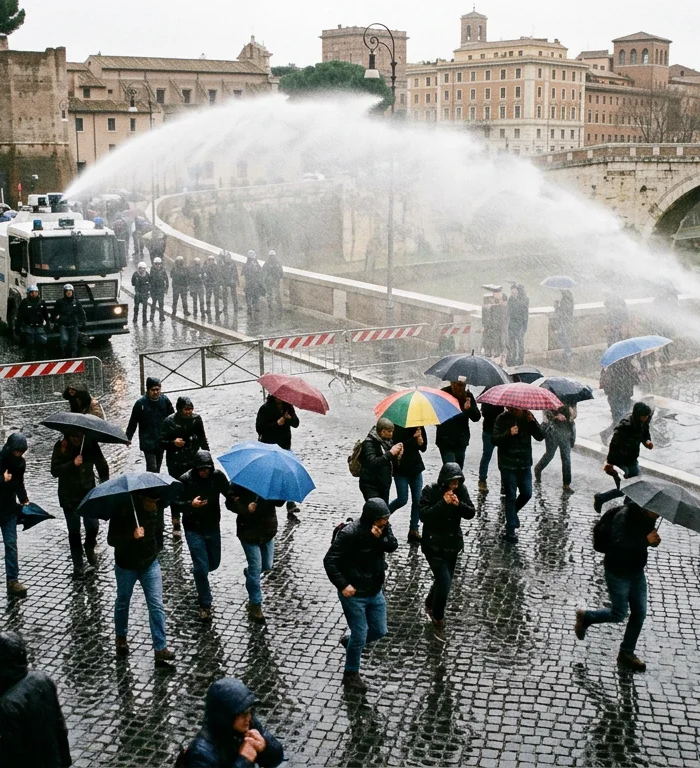
Rome police used water cannon during clashes with demonstrators on Friday as a nationwide strike targeted living costs and military spending.
The confrontation brought police and protesters into conflict over access through central Rome. In Trastevere, demonstrators tried to move across Ponte Sisto toward the Italian parliament, but riot police pushed them back before they could proceed along that route.
The clashes followed a march associated with a nationwide mobilization called by the grassroots trade union USB. Its stated grievances combined household financial pressures with opposition to military expenditure and demands for more money for public services, rather than a single workplace dispute.
Ponte Sisto becomes a confrontation point
Footage shows officers deploying water cannon to scatter demonstrators and advancing through streets with smoke overhead. The account describes protesters attempting to breach police cordons, but does not establish the full sequence of events leading to the use of water cannon.
The source of the smoke is not identified. The available account also provides no confirmed injury or arrest figures, leaving the human consequences of the confrontation unclear beyond the scenes of dispersal described in the material.
USB links wages and military spending
Students, workers, farmers and housing activists took part in the mobilization. That range of participants placed employment, household expenses and housing concerns within the same protest, although the account does not identify separate demands from each participating group.
Organizers presented rising living costs and low wages as reasons for the strike. These are the protesters’ stated grievances; the material provides no inflation readings, earnings figures or other economic data with which to measure the pressures they described.
Military spending formed another part of their objections to government policy, alongside calls for greater investment in public services. No spending totals, proposed reallocations or specific budget measures are identified, so the fiscal scale of their demands cannot be assessed from the account.
Colosseum camp accompanies the street march
Earlier on Friday, thousands of people marched through central Rome, according to the account, which does not identify the source of that crowd estimate. Tractors joined the procession, while protesters established a tent camp near the Colosseum.
The camp and the march were distinct elements of the day’s activity; the account does not say how long the encampment was intended to remain. Nor does it establish whether the confrontation at Ponte Sisto affected demonstrations elsewhere in Italy.
Although the strike was described as nationwide, the reported events concern Rome, with no sector-by-sector participation or service-disruption figures provided. The immediate unresolved issues are the outcome of the police confrontation, the continuation of the camp and any government response to the demonstrators’ demands.
More stories
- French protests draw 320,000 in third cost-of-living wave
- Khamenei orders unrestricted response to any US or Israeli attack
- Trump administration widens Alaska election investigation
- COUP in Poland? Tusk accused of power grab as riot cops swoop on Constitutional Court
- Nigeria minister seeks clean-cooking finance for 2060 plan
- ICN warns on misinformation after Congo Ebola nurse killing
- Malaysia TVET entrants rise 30% in high-skills push
- Thai police arrest 39 in Cambodia-linked laundering probe