

Play2Perfect points to 33-fold robot assembly training gain
The arXiv preprint reports zero-shot transfer to real robots, including 60% success on insertions with 0.5 millimeter clearance.
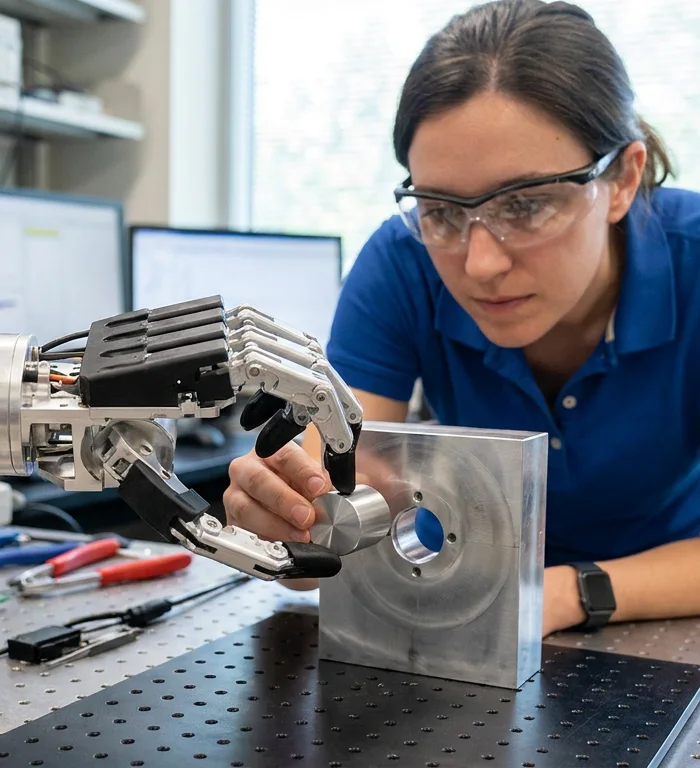
Play2Perfect, a robotics reinforcement-learning framework, delivered a 33-fold sample-efficiency gain over scratch training in an arXiv preprint posted Oct. 17 by Tyler Ga Wei Lum and three co-authors.
That 33-fold comparison is the central stake: the Oct. 17 arXiv preprint targets precise assembly, where the authors say multi-fingered robots still struggle despite use of specialized grippers, tool attachments and fixtures.
Reinforcement learning, a method in which software improves actions through reward signals, can be costly for assembly because useful feedback may arrive only after difficult physical contact. The authors frame their alternative plainly: “before a robot can perfect precise assembly, it must first learn to play.”
Play2Perfect pretrains a robot through task-agnostic play across varied objects and goals, then fine-tunes that prior for assembly. The authors say the play phase builds reusable manipulation skills, including grasping, in-hand reorientation and reaching target poses.
The reported gain came against reinforcement learning from scratch, even when the baseline received dense, multi-stage rewards, according to the preprint. Dense rewards provide more frequent signals during training than sparse rewards, which usually provide feedback only when a goal is reached.
The authors also report zero-shot simulation-to-real transfer, meaning a policy trained in simulation was used on physical hardware without additional real-world training in the reported setup. In those tests, the system achieved 60% success on tight insertion tasks where parts had 0.5 millimeter of contact clearance, about the width of a common mechanical pencil lead.
For longer tasks, the authors report success rates above 50% on multi-part assembly and screwing. The paper also says it studies design choices in pretraining, including object variety, objective design, trajectory diversity and goal precision.
The result is early research rather than a commercial deployment.
The paper was first submitted on June 24 and its fourth version was revised on Oct. 15. The arXiv page lists 26 pages, 19 figures and four tables under Robotics and Artificial Intelligence.
Source: arXiv preprint, arXiv cs.RO/cs.AI, published Oct. 17, 2026; version 4 revised Oct. 15, 2026.
More stories
- DeepSeek updates AI model as speed and cost rivalry grows
- CoreWeave bond yields hit 15% as AI funding doubts deepen
- The Week in Games: Selective capital meets harder scoreboards
- Bhaag Neha Bhaag draws 2,700 players in CJP protest game wave
- Japan & Asia: Switch 2 leads Famitsu chart with 22,420 units
- Kotukh maps quantum side-channel edge to AES-128 rank 2^58.6
- AI devices face privacy test as smart glasses gain users
- Beijing slows robot IPOs as valuations face closer tests
Latest news
- French police arrest more than 1,800 after cost-of-living protests
- Soy-derived LPC70 curbs salt-linked behavior changes in mice
- Meat-derived Neu5Gc tracks with 63% higher diabetes risk
- Godongwana faces 80% debt test in budget update
- Georgia faces surrogacy scrutiny after 1,100 births in 2023
- El Gouna selects 5 filmmakers for third Rising Stars cohort
- Vanillin shows wound-care potential in early research
- Menin restoration improves older-mouse memory in 30 days