

Godongwana faces 80% debt test in budget update
South Africa’s finance minister presents the medium-term fiscal plan on Oct. 21 after stronger mining taxes and ratings upgrades met weak growth forecasts.
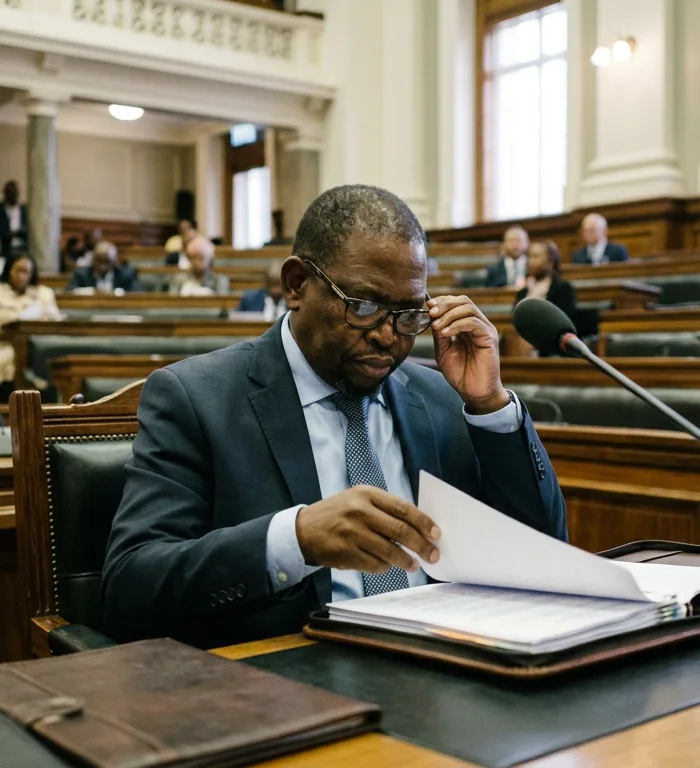
Finance Minister Enoch Godongwana faces an 80%-of-GDP debt-stabilisation test when he presents South Africa’s Medium-Term Budget Policy Statement on Oct. 21, Daily Maverick reported in an Oct. 18 Business Maverick article.
The budget update will test whether stronger mining receipts can offset weak growth: PwC put mining income-tax payments at R53 billion in the 12 months to end-June, up 123% from about R23.8 billion a year earlier, according to Atlas360 calculations based on PwC’s figures.
Investec chief economist Annabel Bishop said in a note on the medium-term budget that metals prices have strengthened the fiscal position early in the year. “An improvement in revenues has occurred, at 39% of budget versus 37% this time last year, on the rally in precious metals prices,” she said.
Higher commodity exports have also helped keep the rand relatively stable, the report said. The Medium-Term Budget Policy Statement sets South Africa’s fiscal framework and policy plans for the next three years, ahead of the annual budget in February.
South Africa has received its first credit-rating upgrades in two decades since Godongwana’s previous medium-term statement. S&P Global Ratings raised South Africa’s rating by one notch in November 2025 and kept a positive outlook, citing Eskom’s improved performance and a better fiscal and growth outlook.
Fitch followed in June 2026, while Moody’s moved South Africa’s outlook to positive from stable. The three major rating companies still place South Africa two notches below investment grade.
Credit ratings affect borrowing costs and investor access for sovereign issuers. For South Africa, lower funding pressure would support the Treasury as it tries to hold debt below a level investors view as difficult to sustain.
Growth remains the main constraint. South Africa’s economy contracted 0.2% in the second quarter, and the International Monetary Fund on Oct. 13 cut its 2026 growth forecast for the country to 1.0%, with 1.3% projected for 2027.
The IMF said growth was expected to “improve gradually over the medium term, underpinned by strengthened policy frameworks and ongoing structural reforms,” the report said. It cited business-government partnerships and the gradual restructuring of Eskom among those reforms.
The fiscal support from stronger mining receipts also has limits. Improvements at the South African Revenue Service have helped the budget position, but commodity cycles can turn and tax administration alone cannot solve a low-growth problem.
George Glynos, head of research at ETM Analytics, linked fiscal strain to pressure for greater private-sector involvement. “Ultimately, when the financial resources of a country run dry, but the politicians still need to get things done, then they will default to where they can find the resources and skills to do that, and that will be the start of a privatisation drive,” he told Daily Maverick.
The report did not include a new Treasury debt path or comment from Godongwana. The next test is whether the Oct. 21 statement sets out a credible route to stabilise debt at 80% of GDP within the next two years.
On Oct. 21, the debt path in the Medium-Term Budget Policy Statement will show whether the Treasury still aims to stabilise debt at 80% of GDP within two years and whether it projects a decline after that peak.
On Oct. 21, the revenue table will indicate how much of the early-year improvement, including receipts equal to 39% of budget versus 37% a year earlier, the Treasury treats as durable.
On Oct. 21, the growth assumptions will be measured against the IMF’s Oct. 13 forecasts of 1.0% growth for 2026 and 1.3% for 2027.
More stories
- Georgia faces surrogacy scrutiny after 1,100 births in 2023
- Iran parliament backs Akhlaghi as defence minister in 237-15 vote
- Belgium seeks EU sanctions after West Bank attack on diplomats
- Macron vows prosecutions after 400 arrests at France protests
- Lovejoy links Bonetta to 700,000-person indenture system
- Six Black Sea ship attacks reach Romanian waters
- US housing starts drop while mortgage costs pressure demand
- Taiwan concerns test Trump-Xi summit as trade gains loom
Latest news
- El Gouna selects 5 filmmakers for third Rising Stars cohort
- Vanillin shows wound-care potential in early research
- Menin restoration improves older-mouse memory in 30 days
- Feijóo targets Catalonia’s 48 seats with Albiol housing pledge
- Govil seeks 50% or full BBL stake to expand T20 portfolio
- BPC-157 use rises 33-fold despite limited human evidence
- Mynt prices $971m IPO in 2026's biggest Southeast Asia debut