Philippines Evacuates Thousands as Mayon Volcano Rumbles
The Mayon Volcano eruption has prompted mass evacuations in the Philippines, with authorities raising the alert status and warning of a hazardous event.
Ayla Demirhan ·
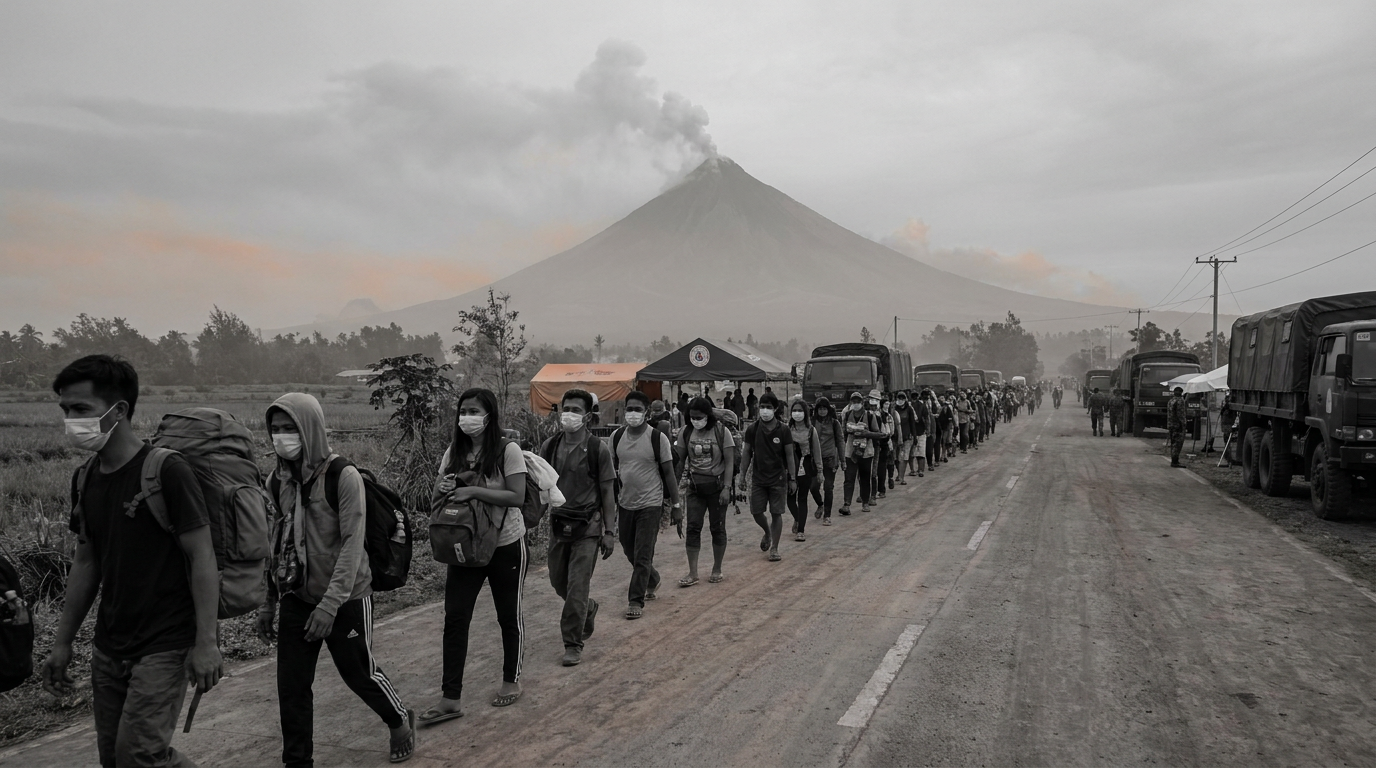
Thousands Flee as Volcano Awakens
The Mayon Volcano eruption has forced the evacuation of thousands of residents in the Philippines after it began spewing lava and ash. Officials have raised the warning to Alert Level 3 on a five-step scale, signaling a heightened risk of a dangerous eruption in the coming days or weeks.
In response to the escalating activity, authorities established a mandatory six-kilometer permanent danger zone around the volcano's crater. Nearly 1,500 families have already been moved to temporary evacuation centers, according to the Department of Social Welfare and Development, as the threat of fast-moving pyroclastic flows and lava looms.
Heightened Alert and Scientific Warnings
The Philippine Institute of Volcanology and Seismology (PHIVOLCS) documented what it described as strombolian activity, characterized by short-lived bursts of lava and gas. The agency has cautioned residents about the potential for significant landslides and widespread ashfall, which has already blanketed several towns across Albay province.
On Saturday, thick plumes of ash disrupted traffic and reduced visibility in nearby communities. Alert Level 3 signifies a high level of magmatic unrest, where magma is near or at the crater and a hazardous eruption is considered possible. A higher alert level would indicate an imminent major event.
A History of Volatility
Located in Albay province south of Manila, Mayon is one of the most active volcanoes in the Philippines. It is a major tourist attraction, renowned globally for its picturesque and near-perfect conical shape. Despite its beauty, the volcano has a long history of violent eruptions that have repeatedly threatened the dense populations living at its base.
Its frequent activity requires constant monitoring by government agencies and a high state of preparedness among local communities. The current eruption is a stark reminder of the geological instability of the Pacific Ring of Fire, a region where a large number of earthquakes and volcanic eruptions occur.
Officials continue to closely monitor seismic activity, gas emissions, and ground deformation for any signs of an impending larger blast. The primary focus remains on securing the safety of residents within the expanded danger zone and preparing for a potentially prolonged displacement.