

Nigeria petrol stocks miss 30-day safety mark for seventh month
NMDPRA data reported by Leadership show imports fell as demand rose, while explanations range from financing constraints to business caution.
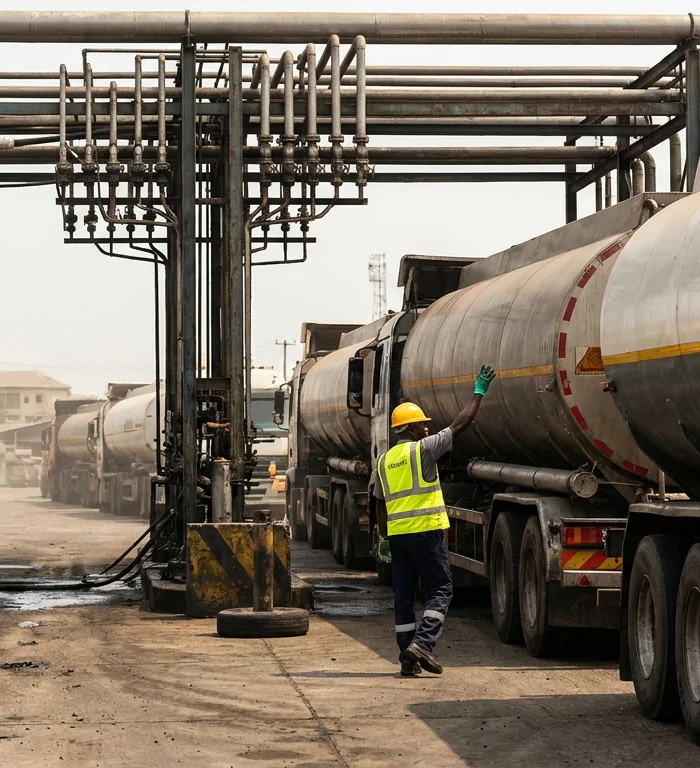
Nigeria’s petrol stock cover, a measure of how long inventories can meet demand, stood at 23.9 days in September, below the 30-day safety benchmark for a seventh month, Leadership reported Oct. 26, citing NMDPRA factsheet.
The September 2026 factsheet from the Nigerian Midstream and Downstream Petroleum Regulatory Authority showed petrol imports fell 30% to 10.2 million litres a day from August, while consumption rose 7% to 44.4 million litres a day. That mismatch leaves supply more exposed before a period when demand rose sharply last year.
Petrol cover had been 30.9 days in February, fell to 21.2 days in March and reached 16.2 days in May, according to the factsheet as reported by Leadership. It then improved for four months, but the monthly gain slowed to 0.5 day in August and one day in September.
Total petrol receipts fell 23% in September to 38.7 million litres a day from 50.5 million litres a day in August, according to the report. Domestic receipts declined 21% to 28.5 million litres a day, leaving the market with 11.8 million fewer litres a day than in August.
Dr Muda Yusuf, chief executive officer of the Centre for the Promotion of Private Enterprise, told Leadership that lower imports may reflect commercial caution as crude trades at elevated levels. “I will say that it's all about business decisions and also concerns by financial institutions not to run the risk of losing money,” Yusuf said.
The financing explanation is contested and not verified in the reported material. Leadership cited an unidentified industry source who imports petroleum products as saying some banks declined to issue Letters of Credit, bank instruments used to finance cargo purchases, to marketers. Another unidentified industry source alleged banks were being pressured to deny the facilities, while Clement Isong, secretary of the Major Energy Marketers Association of Nigeria, said he needed to check the issue.
Dangote Petroleum Refinery raised average petrol production 13% to 47.22 million litres a day in September from 41.94 million litres a day in August, Leadership reported from the NMDPRA data. The increase did not lift domestic deliveries: Dangote’s local petrol supply fell by about one-fifth, while exports rose 59% to 15.47 million litres a day.
The National President of the Petroleum Products Retail Outlets Owners Association of Nigeria, Prince Dr Billy Gillis-Harry, played down the risk of shortages in comments to Leadership. He said the regulator had the data needed to monitor supply and would address any shortfall through imports or domestic sourcing.
The risk is that year-end consumption repeats last year’s pattern. Volumes trucked out rose from 43.8 million litres a day in September 2025 to 56.7 million litres a day in October 2025 and 63.7 million litres a day in December 2025, according to the report.
Based on September’s stock cover and consumption figures, current petrol inventories were estimated at about 1.06 billion litres. At the December 2025 consumption rate, that stock would last about 16.7 days, while 30 days of cover would require about 1.9 billion litres.
Other fuels showed a split picture. Liquefied petroleum gas stock cover was 15.9 days in September, 14.1 days below the benchmark, while diesel cover was 49.7 days and aviation fuel cover was 53.2 days, according to the reported NMDPRA figures.
Source: NMDPRA September 2026 factsheet reported by Leadership via AllAfrica, Oct. 26, 2026.
More stories
- GE Vernova lifts 2026 free-cash-flow outlook to $16bn-$17bn
- Kinross Gold faces Q3 test after 2%-3% output cut
- Private equity firms face scrutiny over third of methadone clinics
- Private equity puts $18.4bn into US healthtech deals
- JSW Cement shares fall 1.2% despite 33% revenue gain
- InstallatørGruppen Q3 revenue rises 42.8%
- Thales seeks Indian suppliers after 5-year sourcing run
- Brent falls 1% before rate decisions
Latest news
- South African parties split over Cape Town's 30,000-home annual gap
- Ruto seeks Russian investment in Kenya's $380m trade push
- Sudan teachers seek 20% budget share with 8m children outside school
- Spain rail network faces scrutiny after 64 killed near Toledo
- Spain reports at least 30 dead in high-speed train crash
- TCM faces uncertainty under Paramount Skydance's $80bn debt
- Villa Vie disembarks 203 passengers in Cambodia over fuel costs