NASA Launches Roman Telescope to Map Dark Energy, Exoplanets
NASA successfully launched the Nancy Grace Roman Space Telescope for a five-year mission to study dark energy and exoplanets, reaching L2 in three months.
Jason Kwon ·
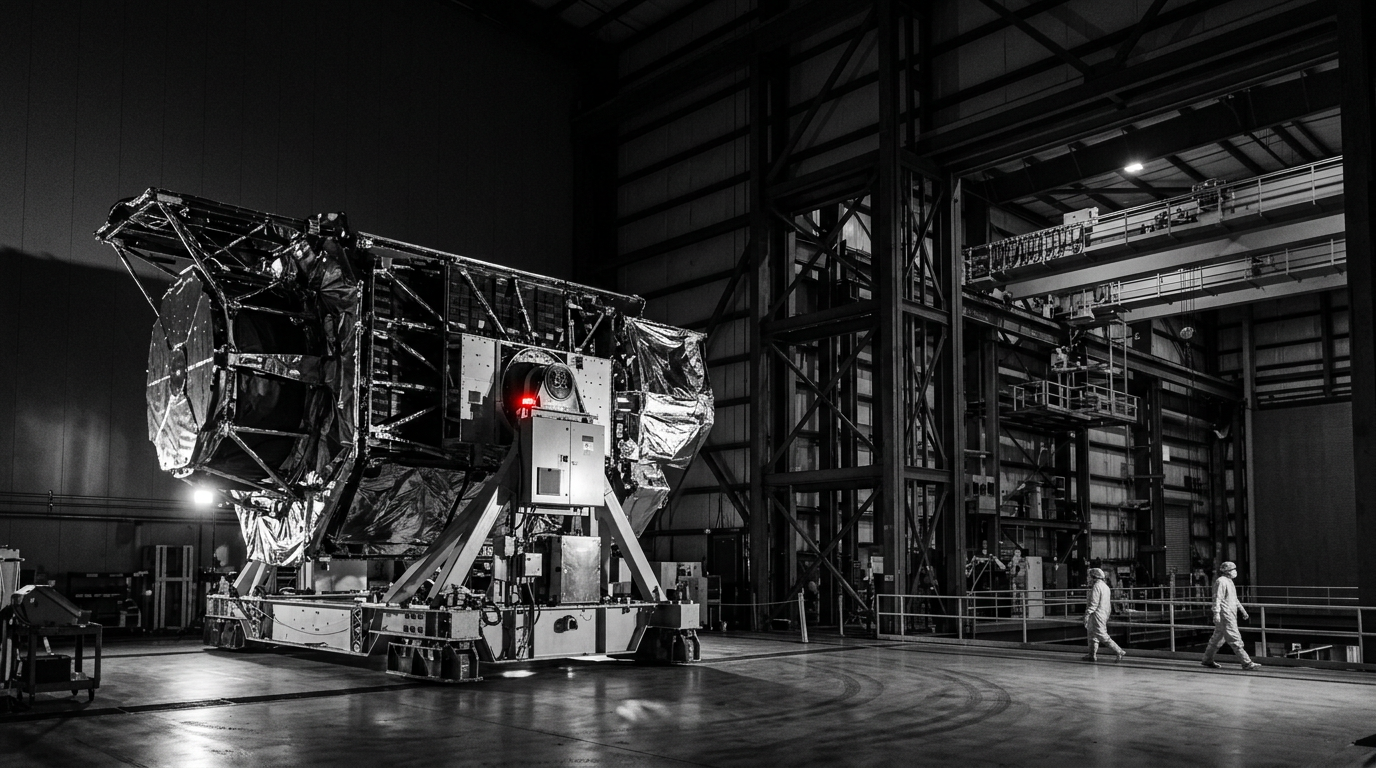
NASA successfully launched the Nancy Grace Roman Space Telescope on August 30, initiating a critical five-year mission. A SpaceX Falcon Heavy rocket propelled the observatory into orbit from Florida's Kennedy Space Center. The telescope's primary mandate involves investigating dark energy and dark matter, which collectively constitute an estimated 95 percent of the universe's total mass-energy content. This ambitious undertaking, with a valuation of $4.3 billion, proceeded both ahead of its initial schedule and within its established financial parameters, according to statements from the space agency.
The telescope's key objectives encompass surveying more than two billion galaxies and conducting a comprehensive statistical enumeration of planetary systems situated beyond our solar system. This initiative represents a significant stride in human observational capabilities, poised to deepen understanding of cosmic evolution and the prevalence of exoplanets throughout the cosmos.
Journey to Lagrange Point and Advanced Optics
Following its successful deployment, the Nancy Grace Roman Space Telescope is now on its trajectory toward Lagrange Point 2 (L2). This gravitationally stable position, located approximately 1.6 million kilometers from Earth, is projected to take over three months for the telescope to reach. Once positioned at L2, the observatory, which is roughly the size of a bus, will operate in conjunction with the James Webb Space Telescope, collectively enhancing deep-space observation efforts.
A distinguishing feature of the Roman Telescope is its wide-angle lens, offering a field of view 100 times larger than that of the venerable Hubble Space Telescope. This advanced optical design allows it to capture extensive regions of the universe within a single observation. Such an unprecedented scope facilitates comprehensive cosmic surveys, which is crucial for efficiently mapping large-scale structures and identifying numerous exoplanet candidates across vast swathes of space.
Unlocking Cosmic Secrets and Potential Lifespan
Astronomers anticipate that the mission will generate vital data essential for quantifying the distribution of dark energy and dark matter. A clearer comprehension of these enigmatic components is fundamental to understanding the universe's ultimate destiny and its evolutionary trajectory. In addition to its cosmological investigations, the telescope is also tasked with actively searching for thousands of exoplanets utilizing its sophisticated instruments.
While the initial mission duration is set for five years, the agency has indicated that the telescope incorporates engineering provisions for potential robotic refueling. This innovative design choice could substantially extend its operational lifespan, potentially allowing observations to continue for a decade or more beyond its initial mission parameters. Such an extension would offer sustained contributions to the fields of astrophysics and planetary science, building upon decades of prior research and observations by missions like Kepler and TESS, while complementing the detailed imaging capabilities of Hubble and Webb.
Expanding Observational Frontiers
The Roman Space Telescope signifies a major advancement in space-based observation technology. Its expansive field of view complements the high-resolution imaging provided by other observatories, including the Hubble and Webb telescopes. This multi-faceted approach aims to construct a more complete and detailed understanding of cosmic structures and the frequency of planetary systems across the galaxy.
The data collected on exoplanets will be invaluable for advancing knowledge of planetary formation processes and identifying conditions necessary for the emergence of life. Concurrently, the detailed mapping of dark energy and dark matter will rigorously test current cosmological models, potentially leading to breakthroughs in fundamental physics. This mission underscores a continuous global commitment to pushing the boundaries of scientific understanding and exploring the fundamental nature of the cosmos, representing a significant investment in future scientific discovery.