King Charles Just Politely Roasted Trump's Foreign Policy in Front of Congress
King Charles III addressed Congress, urging lawmakers to reject an "inward-looking" turn and recommit to NATO, Ukraine, and democratic checks and balances.
Lauren Collins ·
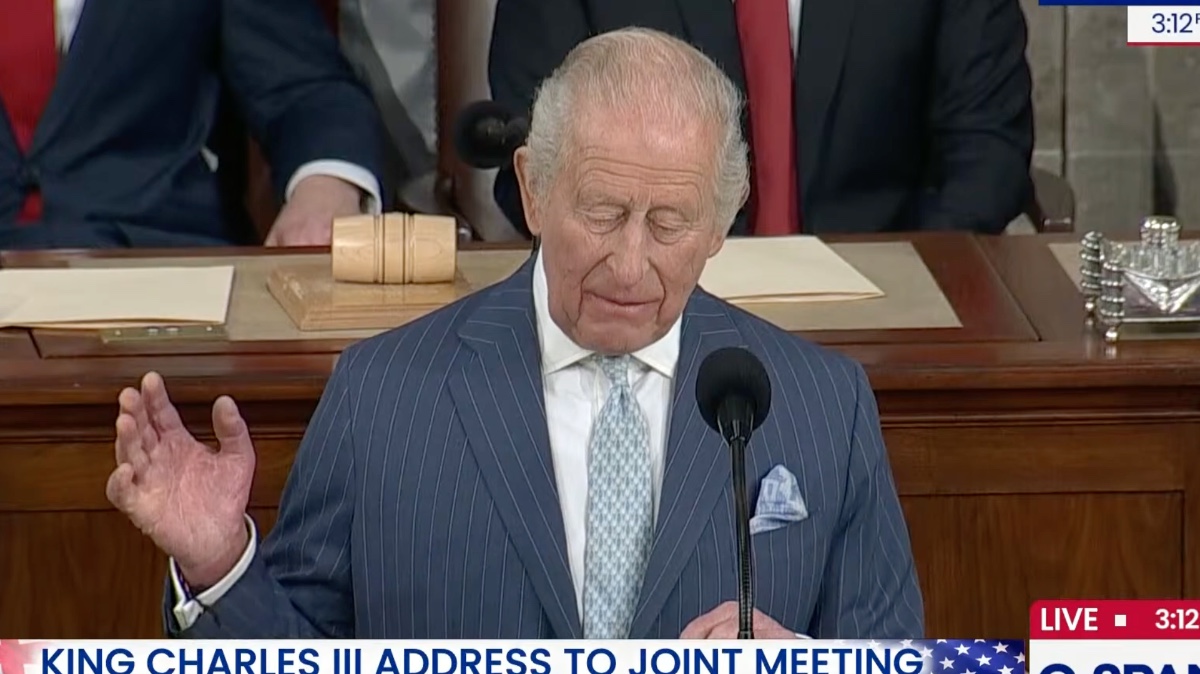
King Charles III delivered a veiled but pointed rebuke of President Trump's foreign policy from the floor of Congress on Tuesday, using only the second-ever royal address to American lawmakers to argue against an "inward-looking" United States. Speaking in the House chamber under Vice President JD Vance and Speaker Mike Johnson, the British monarch said he prayed the alliance would keep defending shared values "with our partners in Europe and the Commonwealth, and across the world." The speech, timed to the 250th anniversary of US independence, was largely written by Charles himself.
The lines aimed squarely at the White House
Each major theme tracked an active dispute with the Trump administration. The king pressed the case for continued support of Ukraine, defended NATO as a "consequential alliance," warned about "disastrously melting ice-caps" in the Arctic, and stressed checks and balances and the rule of law — bringing lawmakers to their feet. He also quoted Prime Minister Keir Starmer, calling the partnership "indispensable," weeks after Trump publicly mocked Starmer for declining to join US strikes on Iran.
Why Buckingham Palace bet on Capitol Hill
The choice to speak directly to Congress rather than rely on a White House readout reflects how London now reads Washington. Britain views Charles as a rare conduit to a royal-loving president, but it also sees a Republican-led Congress and a divided Democratic minority as a more durable audience for arguments about NATO, Ukraine and trans-Atlantic defense than the Oval Office. His mother, Queen Elizabeth II, last addressed lawmakers more than 35 years ago, which underscores how unusual the venue is and how deliberately it was chosen.
A fragile alliance and an irritated president
For Starmer's government, the immediate stake is preventing further US drift away from European security commitments. Trump has criticized the prime minister over his initial refusal to allow American use of British bases for the Iran operation and has called the United Kingdom an ally that "should be our best." London's strategy has been to absorb the public friction while using royal diplomacy — a four-day state visit, a 21-gun salute, an address to Congress — to reset the mood music without directly confronting the White House.
Defense industry and energy markets are watching
The implications run beyond protocol. A US tilt toward isolationism would reshape European defense procurement, NATO burden-sharing debates, and the financing of Ukraine's war effort, all of which European capitals have spent the past two years recalibrating around uncertain American commitments. Energy markets are already absorbing the consequences of the Iran war, with a jet fuel shortage warned for the coming summer in Europe and broader supply pressure tied to the Strait of Hormuz. A weaker US-UK axis would make coordinated responses to those shocks harder.
The democratic-values subtext
Charles's invocation of the Magna Carta, the Bill of Rights and "checks and balances" landed in a Washington still processing an attempted assassination of Trump at Saturday's White House Correspondents' Dinner and a White House that has tested institutional limits on multiple fronts. By framing the rule of law as the through line that distinguishes the US and UK from "countries sliding toward authoritarianism," the king offered a benchmark that members of both parties could applaud while leaving the comparison to drift wherever listeners wanted to take it. The standing ovation suggested many took it somewhere specific.
The limits of royal soft power
Whether the speech changes any policy is a separate question. Trump skipped the address, said warm things about the royal family at the morning ceremony, and has shown little pattern of being moved by foreign appeals once a position hardens — and his rejection this week of Iran's three-step proposal to reopen the Strait of Hormuz suggests he is in a tightening, not loosening, posture. The next test is whether Charles's words give Starmer political cover to push back more openly, or whether the visit ends as a well-staged pause in a slow drift apart.