Artemis II Crew Splashes Down After Historic Lunar Flyby
Artemis II ended Friday night with Orion splashing down near San Diego, returning four astronauts after a 10-day lunar flyby.
Jason Kwon ·
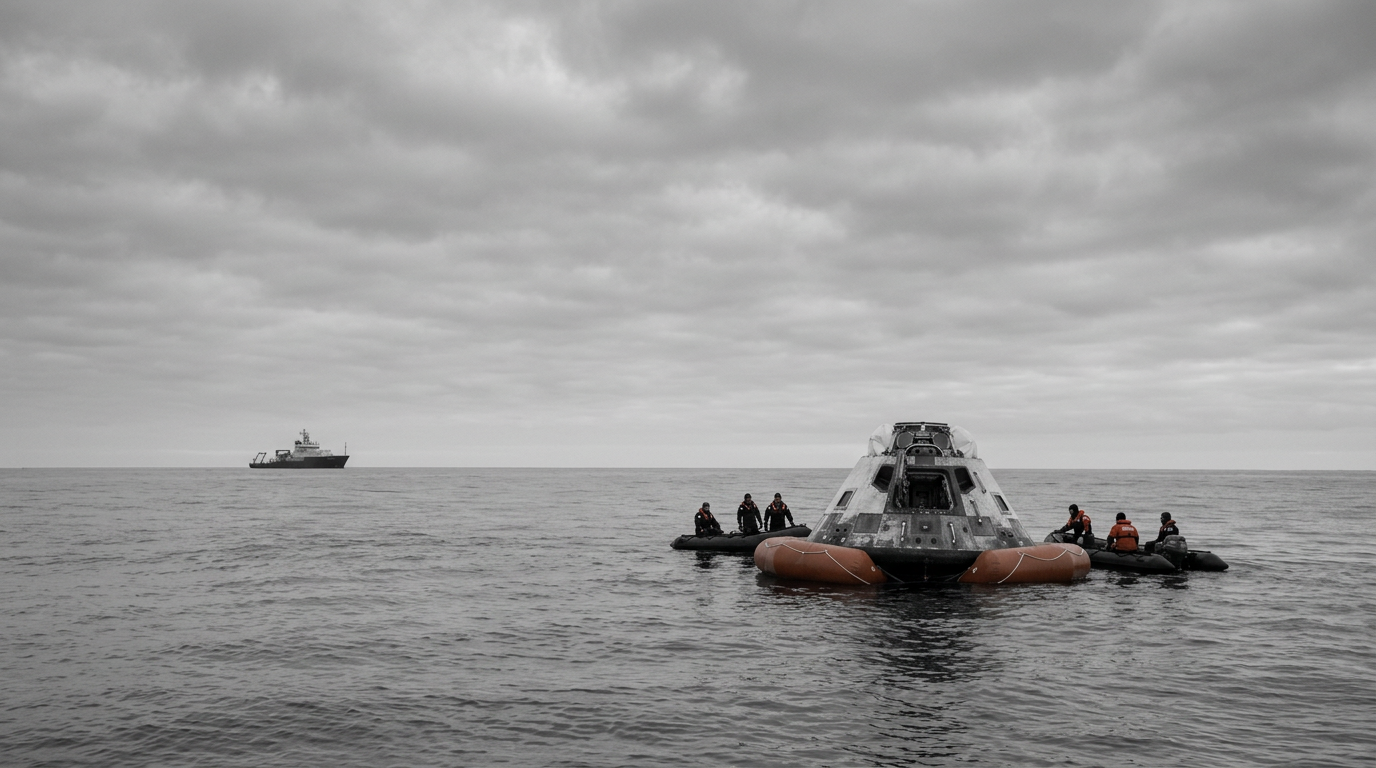
Artemis II ended successfully on Friday night as NASA’s Orion spacecraft returned to Earth with a four-person crew, splashing down in the Pacific Ocean off the coast of San Diego. Officials said recovery teams from the USS John P. Murtha brought the capsule and astronauts safely out of the water, and all four crew members were reported to be in good health.
The mission marked the first time humans have returned safely from a lunar flyby since 1972, according to NASA officials. The flight lasted 10 days and covered 694,481 miles (1,117,659 km), completing a full cislunar journey and return. Officials described the outcome as a major operational milestone for the Artemis program.
The crew included NASA astronauts Commander Reid Wiseman, Pilot Victor Glover, and Mission Specialist Christina Koch, alongside Canadian Space Agency astronaut Jeremy Hansen. NASA officials said the mission set a new distance benchmark for human spaceflight, with the crew reaching 252,756 miles from Earth. The agency characterized the flight as a record-breaking voyage that pushed human operations farther from Earth than any humans before.
NASA officials said Artemis II is intended as a foundational step toward the broader Artemis program’s next phases. The agency’s stated goal is a crewed lunar landing by 2028, and officials framed the successful completion of Artemis II as evidence of renewed capability to transport humans to and from cislunar space. They also said the mission supports longer-term plans for future lunar exploration and the establishment of a sustained human presence on the Moon.
Beyond the immediate recovery, the mission’s completion provides a high-visibility demonstration of end-to-end crewed operations: launch, deep-space travel, lunar flyby, re-entry, splashdown, and retrieval at sea. Officials did not detail any anomalies in the material provided, leaving open what additional technical findings may emerge from post-mission inspections of Orion and its systems.
NASA’s next steps, including how mission data will be incorporated into upcoming Artemis planning, were not specified in the announcement.
Internationally, the inclusion of a Canadian Space Agency astronaut underscores the multinational character of the Artemis effort as described by officials. With Artemis II now completed, attention will remain on how NASA sequences subsequent missions to meet its 2028 crewed lunar landing objective, and what further updates the agency provides as it reviews performance data from the 10-day flight.
Implications
Country Impact: For the United States, NASA officials said Artemis II demonstrates renewed capability to carry humans to and from cislunar space, supporting the agency’s stated goal of a crewed lunar landing by 2028. For Canada, the participation of Canadian Space Agency astronaut Jeremy Hansen highlights an active role in the mission’s crewed operations.
Industry Impact: For the space sector, officials framed Artemis II as a foundational step for future lunar exploration and a sustained human presence on the Moon. The mission’s completion also reinforces the operational credibility of crewed deep-space transport and recovery systems described by NASA.
Market Impact: For global markets, the successful end-to-end execution of a crewed cislunar mission can influence how investors and stakeholders assess momentum in government-led space programs and related supply chains. The multinational element, including Canada’s participation, also signals continued international engagement around lunar exploration efforts described by officials.