Iran's Enduring Missile Strategy Amid Regional Tensions
Iran's missile capabilities, though seemingly inexhaustible, are being deployed strategically, shifting from high-volume attacks to fewer, more precise…
Cuneyd Erdogan ·
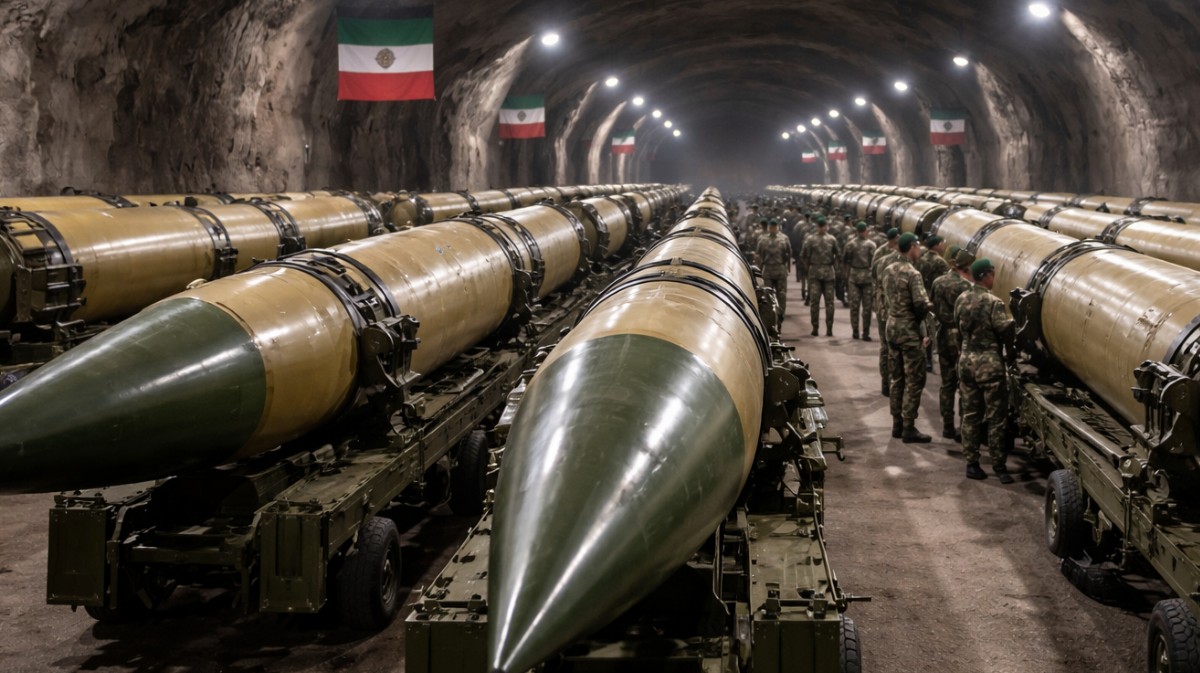
Iran's Missile Doctrine and Infrastructure
Recent conflicts in the Middle East have highlighted Iran's missile capabilities, with projectiles targeting various regional locations. While the intensity of these attacks has decreased, they have not ceased entirely, prompting questions about the sustainability of Iran's missile arsenal.
The answer lies not merely in the quantity of missiles but in Iran's long-standing military doctrine, production infrastructure, and strategic approach to warfare. Tehran has cultivated a robust missile program over decades.
Since the early 2000s, Iran has prioritized missile technology development over conventional air power, particularly due to difficulties in acquiring modern aircraft and international sanctions. This strategic shift has resulted in one of the Middle East's most extensive ballistic missile inventories.
This arsenal includes thousands of short, medium, and long-range systems, cruise missiles, and a substantial fleet of unmanned aerial vehicles. Such a capacity is not easily depleted in a short-term conflict; Iran's strategy is centered on long-term deterrence rather than brief engagements.
Underground Facilities and Dispersed Production
A critical advantage for Iran is its largely subterranean missile infrastructure, often referred to as "missile cities." These facilities, carved into mountains, serve as storage and launch sites, enhancing their survivability against attacks.
Furthermore, missile production is decentralized across a modular network, not concentrated in a single location. This dispersed manufacturing capability means that while adversaries like Israel or the United States can inflict damage, completely crippling the system remains exceptionally challenging.
Recent strikes have undoubtedly impacted Iran's capacity, yet the overall system has not collapsed. This resilience is a testament to its distributed and hardened infrastructure.
Shift to Targeted Strikes
Initial phases of recent conflicts saw Iran launching numerous missiles, many of which were intercepted by air defense systems. However, a notable shift has occurred.
Iran now deploys fewer missiles but with greater selectivity, focusing on more precise targeting and calculated timing. This adaptation has reportedly led to an increase in the relative accuracy of its strikes.
This change reflects an effort to overcome sophisticated air defenses rather than overwhelm them, indicating a strategic evolution rather than a sign of weakness.
Sustainable Warfare and Unused Capabilities
Iran's approach emphasizes managing the tempo of conflict. Depleting its entire missile stock rapidly would undermine its deterrent capability within weeks. By extending attacks over time, Iran maintains continuous pressure on its adversaries.
This strategy involves a deliberate shift to a lower-intensity, prolonged engagement model, akin to a war of attrition. It allows Iran to sustain its influence and project power over an extended period.
Notably, some of Iran's most advanced missile systems, including those rumored to be hypersonic, have either not been fully deployed or have seen very limited use. The full extent of these capabilities remains uncertain.
Multi-Layered Threat and Adversary Limitations
Iran's military capacity extends beyond ballistic missiles to include inexpensive, mass-produced drones, cruise missiles, and regional proxy forces such as Hezbollah and the Houthis. This multi-layered approach ensures that even if missile stockpiles diminish, Iran's overall offensive capabilities persist.
It is also crucial to acknowledge that defensive resources are not limitless. Air defense systems used by Israel and the United States are extremely costly, with interceptor missiles valued at millions of dollars each. In a prolonged conflict, these systems face significant financial and logistical strain.
Therefore, the conflict represents a mutual test of endurance, not a one-sided depletion. Iran's missile capacity, while impacted, is being managed strategically. The country has transitioned from high-volume attacks to more selective and strategic engagements, indicating that the conflict is unlikely to conclude in the short term.