India semiconductor market set for $200 billion by 2035
An EY-IESA report projects India’s chip market will top $200 billion by 2035 as AI, data centers and electronics demand expand.
Mei Lin ·
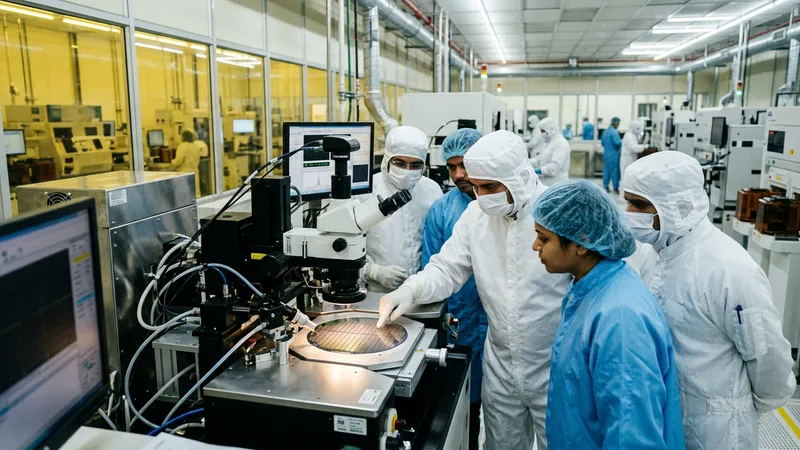
India semiconductor market demand is projected to reach $200 billion by 2035, up from nearly $64 billion in 2026, an EY-IESA report said.
The forecast points to a more than threefold expansion over nine years, with the report attributing the increase to artificial intelligence, data centers, telecommunications, electric mobility and advanced manufacturing. The policy question is whether India can turn that demand into domestic production, rather than a larger import bill.
AI demand changes the mix
Consumer electronics now accounts for 30% of India’s semiconductor market, according to the report titled “Semicon India 2.0: From capacity creation to ecosystem leadership.” Automotive applications represent 16%, while industrial uses account for 15%, giving India a demand base beyond smartphones and household devices.
The report said AI and data centers are opening new chip demand channels that require stronger digital infrastructure and more specialized manufacturing capacity. That shift matters because chips used in computing, power management and connectivity sit across several sectors rather than one consumer cycle.
India’s semiconductor imports rose from $5.7 billion in FY17 to $30.3 billion in FY25, a more than fivefold increase at a compound annual growth rate of 23%, the report said. India also contributes nearly 20% of the world’s chip design engineers, giving the country a talent base that policy makers and companies are trying to connect with fabrication and packaging capacity.
Local fabs test execution
Ashok Chandak, president of the India Electronics and Semiconductor Association, said India can combine engineering talent, domestic electronics demand and new manufacturing capacity with global supply-chain partnerships. “India has moved beyond semiconductor ambition,” Chandak said, describing execution, indigenous intellectual property and specialized talent as the next tests.
Aisha Ali Hussaini, partner and semiconductor tax leader at EY India, pointed to the electronics base that could feed chip demand. Electronics production increased from INR1.9 lakh crore in FY15 to INR11.3 lakh crore in FY25, while electronics manufacturing and exports grew sevenfold and elevenfold, respectively, over the same period, she said.
The report said the next stage should align state semiconductor policies with the wider Semicon 2.0 framework, build manufacturing clusters with shared infrastructure and create talent-certification programs across design, fabrication and advanced packaging. It identified advanced packaging, compound semiconductors, photonics and chip-to-system integration as higher-value areas where India’s design strengths could translate into production roles.
Two Gujarat projects show the scale of the manufacturing push. Tata Electronics and Taiwan’s Powerchip Semiconductor Manufacturing Corporation are building a roughly $11 billion fabrication plant in Dholera that is expected to be commissioned in 2028, while Micron Technology’s $2.75 billion assembly and test facility in Sanand began commercial production in 2026.
Singapore suppliers enter India
Singapore-based suppliers are also moving into India’s semiconductor buildout. A record 27 Singapore companies exhibited at the Singapore Pavilion at the 2026 summit, up from 10 in 2024, alongside ministerial roundtables and industry delegation visits.
Singaporean companies have secured more than $180 million in semiconductor contracts in India since 2024 and invested more than $20 million, hiring over 300 employees to support government-backed projects. Tan Soon Kim, deputy managing director of Enterprise Singapore, said the sector is “poised to take off in India.”
Industrial Vision Technology and Chasen Holdings Limited are among the Singaporean firms already present, supplying factory automation and high-tech equipment relocation services. Specmax Techno, a Singapore-based engineering company focused on high-purity piping installations, expanded from about 100 million rupees of India business in 2024 to more than 1 billion rupees.
Material availability remains a constraint for some suppliers. Dr. M. Gopinath, Specmax Techno’s Chennai-based operation manager, said the firm relies on imported equipment such as gas valves from Taiwan, with waits that can reach 18 weeks and delay project schedules.
If India keeps demand growth, policy coordination and project execution on track, the global effect would be another large Asian production node, while Tata Electronics, Micron and suppliers could deepen local value addition. If infrastructure, fiscal predictability or materials access lag instead, India’s chip demand could still rise, but the industry would remain more dependent on imports and foreign bottlenecks.
Over the coming years, India's aggressive push to build a domestic semiconductor ecosystem is likely to accelerate regional supply chain realignments as specialized equipment suppliers and foreign partners establish a permanent operational footprint across key industrial corridors. This structural shift could enhance the nation's economic security and elevate its standing in global technology governance, transforming it from a pure consumer market into a strategic supply chain node.
Nevertheless, critical risks remain, including long lead times for imported high-purity inputs, potential infrastructure shortfalls, and the challenge of harmonizing federal and state incentive frameworks. Should these operational hurdles be overcome, the convergence of vast engineering talent and domestic demand could unlock substantial opportunities in high-value segments like compound semiconductors and advanced packaging.
Much like earlier supply chain expansions across Southeast Asia, establishing deep local supplier networks and indigenizing intellectual property will be essential to sustain long-term competitiveness. Consequently, the long-term outlook hinges on whether current project execution can match policy momentum to prevent widening trade deficits and foster true ecosystem self-reliance.