Cheating Scandal Rocks Beijing Half-Marathon
Robots beat humans in Beijing’s Sunday half-marathon as a humanoid finished in 50:26, faster than the 57:31 human world record.
Jason Kwon ·
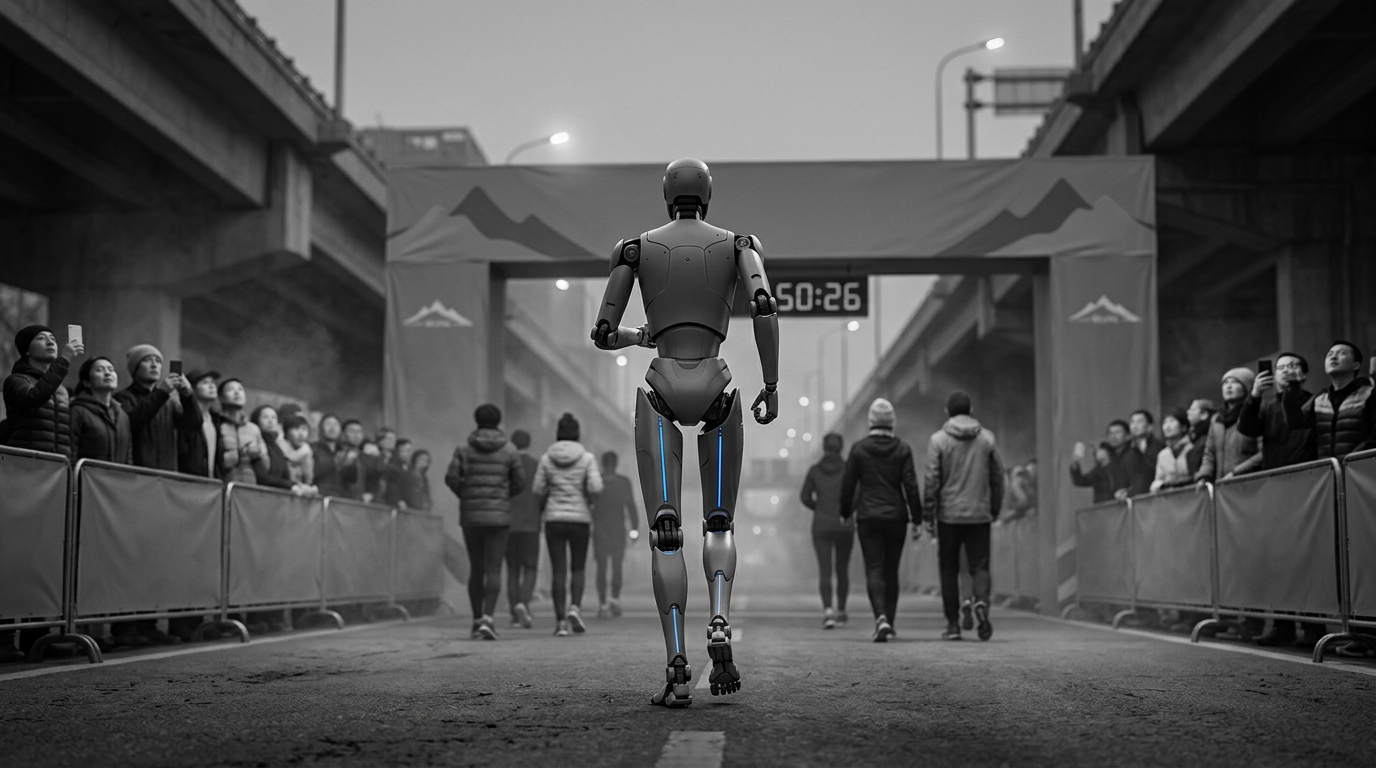
Beijing hosted a half-marathon on Sunday where humanoid robots posted times that surpassed elite human benchmarks. Organisers staged the event as the second Beijing E-Town half marathon and humanoid half marathon, with robots running on parallel tracks to reduce the risk of collisions with human participants.
The fastest robot finished in 50 minutes and 26 seconds. That result was quicker than the current human world record for the half-marathon, which stands at 57 minutes and 31 seconds and is held by Jacob Kiplimo. Officials presented the outcome as a visible sign of rapid progress in humanoid mobility and endurance.
More than 100 robots took part this year, a sharp increase from 20 in the inaugural race last year. The earlier edition saw many robots fail to complete the course, while this year’s field delivered a broader set of finishers, highlighting improvements in reliability as well as speed. The parallel-track format also signalled an effort to scale participation while keeping the event manageable and safe.
The winning robot was developed by Chinese smartphone manufacturer Honor. Despite the leading time, the robot required assistance after a minor incident near the finish line, underscoring that performance gains are still accompanied by operational constraints. Even so, the overall showing was framed as a step forward in physical capability for humanoid systems in a public, measurable setting.
What it means: The race served as a high-profile demonstration aligned with China’s stated push to build a globally competitive humanoid robotics industry. The country is pursuing leadership in the sector through policies that include subsidies and infrastructure projects designed to support local firms. The event’s scale-up—from 20 robots to over 100—also reflected growing institutional and corporate interest in testing robots outside laboratory conditions.
Organisers and participants pointed to potential downstream uses for humanoid robots, including deployment in hazardous work environments and in military operations. These applications were presented as consistent with China’s broader manufacturing and technology ambitions.
At the same time, the need for assistance after an incident near the finish line highlighted an uncertainty for real-world deployment: performance in controlled demonstrations does not eliminate the practical challenges of stability, safety, and continuity under stress.
Internationally, the demonstration adds to intensifying competition around advanced robotics, with implications for industrial strategy, supply chains, and standards-setting. The Beijing event offered a clear datapoint—measured against a known human record—while leaving open questions about how quickly such systems can translate from staged races to sustained, high-stakes operational roles.