Hull City Stun Manchester United 2-0 in Premier League Opener
Hull scored twice before halftime and then showed why possession statistics can mean little against a compact, disciplined defensive side.
Mehmet Şahinoğlu ·
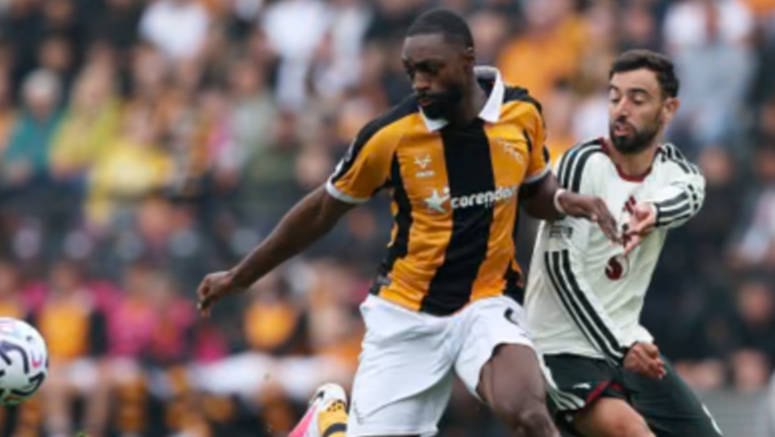
Ajayi and Mendy strike early
Hull City could hardly have designed a more convincing way to announce their Premier League return, beating Manchester United 2-0 at the MKM Stadium through first-half goals from defenders Semi Ajayi and Nobel Mendy. Ajayi struck in the 17th minute before Mendy, making his league debut for Hull, added the second in the 38th, with both goals developing from dead-ball situations that United failed to control. The victory was Hull’s first league success against United since November 1974 and came in their first top-flight match for nine years, turning a fixture widely expected to test the promoted club’s survival credentials into an immediate statement of tactical competence. United had much more possession and spent long periods in Hull territory, but the important contest was not over who circulated the ball most often; Hull won the moments that decided the match and protected the resulting advantage without losing their shape.
United’s possession hit a wall
The central tactical problem for United was that control of the ball rarely became control of Hull’s penalty area. Hull defended in a shape that often resembled a 5-4-1, narrowing the spaces around Bruno Fernandes and forcing United toward the wings, where crosses and recycled possession became increasingly predictable; during the first half, one recurring United route involved Harry Maguire initiating attacks before moves ended on Patrick Dorgu’s side rather than through Fernandes in the most dangerous central areas. Matheus Cunha frequently dropped away from the highest attacking position, while Bryan Mbeumo moved across the frontline, but neither adjustment consistently dragged Hull’s centre-backs far enough out of position to create gaps behind them. Marcus Rashford replaced Dorgu after halftime and Benjamin Sesko and Kobbie Mainoo later entered as Carrick searched for a different route, yet Hull goalkeeper Konstantinos Tzolakis remained protected by a defence that blocked shots, attacked crosses and prevented United’s pressure from becoming sustained high-quality chances.
Sixth place became promotion
Hull’s victory makes more sense when placed against the unusual path that brought Sergej Jakirovic’s team into the Premier League. The Tigers finished sixth in the 2025-26 Championship and reached Wembley after eliminating Millwall, then secured promotion when Oli McBurnie scored in the fifth minute of stoppage time to beat Middlesbrough 1-0 in the playoff final; Premier League analysis later noted that Hull’s underlying expected-goal numbers had painted the picture of a team much weaker than its eventual league position suggested. Their goal difference was only plus four, while an expected-goal model cited by the league produced an expected differential of minus 19.5, evidence that Hull repeatedly survived matches without controlling them in conventional statistical terms. That background matters because Saturday’s formula was familiar: Hull did not need prolonged possession to dictate where the decisive contests occurred, and the club again showed an ability to keep games inside a narrow margin until efficiency, physical strength or one isolated moment could swing the result.
McBurnie made Hull’s plan work
Oli McBurnie did not score against United, but his performance gave Hull a reference point that allowed the entire defensive strategy to function. Instead of trying to play through United every time possession changed hands, Hull could send the ball toward McBurnie, compete for the first contact and push midfielders such as Regan Slater and Matt Crooks toward the second ball, reducing the danger of becoming trapped permanently around their own box. That direct route also forced Maguire, Ayden Heaven and United’s midfielders into physical duels rather than allowing Carrick’s side to establish a comfortable rhythm, and observers at the match repeatedly highlighted Hull’s greater aggression when loose balls appeared. For a promoted club likely to spend substantial stretches of the season without possession, that offers a realistic survival model: defend narrow spaces, create territory quickly, make set plays valuable and ensure the centre-forward contributes even on afternoons when goals must come from defenders.
Carrick’s midfield lacked an outlet
The defeat also interrupted the optimism surrounding Carrick after United’s strong finish to last season and its summer midfield changes. Carrick initially took over in January 2026, won 11 of his 16 Premier League matches, lifted United from seventh to third and secured Champions League qualification before receiving a two-year permanent contract; the club then added Youri Tielemans and Andrey Santos as part of an effort to reshape the centre of the team. Both started at Hull, but the problem was less an inability to complete passes than an inability to use those passes to destabilise a settled defensive block, particularly when Fernandes was denied easy access to the spaces between Hull’s midfield and defence. United’s recruitment may ultimately give Carrick more control and technical security, but this match illustrated the distinction between owning the ball and manipulating an opponent: without sharper movement ahead of midfield, faster combinations around the box and stronger occupation of central scoring areas, possession can become precisely what Hull wanted — circulation in front of an organised defence.
£78 million meets Premier League reality
Hull’s result also challenges, at least for one weekend, the assumption that promotion through sixth place must lead directly to Premier League distress. The club entered the summer with genuine structural concerns: it had conceded 66 league goals during the promotion campaign, operated under financial restrictions, and was ranked by several preseason observers among the strongest relegation candidates, yet owner Acun Ilicali backed the squad with a major recruitment drive that reportedly reached about £78 million and included 11 arrivals. Mendy was one of those additions, while Tzolakis also began his Hull league career against United, giving Jakirovic new personnel in exactly the areas where the Championship numbers suggested improvement was essential. One victory cannot erase the financial and sporting gap facing promoted clubs, but Hull have already shown that the gap does not have to be confronted by trying to imitate richer opponents; organisation, aerial power and repeatable set-piece routines can turn limited possession into points, particularly at home.
Set pieces become United’s warning
The strongest warning for United is not simply that they lost to a promoted club, but that Hull found a repeatable route to hurting them twice before halftime. Defensive set pieces depend on assignments, communication, first contact and reactions to the second phase, so conceding two in 38 minutes suggests a problem that opponents will test again until Carrick’s team demonstrates otherwise; at the opposite end, United also failed to extract enough value from their own corners and wide free kicks despite having players such as Maguire, Cunha and Mbeumo available in the box. Hull face a different uncertainty: their Championship campaign contained warning signs that cannot be dismissed after one excellent afternoon, and deeper Premier League attacks will eventually test whether Tzolakis and the rebuilt defence can survive weeks when set pieces do not produce goals. The opening weekend therefore offers evidence rather than a final conclusion — Hull have identified a style capable of making them competitive, while United have been reminded that a Champions League-calibre squad must solve compact opponents as convincingly as it handles teams willing to leave space behind them.