From Niels Bohr to American Capital: A 137-Year-Old Danish Club Bets on the World
Akademisk Boldklub, once home to a Nobel laureate in goal, won promotion in 2026 under an ownership group of roughly 105 Americans.
Liam Walsh ·
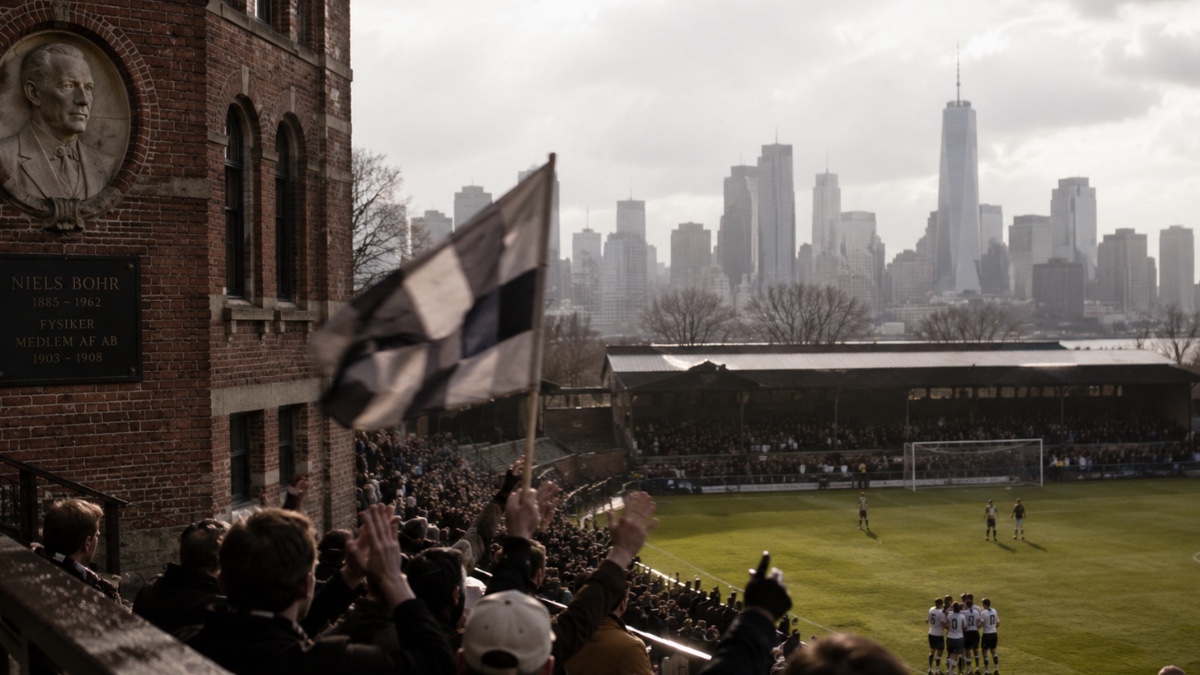
On Friday afternoons, in a wood-paneled bar in Williamsburg called Mug’s Ale House, a stuffed red deer wears a green cap while a few dozen New Yorkers, among them shopkeepers, lawyers, dentists and consultants, crowd around flat-screens to watch third-tier Danish football beamed in, sometimes shakily, over a VPN from a single camera on the far side of the Atlantic. “Come on, everyone!” one of them shouts. They are not tourists or expatriates. They are the owners.
The club on the screen is Akademisk Boldklub, or AB, founded in 1889 by university students outside Copenhagen and one of the most decorated names in Danish football history. In May 2026 it won promotion out of Denmark’s third tier, and in June it clinched the 2. Division championship, returning to the country’s second tier for the first time since a 2017 relegation. For its American backers, thousands of miles away, it was the first tangible return on a bet placed in late 2022: that international capital and a globally dispersed fan community could revive a fading institution without severing it from Gladsaxe, the leafy suburb it calls home.
A club with a Nobel laureate in goal
AB was formed on Feb. 26, 1889, from the merger of a students’ cricket club and the football side of Copenhagen’s polytechnic institute, and it won the Danish football association’s first championship in 1889-90. It went on to win nine Danish titles, the last in 1967, a total that still ranks among the most in the country.
Its most famous player never became famous for football. Niels Bohr, who would win the 1922 Nobel Prize in Physics, kept goal for AB, playing for the first team in the 1905 season. His younger brother Harald, a defender and midfielder who made his debut at 16 in 1903, was the better footballer: he won a silver medal with Denmark at the 1908 Olympics in London, the first time football was an official event. Harald went on to found the mathematical field of almost periodic functions, and legend holds that more football fans than mathematicians turned up to his doctoral defense.
Niels, by contrast, was a distracted keeper. In one match against a German side he failed to react to a long shot; he later admitted he had been working through a math problem.
“If I were to make a football movie, it would be about Akademisk Boldklub. It would be about Niels Bohr, who is too busy solving mathematical puzzles to save the ball when it comes flying towards the goal.”
SIMON YOUNG · INVESTOR, FIVE CASTLES FOOTBALL GROUP
The club drew crowds of more than 40,000 at the old Copenhagen Idrætspark in the 1940s and 1950s. It moved to Gladsaxe Stadion in the mid-1960s, had a late revival around the turn of the millennium, with eight Superliga seasons and a Danish Cup win in 1999, and last played in the top flight in 2004. After the 2017 relegation it settled into the third tier, where it stayed until this season.
An American consortium, assembled in a coffee shop
The takeover began, improbably, with a conversation in a New York coffee shop as the pandemic wound down. Jen Chang, a former Sports Illustrated editor and Liverpool FC communications director, asked Simon Young, a tech entrepreneur, what he thought about buying a European club. “I said he must be out of his mind,” Young recalled to the Danish weekly Weekendavisen. “What on earth would it cost?”
The answer, it turned out, was manageable, provided enough people chipped in. Rather than a handful of multimillionaires, Chang assembled a long list of smaller investors willing to put in five-figure sums. “I was shocked by the level of interest,” Young said. “As soon as I heard how many others were interested in jumping on board, I was ready too.” In November 2022, a group of roughly 105 investors, organized as Five Castles Football Group LLC, acquired the majority of AB. Young estimated the price at about 10 million Danish kroner, roughly $1.5 million, plus debt and other obligations, with a comparable sum invested again into operations. In the first year alone, the owners put about 32 million kroner into the club.
The consortium is unusual for its breadth. “We’d rather have ten investors with $10,000 each than one investor with $100,000,” said Joe Gordon, a sales consultant who sits on the board and organizes the Brooklyn gatherings. The named owners include the football writer Ben Lyttleton, Andy Glockner, Alex Lee and Tina Carr, the group’s only investor with Danish roots. A minority stake of 25 percent was later sold to Green Owls Football Holdings, a vehicle created by the tech entrepreneur Zachary Smith.
The chairman is Brian Grieco, a New York lawyer who has become the public face of the project and who makes frequent trips to Denmark. “It’s a club with a fantastic history, and that’s one reason I’m incredibly passionate about this project,” Grieco told the Danish outlet Tipsbladet. He has laid out a timeline: the second tier within three years, and eventually a return to the Superliga. “We can only become a Superliga club when everything we can offer is at Superliga standard,” he said. “I’m talking about the infrastructure, the fan experience and what we can offer sponsors.”
“We are not passive investors, we are not looking to flip the club, and we are definitely not private equity, in any way.”
BRIAN GRIECO · CHAIRMAN, AKADEMISK BOLDKLUB
The owners are adamant they are not the kind of financial buyers that have burned Danish clubs before. And unlike the owners of Brøndby, FC Midtjylland and others, they insist AB will not be one club in a multi-club portfolio. “This is a long-term investment plan exclusively in AB A/S,” said Erik Stover, the former New York Red Bulls executive who led the group’s early operations.
Winning trust in Gladsaxe
Foreign ownership is a fraught subject in Danish football. Clubs including Fremad Amager, Esbjerg, Sønderjyske, Helsingør and Jammerbugt have all cycled through foreign owners in recent years, several ending in chaos or near-bankruptcy; Fremad Amager was hours from insolvency after an American investor group. The Divisionsforeningen, the league body, has tightened its rules on foreign owners, demanding transparency of money flows.
AB’s owners say they studied those failures. “It’s an important lesson to learn as an American: to look at what went wrong in the past, and then avoid making the same mistakes,” Grieco said. Early skepticism was blunt; on one Instagram post, a commenter wrote, “Go to hell, useless owners.” Others were more measured: “Trust is not a given. A historic club like AB has a loyal following, a local base, and a lot of emotion around the club. It has nothing to do with playing Football Manager.”
Three years on, the mood has shifted. “It has taken time to gain the trust of the locals, and rightly so,” said Jon Diamond, an investor. “Over the last three years we have tried to live up to our word and get deeply involved.” The parent members’ association, which still runs AB’s broader amateur sports under the green-and-white owl crest, describes the relationship as constructive. “We experience a strong and respectful collaboration with AB A/S and the American ownership group,” said Ulrik Rasch, a senior figure in the parent club. “It makes a big difference that they don’t just come with investments, but also with the will to listen, learn and take part.”
Not everything has been smooth. The owners fired the long-serving coach Patrick Birch Braune early in their tenure despite a strong autumn, drawing fan protests, and some supporters have questioned the club’s spending and direction. The politics of the transatlantic relationship intrude, too, as a Danish consumer boycott of American goods gathered pace in 2025. Grieco said he does not feel judged for his government: “People talk to me about things and tell me what they think, but I am, thank God, not considered part of that system.”
The season: a champion built through the winter
On the pitch, 2025-26 was a demolition. AB won the 12-team CampoBet 2. Division’s promotion group and the championship. After 31 games the club sat first on 68 points, with 22 wins, two draws and seven defeats, a plus-44 goal difference, 78 goals scored and 34 conceded, well clear of runners-up Vendsyssel on 60. Promotion was mathematically secured with four matches to spare. A closing 3-0 win over Thisted brought the full-season record to roughly 23-2-7 and about 71 points.
The clincher came, oddly, in defeat. On May 13, 2026, AB lost 2-1 at home to FC Roskilde in front of 1,544 spectators, but a Hellerup win over Næstved the same evening put AB out of reach of third place. “We’re going up because we have the points we need,” said the head coach, Fannar Berg Gunnolfsson, an Icelander. The captain, Marc Dal Hende, called it a bittersweet night: “It’s really disappointing that we didn’t win today in front of all the fans who showed up. I think a lot of the team got goosebumps when we ran onto the pitch with that fantastic support.” The title was formally sealed on June 6 with a 3-0 win over Thisted on a “Celebration Day” at Gladsaxe Stadion.
The turning point was the winter transfer window. In January, AB signed Milan Silva Rasmussen, the division’s standout attacker, from Sweden’s Helsingborg; he had already scored 11 goals in the autumn on loan at Hellerup. He finished level as AB’s top scorer with Jonathan Mathys on 11 league goals apiece, with the winger O’Vonte Mullings adding six. The squad blended a Danish core with international talent, including the Icelandic goalkeeper Adam Ingi Benediktsson and midfielder Ægir Jarl Jonasson. In one late-season stretch the team won five straight by a combined 17-2. Recruitment has continued at the higher level; over the summer AB signed Saliou Diop from France’s Stade Brestois.
Why Denmark, and why the third tier
AB is a small piece of a very large trend. American money has surged into European football since the pandemic. UEFA’s most recent European Club Finance and Investment Landscape report found top-division revenues set to surpass 30 billion euros in 2025, after a record 28.6 billion in 2024, and recorded an all-time high of 123 club investment transactions in 2025 across men’s and women’s football. Of the 29 controlling stakes sold in 2025, North American investors accounted for roughly one third of all top-flight takeovers, and 122 European clubs now sit within multi-club ownership networks, about 50 of those groups based in the United States. In England, 13 of the 20 Premier League clubs had at least a minority American shareholder in 2025-26, according to Sky Sports.
The logic is straightforward, Maguire argues: closed American leagues price out all but billionaires, an NFL franchise now costs several billion dollars, and European football is the affordable alternative. As valuations at the top have soared, investors have moved down-market. Ryan Reynolds’s Wrexham is the template, and Grieco is unabashed about the comparison.
“Wrexham didn’t even have what we have in AB. They had Ryan Reynolds, but Gladsaxe is beautiful, and Copenhagen is beautiful.”
BRIAN GRIECO · CHAIRMAN, AKADEMISK BOLDKLUB, TO WEEKENDAVISEN
Denmark is attractive for specific reasons: an open, lightly regulated ownership market, English widely spoken, EU access, and a proven player-development-and-trading model exemplified by FC Nordsjælland and FC Midtjylland. The financial ladder is steep enough to make promotion valuable and cheap enough to make entry feasible. A 2. Division club competes for a television pool of only about 6 million kroner; in the second tier, now branded the Betinia Liga, the pool is roughly 70 million kroner across 12 clubs. “It’s insane to run Esbjerg in the 2. Division,” the Esbjerg director Jens Hammer said of the gap; “it’s a little less insane in the NordicBet Liga, and it can turn a profit in the Superliga.” Player budgets in the second tier run from around 15 million kroner at clubs like Hvidovre and Kolding to about 35 million at the wealthiest, according to Tipsbladet.
The risks are equally clear. Danish football’s watchdogs remain wary; the former Danish FA general secretary Jim Stjerne Hansen has warned that dubious foreign investors could set the agenda for the game’s future. And AB’s own accounts show the pattern common to ambitious lower-league projects: expenses still exceed income, and the model depends on promotion continuing to unlock the next tier of revenue.
A global club with a hometown
For now, AB is trying to be two things at once: a Gladsaxe institution and a global brand. It streams matches to international members through its MyAB platform, runs an online shop, and, the owners say, set a club record for kit-sponsorship revenue in the third tier. The Brooklyn crowd gathers monthly, groups of investors fly to Copenhagen to meet players and fans, and the club leans into a “local roots, global vision” identity.
The real test starts now. Promotion raises the stakes and the costs, and the second tier is a sterner league than the one AB just dominated. “Our chances next year are incredibly good,” Grieco said before promotion was won. “I am not worried.” The distracted goalkeeper who once let a ball fly past while pondering mathematics would perhaps appreciate the gamble: a century-old Danish club, reinvented as an experiment in whether the world can be persuaded to care.