How Football Is Quietly Rewriting the Rules of the Game
FIFA and football’s rule-makers are advancing trials that could alter attacking tactics, video reviews and match management over the next decade
Mehmet Şahinoğlu ·
Eight Seconds Changed the Direction
The most revealing clue about where soccer is heading is not a futuristic technology but a stopwatch: beginning with the 2025/26 laws, goalkeepers who control the ball with their hands beyond eight seconds concede a corner, with referees visibly counting down the final five, replacing a six-second rule that was widely regarded as difficult to enforce.
The International Football Association Board, which writes the Laws of the Game, went further for 2026/27, introducing mechanisms aimed at delaying goal kicks, throw-ins and substitutions; players being replaced are generally required to leave within 10 seconds, with a delayed substitute prevented from entering until a later stoppage if the limit is breached.
The sequence matters because it reveals the governing philosophy likely to shape the next decade: rather than replacing the traditional 90-minute match with a basketball-style stopped clock, football’s rule-makers are increasingly attaching explicit consequences to the small delays that collectively drain playing time.
The current IFAB program is also examining tactical stoppages linked to goalkeeper injuries, suggesting that the next frontier will be situations in which officials must distinguish genuine treatment from strategic interruption.
Canada Tests the Offside Fault Line
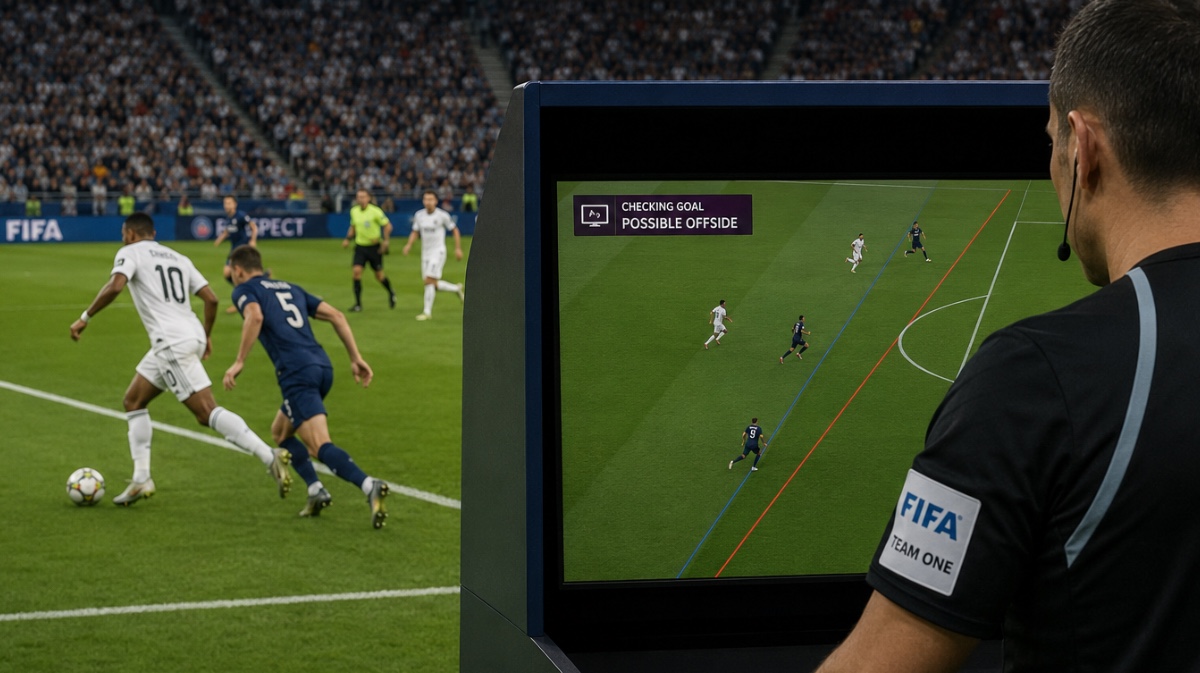
The potentially transformative experiment is happening in Canada, where the Canadian Premier League began an IFAB-approved professional trial in April 2026 of a “daylight” interpretation of offside backed by FIFA.
Under the experimental approach, an attacker remains onside when any legal goalscoring part of the body is level with or behind the second-last defender; offside requires the attacker’s eligible body to be completely beyond that opponent, effectively giving forwards considerably more latitude than under the existing law.
Arsène Wenger, FIFA’s chief of global football development and a longtime advocate of reconsidering marginal offside decisions, has framed the experiment around attacking play and clarity, but the consequences would reach far beyond a few additional goals: defensive lines could retreat, through balls could become more valuable and the spacing of entire teams could change.
IFAB’s own 2026/27 material says alternative offside concepts remain one of its principal trial areas, which makes a meaningful rewrite before 2036 plausible in a way that was largely theoretical only a few years ago.
VAR Is Beginning to Split
Video officiating is also moving in two directions at once: more sophisticated systems at wealthy competitions and a cheaper, coach-triggered alternative for leagues that cannot support a full VAR operation.
FIFA’s Football Video Support system eliminates dedicated video match officials and instead allows a coach to request review of specified match-changing decisions; in the original trial framework, teams were expected to receive two requests and retain a request when the referee changed the initial ruling.
By October 2025, FIFA said FVS had entered full-time trials in Italy’s Serie C, Spain’s Liga F and Primera Federación, while additional programs were developing in Brazil and elsewhere; roughly 200 Serie C matches had already used it by that point.
The significance is structural: soccer may eventually stop treating video review as one universal product and instead operate two tiers, with automated or semi-automated systems continuously supporting officials in elite tournaments while lower-cost competitions use a limited challenge model closer to tennis or American football.
Second Yellows Enter the Screen
The boundary around what video officials may correct is loosening too, although incrementally rather than through an unrestricted replay system. For the 2026/27 laws, IFAB approved VAR assistance when a player receives a red card because of a clearly erroneous second yellow, in cases involving mistaken identity across teams, and—where competitions choose to adopt it—for an obviously incorrect corner when the mistake can be corrected immediately without holding up the restart.
These additions attack one of VAR’s recurring credibility problems: spectators can watch technology identify an obvious mistake while the protocol prevents officials from fixing it because the incident falls outside the review categories. Yet every expansion carries a competing risk, because the more decisions the video operation is authorized to inspect, the harder it becomes to preserve the uninterrupted rhythm that IFAB is simultaneously trying to protect.
Over the next decade, the important argument may therefore move away from whether soccer should have video review at all and toward which errors are serious enough to justify stopping a game to correct them.
Captains Get the Referee’s Ear
The treatment of match officials is producing another rule shift with a firm date already attached: IFAB says its “Only the captain” guidelines will become compulsory for competitions starting on or after July 1, 2027, restricting who may approach the referee in specified situations and placing responsibility on captains to keep teammates away.
That decision sits beside another important development in the 2026/27 rules, which allow referee body cameras as a competition option, extending a technology first explored at grassroots level as a tool against abuse and threats.
IFAB is also continuing lower-level trials of formal “cooling-off periods,” during which referees can suspend play when confrontations make the match difficult or unsafe to control; the protocol permits no more than two such interruptions before abandonment becomes the next step if conditions remain unacceptable.
Taken together, those measures suggest the rulebook of the 2030s could regulate player-referee interaction far more explicitly than the traditional model, in which dissent has largely depended on individual referees deciding when complaining crosses the line.
Technology Could Widen — or Narrow — Football’s Gap
The global consequence of these reforms may depend less on the Premier League, Champions League or World Cup than on whether technology becomes affordable enough for leagues outside football’s richest tier.
FIFA created Football Video Support specifically for competitions with fewer cameras and smaller officiating budgets, and its spread would create something soccer has struggled to achieve since VAR’s introduction: access to replay assistance without reproducing the infrastructure of an elite broadcast operation.
At the top end, meanwhile, semi-automated offside technology continues to advance, creating the possibility that one of football’s most subjective-looking decisions becomes increasingly machine-assisted even as IFAB debates changing the underlying definition of offside itself.
That combination is crucial: a more attacker-friendly offside law would be easier to sell if decisions can also be produced rapidly and consistently, while affordable review systems could reduce the officiating gulf between globally televised competitions and professional leagues operating on a fraction of their budgets.
Sin Bins Remain Outside the Elite
The strongest evidence for football’s future also shows what is not yet close to becoming universal: temporary dismissals, stop-clock matches and wholesale automation remain much less certain than the offside, timing and referee-management reforms already on IFAB’s agenda.
Temporary dismissals are currently permitted in youth, veterans, disability and grassroots competitions, with IFAB guidelines proposing roughly 10% to 15% of match duration for the punishment, but the elite game has not crossed that threshold; the current 2026/27 trial program instead lists alternative offside models, Football Video Support, cooling-off periods at lower levels and goalkeeper injury delays.
That distinction matters when projecting the next 10 years: football usually changes through controlled trials that become optional competition rules before they become universal law, and several ideas that generate headlines never advance through that chain. Football’s Rulebook Is Entering an Experimental Decade
Eight Seconds Changed the Direction
The most revealing clue about where soccer is heading is not a futuristic technology but a stopwatch: beginning with the 2025/26 laws, goalkeepers who control the ball with their hands beyond eight seconds concede a corner, with referees visibly counting down the final five, replacing a six-second rule that was widely regarded as difficult to enforce.
The International Football Association Board, which writes the Laws of the Game, went further for 2026/27, introducing mechanisms aimed at delaying goal kicks, throw-ins and substitutions; players being replaced are generally required to leave within 10 seconds, with a delayed substitute prevented from entering until a later stoppage if the limit is breached.
The sequence matters because it reveals the governing philosophy likely to shape the next decade: rather than replacing the traditional 90-minute match with a basketball-style stopped clock, football’s rule-makers are increasingly attaching explicit consequences to the small delays that collectively drain playing time.
The current IFAB program is also examining tactical stoppages linked to goalkeeper injuries, suggesting that the next frontier will be situations in which officials must distinguish genuine treatment from strategic interruption.
Canada Tests the Offside Fault Line
The potentially transformative experiment is happening in Canada, where the Canadian Premier League began an IFAB-approved professional trial in April 2026 of a “daylight” interpretation of offside backed by FIFA.
Under the experimental approach, an attacker remains onside when any legal goalscoring part of the body is level with or behind the second-last defender; offside requires the attacker’s eligible body to be completely beyond that opponent, effectively giving forwards considerably more latitude than under the existing law.
Arsène Wenger, FIFA’s chief of global football development and a longtime advocate of reconsidering marginal offside decisions, has framed the experiment around attacking play and clarity, but the consequences would reach far beyond a few additional goals: defensive lines could retreat, through balls could become more valuable and the spacing of entire teams could change.
IFAB’s own 2026/27 material says alternative offside concepts remain one of its principal trial areas, which makes a meaningful rewrite before 2036 plausible in a way that was largely theoretical only a few years ago.
VAR Is Beginning to Split
Video officiating is also moving in two directions at once: more sophisticated systems at wealthy competitions and a cheaper, coach-triggered alternative for leagues that cannot support a full VAR operation.
FIFA’s Football Video Support system eliminates dedicated video match officials and instead allows a coach to request review of specified match-changing decisions; in the original trial framework, teams were expected to receive two requests and retain a request when the referee changed the initial ruling.
By October 2025, FIFA said FVS had entered full-time trials in Italy’s Serie C, Spain’s Liga F and Primera Federación, while additional programs were developing in Brazil and elsewhere; roughly 200 Serie C matches had already used it by that point.
The significance is structural: soccer may eventually stop treating video review as one universal product and instead operate two tiers, with automated or semi-automated systems continuously supporting officials in elite tournaments while lower-cost competitions use a limited challenge model closer to tennis or American football.
Second Yellows Enter the Screen
The boundary around what video officials may correct is loosening too, although incrementally rather than through an unrestricted replay system. For the 2026/27 laws, IFAB approved VAR assistance when a player receives a red card because of a clearly erroneous second yellow, in cases involving mistaken identity across teams, and—where competitions choose to adopt it—for an obviously incorrect corner when the mistake can be corrected immediately without holding up the restart.
These additions attack one of VAR’s recurring credibility problems: spectators can watch technology identify an obvious mistake while the protocol prevents officials from fixing it because the incident falls outside the review categories. Yet every expansion carries a competing risk, because the more decisions the video operation is authorized to inspect, the harder it becomes to preserve the uninterrupted rhythm that IFAB is simultaneously trying to protect.
Over the next decade, the important argument may therefore move away from whether soccer should have video review at all and toward which errors are serious enough to justify stopping a game to correct them.
Captains Get the Referee’s Ear
The treatment of match officials is producing another rule shift with a firm date already attached: IFAB says its “Only the captain” guidelines will become compulsory for competitions starting on or after July 1, 2027, restricting who may approach the referee in specified situations and placing responsibility on captains to keep teammates away.
That decision sits beside another important development in the 2026/27 rules, which allow referee body cameras as a competition option, extending a technology first explored at grassroots level as a tool against abuse and threats.
IFAB is also continuing lower-level trials of formal “cooling-off periods,” during which referees can suspend play when confrontations make the match difficult or unsafe to control; the protocol permits no more than two such interruptions before abandonment becomes the next step if conditions remain unacceptable.
Taken together, those measures suggest the rulebook of the 2030s could regulate player-referee interaction far more explicitly than the traditional model, in which dissent has largely depended on individual referees deciding when complaining crosses the line.
Technology Could Widen — or Narrow — Football’s Gap
The global consequence of these reforms may depend less on the Premier League, Champions League or World Cup than on whether technology becomes affordable enough for leagues outside football’s richest tier.
FIFA created Football Video Support specifically for competitions with fewer cameras and smaller officiating budgets, and its spread would create something soccer has struggled to achieve since VAR’s introduction: access to replay assistance without reproducing the infrastructure of an elite broadcast operation.
At the top end, meanwhile, semi-automated offside technology continues to advance, creating the possibility that one of football’s most subjective-looking decisions becomes increasingly machine-assisted even as IFAB debates changing the underlying definition of offside itself.
That combination is crucial: a more attacker-friendly offside law would be easier to sell if decisions can also be produced rapidly and consistently, while affordable review systems could reduce the officiating gulf between globally televised competitions and professional leagues operating on a fraction of their budgets.
Sin Bins Remain Outside the Elite
The strongest evidence for football’s future also shows what is not yet close to becoming universal: temporary dismissals, stop-clock matches and wholesale automation remain much less certain than the offside, timing and referee-management reforms already on IFAB’s agenda.
Temporary dismissals are currently permitted in youth, veterans, disability and grassroots competitions, with IFAB guidelines proposing roughly 10% to 15% of match duration for the punishment, but the elite game has not crossed that threshold; the current 2026/27 trial program instead lists alternative offside models, Football Video Support, cooling-off periods at lower levels and goalkeeper injury delays.
That distinction matters when projecting the next 10 years: football usually changes through controlled trials that become optional competition rules before they become universal law, and several ideas that generate headlines never advance through that chain.
The safest forecast for 2036 is therefore not a radically redesigned sport but a recognizably familiar one with less tolerance for manufactured stoppages, a potentially larger advantage for attackers, wider but more differentiated video assistance and a referee whose authority is protected by rules that are far more specific than those governing the game today.