Erdoğan’s Fund-Market Reassurance Tests Washington’s Turkey Calculus
President Recep Tayyip Erdoğan said stress in Turkey’s fund market remains limited and poses no systemic risk.
Lauren Collins ·
Erdoğan’s Fund-Market Reassurance Tests Washington’s Turkey Calculus
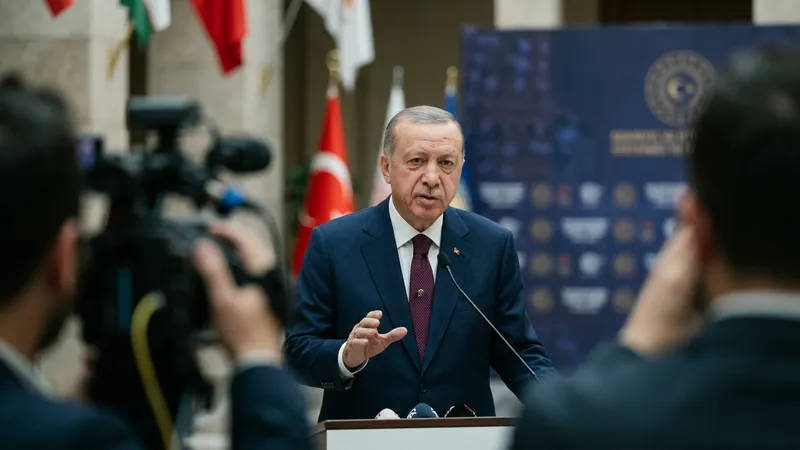
President Recep Tayyip Erdoğan said Monday that stress in Turkey’s fund market is confined to a limited area and does not threaten the country’s financial system. The statement gives Washington a narrow diplomatic problem: how to assess a NATO ally’s market strain without turning a contained episode into a wider confidence test.
Market Reassurance Tests Washington
The White House, Treasury, State Department and Pentagon each have a different stake in that calculation. Treasury would look first at financial spillover and any International Monetary Fund channel; State and the National Security Council would weigh alliance politics; the Pentagon would watch whether market pressure changes Ankara’s room for maneuver inside NATO.
The immediate issue is a fund-market episode in Turkey that Erdoğan described as limited rather than systemic. The source material does not provide the size of the liquidity stress, the funds affected, the role of banks or corporate issuers, or whether foreign investors were material participants, so those details cannot be stated as fact here.
That missing scale matters in Washington. A small redemption problem inside a narrow slice of the domestic fund market is a different policy question from stress that reaches banks, dollar funding channels or companies that rely on short-term refinancing.
It is a NATO member with direct relevance
Turkey occupies an unusual place in US policy. It is a NATO member with direct relevance to Black Sea security, the Middle East, defense industrial policy and sanctions enforcement, but it also has a history of financial volatility that can pull economic and security files into the same conversation.
The IMF dimension is equally sensitive. The fund is formally independent, but the United States is its largest shareholder and has influence over the political environment around any major program, especially when a borrower is also a treaty ally.
If Ankara seeks outside support, Washington’s default instinct would likely be conditionality rather than open-ended reassurance. In practice, that means US officials would look for credible monetary policy, transparent data, bank-sector resilience and fiscal commitments before supporting any broader stabilization package.
Congress adds a harder edge. Lawmakers who focus on Turkey often connect economic engagement to security disputes, sanctions policy, human rights concerns and Ankara’s ties with Russia, meaning any visible financial rescue could draw scrutiny beyond Treasury and the IMF boardroom.
For the Biden-era foreign-policy establishment and the current Washington bureaucracy, the operating question is not whether Turkey matters. It is whether economic pressure makes Ankara more receptive to Western coordination or more likely to use alliance leverage to extract concessions.
Erdoğan’s statement attempts to reduce the first-order risk: the idea that investors, depositors or counterparties should treat the fund episode as a sign of wider financial weakness. Washington will read it against market behavior, central-bank communication and any private Turkish outreach to international institutions.
A reassurance can work if it is followed by facts that make it credible. It can also lose force if investors see policy ambiguity, inconsistent liquidity support or signs that losses are being shifted rather than recognized.
The NATO channel is where the economic file becomes geopolitical. Turkey’s cooperation matters for defense planning, the Black Sea, Ukraine-related diplomacy, counterterrorism coordination and alliance cohesion at a time when Washington is trying to keep European and Middle Eastern files from colliding.
That does not mean Washington would welcome instability in Turkey. A disorderly financial shock in a NATO ally would complicate regional diplomacy, risk another source of market stress, and weaken a partner whose cooperation remains useful even when relations are strained.
The tougher question is whether the United States should lean toward quiet support or harder signaling. Quiet support would mean encouraging credible economic steps, allowing IMF engagement to proceed on technical terms and avoiding public language that could amplify market anxiety.
Harder signaling would mean using the moment to press Ankara on policy choices beyond markets, including sanctions enforcement, defense procurement and alliance coordination. That route carries a risk: it could strengthen market pressure if investors interpret political tension as another reason to reduce exposure.
Erdoğan’s line that there is no systemwide risk therefore functions as more than a domestic reassurance. It also asks foreign governments and institutions to treat the issue as a manageable market disturbance, not as the start of a broader Turkish balance-of-payments or banking problem.
Washington will not have to answer that claim rhetorically. It will answer through meetings, IMF posture, public briefings, sanctions language, export-control decisions and the tone of NATO consultations involving Ankara.
The central bank is another focal point, even without new figures in the source material. If Turkish monetary authorities provide consistent liquidity and maintain a policy stance that investors regard as credible, Erdoğan’s statement gains weight; if policy signals diverge, the reassurance becomes harder for outsiders to accept.
For international investors, the practical concern is transmission. Fund stress becomes strategically relevant when it forces asset sales, pressures banks, widens corporate funding costs or causes foreign holders to reassess currency and convertibility risk.
For Turkish companies, the mechanism is simpler. A contained fund issue may raise financing costs at the margin; a broader confidence shock would make refinancing harder and could slow investment, especially for firms exposed to foreign currency debt or short-term domestic funding.
For the wider emerging-market universe, Turkey is a watched case because it combines geopolitical weight with a large domestic market and a record of policy shifts that investors track closely. A contained episode would remain a local story; a credibility break would become a comparative test for other high-yield markets.
By December 31, 2026, the clearest confirmation of the calmer scenario would be a concrete stabilization track: Turkish policy steps that markets treat as credible, any IMF engagement tied to reform commitments, and supportive but measured US language that avoids turning financial stress into an alliance dispute. The call is wrong if Turkey sees renewed capital outflows, another fund or banking shock, or a punitive Washington signal, such as sanctions or tighter export controls, that adds political risk faster than Ankara can restore confidence.