Enter the Killer Robots: The Ukrainian Forging the Future of Warfare
The New York Times: Breaking news, investigations, opinion, photos and videos from the New York Times.
Jason Kwon ·
Credit...Brendan Hoffman for The Supported by
Listen · 10:53 min
- Share full article
By Andrew E. Kramer
Reporting from Kyiv, Ukraine
- May 15, 2026
As Ukraine’s 35-year-old defense minister strolled about in tennis shoes, jeans and a fleece, gazing at displays of his country’s latest crop of oddball weapons, he paused to eye one gigantic, ungainly new device.
It was a drone with muscular carbon fiber arms stretching eight feet to each side, propellers the size of scythes, and a sprawl of wires, protruding antennas and Velcro straps. The drone substitutes for a 155-milometer howitzer, carrying shells to targets and dropping them.
“Can you make it bigger?” the minister, Mykhailo Fedorov, asked the drone’s developers during a recent defense exhibition. They were working on it, they replied.
The future of warfare is being written in Ukraine, and Mr. Fedorov, a technology evangelist who is four months into his job, is one of its authors.
In the same way that apps remade taxi services and food delivery, Mr. Fedorov believes that warfare is ripe for disruption. That, he says, means offloading the fighting as much as possible onto machines — including, someday, those that can make lethal decisions on their own.
“The world needs security, and only autonomous weapons can ensure it,” Mr. Fedorov said in an interview in his office at the Ministry of Defense. “Autonomous weapons are the new nuclear weapons. Countries that possess them will be protected.”
While killer robots may seem a horrifying prospect, something out of dystopian science fiction, the race for them is on worldwide.
In Ukraine, the use of artificial intelligence in weapons is still in its infancy. It is most helpful now in target recognition, like helping a drone pilot pick out a camouflaged tank hidden in a forest. But the technology is improving, and Mr. Fedorov sees it as a pillar of Ukraine’s broader embrace of new-generation weapons that have kept its outnumbered military in the fight.
These weapons power a strategy, devised by Mr. Fedorov and endorsed by President Volodymyr Zelensky, that is intended to force Russia into a settlement to end the war.
Image
Devices on display at a drone expo in the Kyiv region of Ukraine in March.Credit...Brendan Hoffman for The The strategy, called Air, Land, Economy, envisions using drones and other advanced weapons to intercept at least 95 percent of incoming Russian drones and missiles; to kill or seriously injure more soldiers than Moscow can recruit; and to weaken the Russian economy by blowing up oil export terminals.
There has been pushback within the Ukrainian military against Mr. Fedorov’s futuristic talk of robot warfare, leading to what analysts say is a power struggle between him and generals. Some commanders say the idea of a rapid transition to unmanned battle is disconnected from the grim reality of muddy trenches and broken bodies.
Mr. Fedorov appears undeterred. In the interview, he said he held about a dozen meetings a day, working 10 or 12 hours, as part of his mission to push the military to adopt technology more quickly. He gets by on a restrictive diet that includes salads and bread made from buckwheat.
His interest in technology began with the video games he played as a teenager in the steel-making city of Zaporizhzhia. He turned his hobby into a tech career, starting a digital advertising business before graduating from college, and becoming a partner with Facebook in selling targeted ads on the platform.
Mr. Zelensky hired Mr. Fedorov to run social media advertising for his 2019 presidential campaign, then appointed him at age 28 to lead the ministry in charge of digitizing government services.
When Mr. Fedorov, who has never served in the military, moved to the Defense Ministry this January, he brought with him a team of advisers and data analysts. Mostly young men and women, they stand out for wearing sweatshirts to work. Mr. Fedorov set up a Ping-Pong table in one hallway.
Image
“Autonomous weapons are the new nuclear weapons,” said the Ukrainian defense minister, Mykhailo Fedorov. “Countries that possess them will be protected.”Credit...Brendan Hoffman for The Through the full-scale war that started in 2022, Mr. Fedorov has been Ukraine’s point person for contact with Silicon Valley. To attract military technology, he has promoted the war as a test bed for defense ventures.
He has met in Ukraine with Alex Karp, the chief executive of the defense-focused data analysis company Palantir, and with Eric Schmidt, a former chief executive of Google who founded a venture fund, D3, focused on weapons development in Ukraine.
After a meeting this week with Mr. Karp, Mr. Fedorov said that Ukraine was working with Palantir to further integrate A.I. into warfare, including systems to analyze air attacks, process intelligence data and plan for deep strikes into Russia.
During the recent defense-technology exhibition that Mr. Fedorov attended, a vast array of innovative Ukrainian battlefield products — the sort he has championed — were on display.
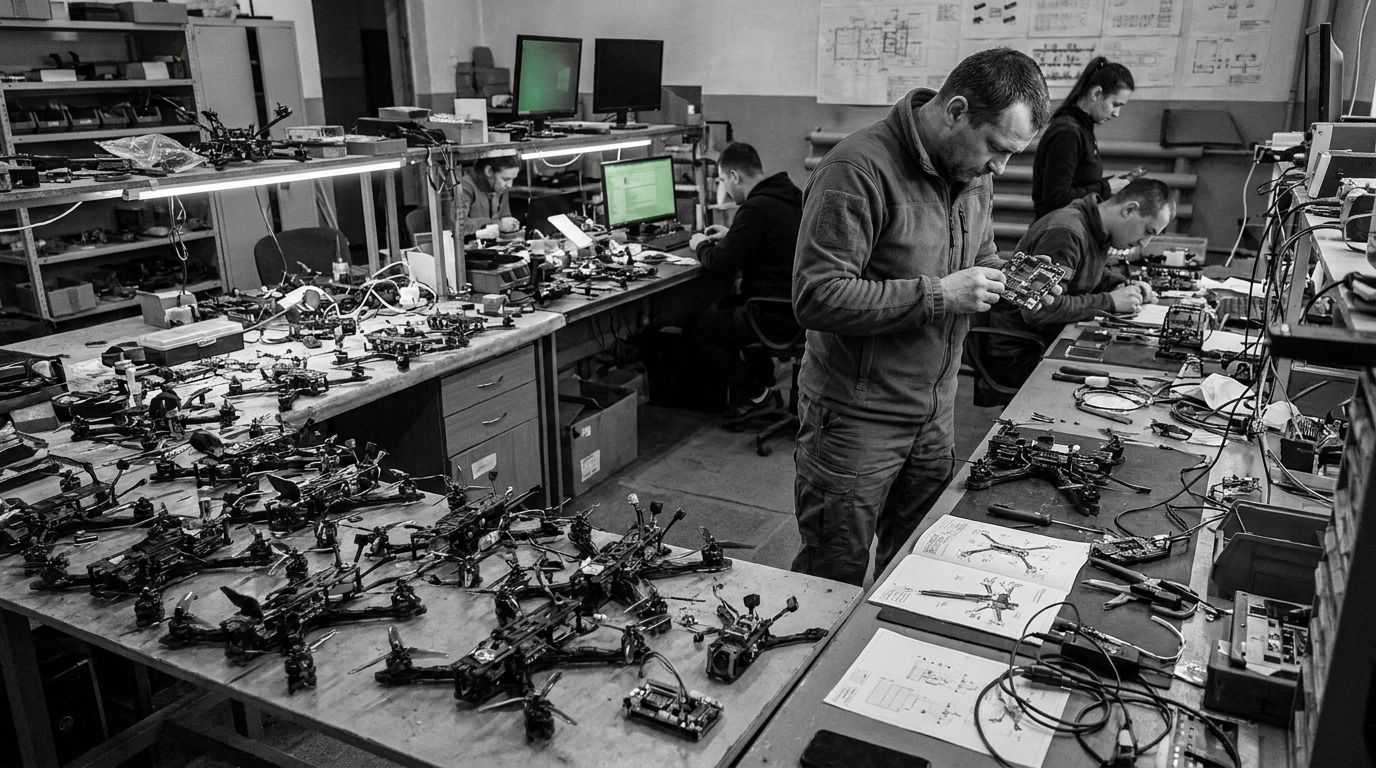
There were spools of fiber-optic wire that guide drones impervious to electronic jamming. There was a weapon made from a balloon, a palm-sized surveillance drone and a green unmanned ground vehicle that looked like a table mounted on a mini-bulldozer. There were dozens of prototypes of small “smart” weapons to replace machine guns, sniper rifles, tanks and artillery systems.
Mr. Fedorov eyed one microwave-oven-sized remote-controlled plane with a plastic fuselage shaped like a loaf of bread. The weapon, a dirt-cheap exploding drone, was called Loaf. “That’s a game changer,” he said.
Like much Ukrainian battlefield tech, the devices appeared soldered or duct-taped together in someone’s garage. Mr. Federov asked about prices. Everything had to be cheap and disposable, he said, because a lot would be shot down or blown up.
Mr. Fedorov wants to use this technology to eliminate as many Russian soldiers as possible.
Both armies endure high casualties, as drones buzz continually over the battlefield, posing lethal dangers to any soldier or vehicle that moves within the “kill zone,” a miles-wide strip along the front line that is dominated by unmanned weapons.
Image
Soldiers installing anti-drone netting over a road between Izium and Sloviansk in March.Credit...Brendan Hoffman for The Mr. Fedorov called this phase of the war “targeted destruction.” He said his was to raise the Russian casualty rate from about 35,000 killed and wounded a month now to more than 50,000, a level he said would slow the invasion and then halt it.
An aide, Valeriya Ionan, said Mr. Fedorov “believes in the mathematics of war.”
In the future, Mr. Fedorov said in the interview, robotic systems will do all of the fighting. The kill zone will empty of people entirely, he said. Unmanned systems will fight among themselves, he added, on the ground and in the air.
As robotic systems improve, he said, there will be an understanding that large-scale human losses in war “are unsustainable, and warfare will evolve again.”
Wars, however, tend to spiral in unpredictable directions, and taking humans out of the loop could compound that risk.
Mr. Fedorov’s vision has at times conflicted with that of Ukraine’s military leaders.
The armed forces’ commander in chief, Gen. Oleksandr Syrsky, has not shied away from battles fought with traditional tactics of armored vehicles and infantry maneuvering in the fields. He won major victories earlier in the war with such strategies.
A dispute between Mr. Fedorov and the military command spilled into the open last month.
A Ukrainian unit called Skala attempted a risky assault in armored vehicles near the city of Pokrovsk in eastern Ukraine, losing four vehicles. Soldiers were killed and wounded, though the numbers are disputed.
Afterward, an adviser to Mr. Fedorov, Serhii Sternenko, sharply criticized the tactics in a social media post . “We often laugh at the enemy when he sends his troops in columns,” Mr. Sternenko wrote, referring to armored columns. “Treating our people like this is a crime. There should be accountability.”
Skala lashed back, accusing Mr. Sternenko of nurturing fantastical ideas unhinged from battlefield realities.
In a post on its Facebook page, the unit wrote that the assault group took necessary risks to save comrades in need of backup. “If Mr. Sternenko knows how to organize assault actions against the enemy’s strong points in Pokrovsk,” it said, he should enlist in the army and fight.
Still, frontline brigades have generally embraced whatever edge technology can bring.
“We have a young minister who is into technology, who is on one wavelength with us,” said Kyrylo Veres, commander of the K-2 brigade, which was an early adopter of exploding first-person-view drones early in the war. With Mr. Fedorov, “we don’t have to explain anything,” Mr. Veres added.
Image
Mr. Fedorov, center, at the drone expo.Credit...Brendan Hoffman for The Public opinion polls show wide support for Mr. Fedorov’s work as defense minister. Mr. Zelensky has praised him, saying he is “grateful for the increasing volumes” of drones reaching the military.
One silver lining of the war, Mr. Fedorov said, has been the vast troves of data it has generated.
He is leading an effort to monetize or trade Ukrainian war data, including a library of more than five million annotated videos of the battlefield filmed by surveillance and strike drones. These include footage showing how humans behave as killer drones close in, such as running or hiding.
Last month, the Defense Ministry, through a program called Avenger Labs, opened up the data sets to companies from allied nations to train artificial intelligence models.
Human rights groups oppose the use of A.I. in lethal weapons. But Mr. Fedorov argued that “the risks are not as high as you think.” For now, the technology is focused mostly on identifying military equipment, not soldiers, aides said.
Access to Avenger Labs is conditioned on Ukraine receiving the A.I. models that are produced from the data. About 20 companies have expressed interest.
“It’s a win-win approach,” Mr. Fedorov said.
Evelina Riabenko and Yurii Shyvala contributed reporting from Kyiv and Lviv, Ukraine.
Andrew E. Kramer is the Kyiv bureau chief for, who has been covering the war in Ukraine since 2014.
See more on: Russia-Ukraine War
- Share full article