

Conflict-zone athletes face sleep stress standard plans miss
A BJSM editorial proposes a three-part model for athletes training under armed conflict, but direct evidence in this population remains limited.
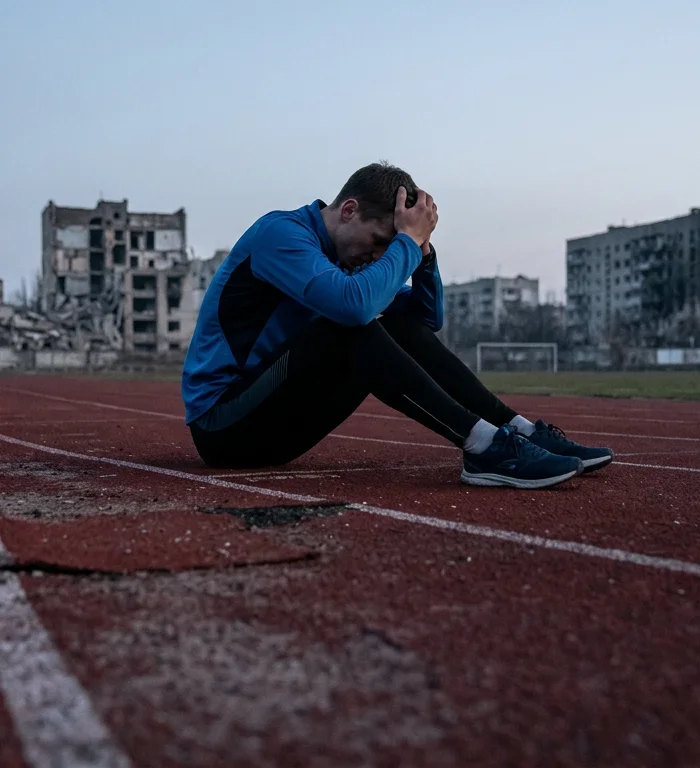
British Journal of Sports Medicine published a four-page editorial on Oct. 9 proposing the Tripartite Athletic Stress Framework for athletes training and competing in conflict zones.
Evidence grade: Claim (no study cited). The article is an externally peer-reviewed editorial, not a trial or cohort study, and it argues that standard training and recovery models do not account for sustained threat exposure across five regions.
Wissem Dhahbi and five co-authors wrote that conflict-zone athletes face a physiological load that sports medicine has not fully incorporated. “The physiological burden of armed conflict on athletic populations remains under-represented in sports medicine research,” they said in the BJSM editorial.
The proposed framework links conflict exposure with three interacting stress pathways. The excerpted article identifies conflict-induced chronic psychological stress and acoustic sleep disruption, and says the broader Tripartite Athletic Stress Framework, or TASF, is intended as a testable model for monitoring and intervention priorities.
The authors said athletes in the Eastern Mediterranean, Middle East, sub-Saharan Africa, Eastern Europe and South Asia may continue training while exposed to threat conditions. They argue that these conditions are not captured by conventional periodisation, the planning of training and recovery over time.
Where sleep is affected
The editorial centres on the hypothalamic-pituitary-adrenal axis, or HPA axis, the hormone-control system involved in stress responses. The authors said conflict exposure can alter cortisol regulation, heighten amygdala activity, reduce prefrontal cortical activity and create hypervigilance that impairs sleep architecture, the structure of sleep stages across the night.
For conflict-induced chronic psychological stress, the authors draw on mechanisms described in earlier work on trauma. They said the performance consequences, extrapolated from largely non-athlete groups, could include poorer declarative memory, reduced executive function and suppression of hormonal systems linked with testosterone availability and growth-hormone pulsatility.
The editorial does not present new measurements from athletes living in conflict zones. It proposes that athletes might show attenuated rather than elevated basal cortisol, depending on exposure duration and genetic susceptibility, consistent with patterns described in post-traumatic stress disorder research.
The second pathway in the excerpt is acoustic sleep disruption. The editorial distinguishes emergency sound exposure from voluntary digital sleep fragmentation, which it describes as sleep disruption driven by blue light and notification-related arousals.
State-broadcast emergency alerts deliver acoustic stimuli exceeding 85 dB without advance warning, the authors said. They propose that these sounds may activate threat-response circuits before conscious appraisal, producing acute sympathetic-adrenomedullary discharge, a stress response involving adrenaline-related activation.
Limits for athletes
The article applies most directly to competitive or training athletes exposed to armed conflict or repeated emergency alerts. It does not directly apply to athletes with ordinary travel stress, routine competition anxiety or sleep disruption from voluntary device use outside conflict settings.
The study cannot show that TASF improves sleep, performance, injury risk or mental health outcomes. It also cannot quantify the size of any effect in conflict-zone athletes because the editorial provides no sample size, comparison group, duration, absolute effect size or confidence interval.
The authors declared no specific funding from public, commercial or not-for-profit sources and reported no competing interests. BJSM lists the editorial as not commissioned and externally peer reviewed. The footnotes say a generative artificial intelligence tool, Claude Sonnet V.4.6, was used only for linguistic enhancement and not to generate scientific content.
For sports organisations, the practical value is still provisional. The editorial frames sleep and stress physiology as areas that may need monitoring when athletes train under threat, but it does not provide outcome data showing which monitoring tools or interventions work best in this population.
The next step for the field is empirical testing of the framework in conflict-zone athletes, with direct measures of sleep, stress hormones and performance outcomes. The authors provided no dated trial, registry entry or planned data release.
Source: peer-reviewed editorial, British Journal of Sports Medicine, Oct. 9, 2026.
Atlas360 reports health research and does not provide medical advice.
More stories
- Athlete eye-balance screens may move beyond concussion rehab
- Football doctors seek concussion role after 2-day Zurich forum
- Tai Chi may ease pain in musculoskeletal disorders
- Peptide access push may obscure patient harm reports
- Emergence of Youth Support Networks Addressing Polycrisis-Induced Mental Health Risks
- Ebola Outbreak Escalates in Congo Amid Security and Operational Failures
- El Nino Triggers Food Crisis in Papua New Guinea
- FDA Authorizes Over-the-Counter Continuous Glucose Monitor for Pediatric Use
Latest news
- Twelve senators press Trump to rescind Russian diesel waiver
- South America ventilation market to add $70 million by 2031
- Pakistan tests Fatah-2 missile after Fatah-4 launch
- Arm rises 0.94% as chip selloff tests AI trade
- Fed finds debt delinquencies hit post-2010 high
- Regulatory Divergence in European Football Financial Governance
- Rwanda Secures 10-Year Formula 1 Hosting Rights Starting Early 2030s
- Operational Failures in Formula 1 Race Control Impact Competitive Integrity