

Tai Chi may ease pain in musculoskeletal disorders
A BJSM umbrella review found strongest evidence for traditional Chinese exercises in selected outcomes, including knee osteoarthritis function and…
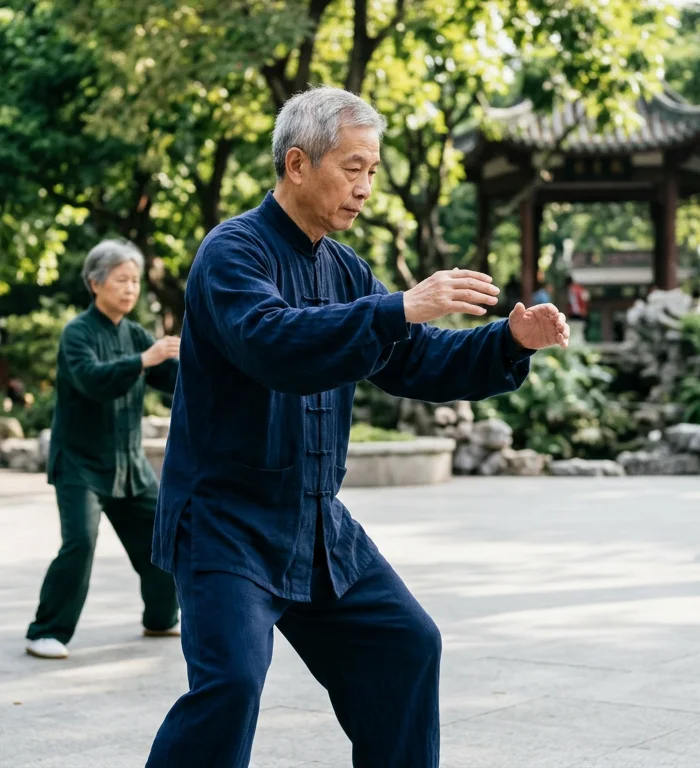
Traditional Chinese exercises were linked to better outcomes in a British Journal of Sports Medicine umbrella review of 92 meta-analyses, 1744 randomized controlled trials and 547 associations published Oct. 9.
Evidence grade: Strong (large randomized trials or meta-analysis) for selected outcomes, not every condition. The review matters because musculoskeletal disorders affected more than 1.69 billion people in 2021, according to background cited in the article.
The authors reviewed systematic reviews with meta-analyses of randomized controlled trials involving people with musculoskeletal disorders. An umbrella review is a review of existing reviews, used to compare evidence across many conditions and outcomes.
The exercise types included Tai Chi, Baduanjin, Yijinjing, Qigong, Wuqinxi, Daoyin and mixed or unspecified traditional Chinese exercises. Tai Chi accounted for 41.5% of the exercise associations, compared with 37.3% for mixed or unspecified traditional Chinese exercises and 11.0% for Baduanjin.
The authors wrote that the review “consolidates high-quality evidence demonstrating that TCEs, especially Tai Chi, provide multidimensional benefits for MSDs, improving function, pain, mental health, sleep and BMD with sustained practice.” Bone mineral density, or BMD, measures mineral content in bone and is used in osteoporosis assessment.
The strongest evidence was concentrated in specific outcomes. The review reported high-certainty evidence that traditional Chinese exercises improved physical function in knee osteoarthritis, mental health in people with knee osteoarthritis and neck pain, and sleep quality in fibromyalgia.
Tai Chi was also reported to reduce chronic musculoskeletal-disorder-related pain and stiffness and to increase bone mineral density in participants with osteopenia or osteoporosis. Osteopenia means lower-than-normal bone density, while osteoporosis indicates weaker bones with higher fracture risk.
The review used the Grading of Recommendations, Assessment, Development and Evaluations framework, known as GRADE, to judge certainty. Of 547 associations, 23, or 4.2%, were rated high certainty, while 179, or 32.7%, were rated moderate certainty.
Methodological quality was rated high for 65 of the 92 meta-analyses, or 70.7%, using A Measurement Tool to Assess Systematic Reviews. Arthritis was the most common disorder category, representing 38.8% of targeted musculoskeletal conditions across 10 categories.
The dose pattern favored sustained practice. Subgroup analyses linked greater clinical gains in knee osteoarthritis and osteoporosis with interventions lasting at least six months, sessions at least three times a week and weekly exercise volume of at least 150 minutes.
The study cannot show that every traditional Chinese exercise works equally well for every musculoskeletal disorder. The high-certainty findings covered a limited share of the mapped associations, and the article described earlier evidence as fragmented and methodologically heterogeneous.
The excerpt did not provide participant age, sex, baseline disease severity, absolute effect sizes, confidence intervals, funding details or declared conflicts. That limits how precisely readers can judge who the findings apply to and how large the benefits were.
For ordinary readers, the review supports traditional Chinese exercises as a possible complement to conventional musculoskeletal rehabilitation, especially where the evidence was rated high certainty. It does not replace individualized clinical assessment or treatment.
Source: systematic review, British Journal of Sports Medicine, Oct. 9, 2026.
Atlas360 reports health research and does not provide medical advice.
More stories
- Peptide access push may obscure patient harm reports
- Emergence of Youth Support Networks Addressing Polycrisis-Induced Mental Health Risks
- Ebola Outbreak Escalates in Congo Amid Security and Operational Failures
- Measles Mortality Increases Amidst Declining U.S. Vaccination Coverage
- New mRNA Adjuvant Technology Enhances T-Cell Immune Response
- Youth-sport labels may shape athlete rights and risk
- mRNA Cancer Vaccine Shows Promise for Melanoma Patients
- DRC Ebola Outbreak Surpasses 5,000 Cases Amid Conflict
Latest news
- Accordion adds 50 engineers in Stride AI acquisition
- Centerra targets 70% of Azimut projects with $16 million earn-in
- Hezbollah drone report tests Washington’s Lebanon ceasefire strategy
- Memory costs push smartphone shipments down 20%
- Citigroup profit beats estimates as bond trading hits decade high
- Konya exports near $4 billion as leaders assess risks
- Sharjah Islamic Bank profit rises 9% as financing expands
- UAE green plans put Dh200 billion investment target in focus