Claude Opus 5 Cuts AI Costs as Anthropic Chases Work Use
Anthropic introduced Claude Opus 5 as a lower-cost workplace AI model aimed at enterprise users weighing capability against tighter AI budgets.
Edward Mullen ·
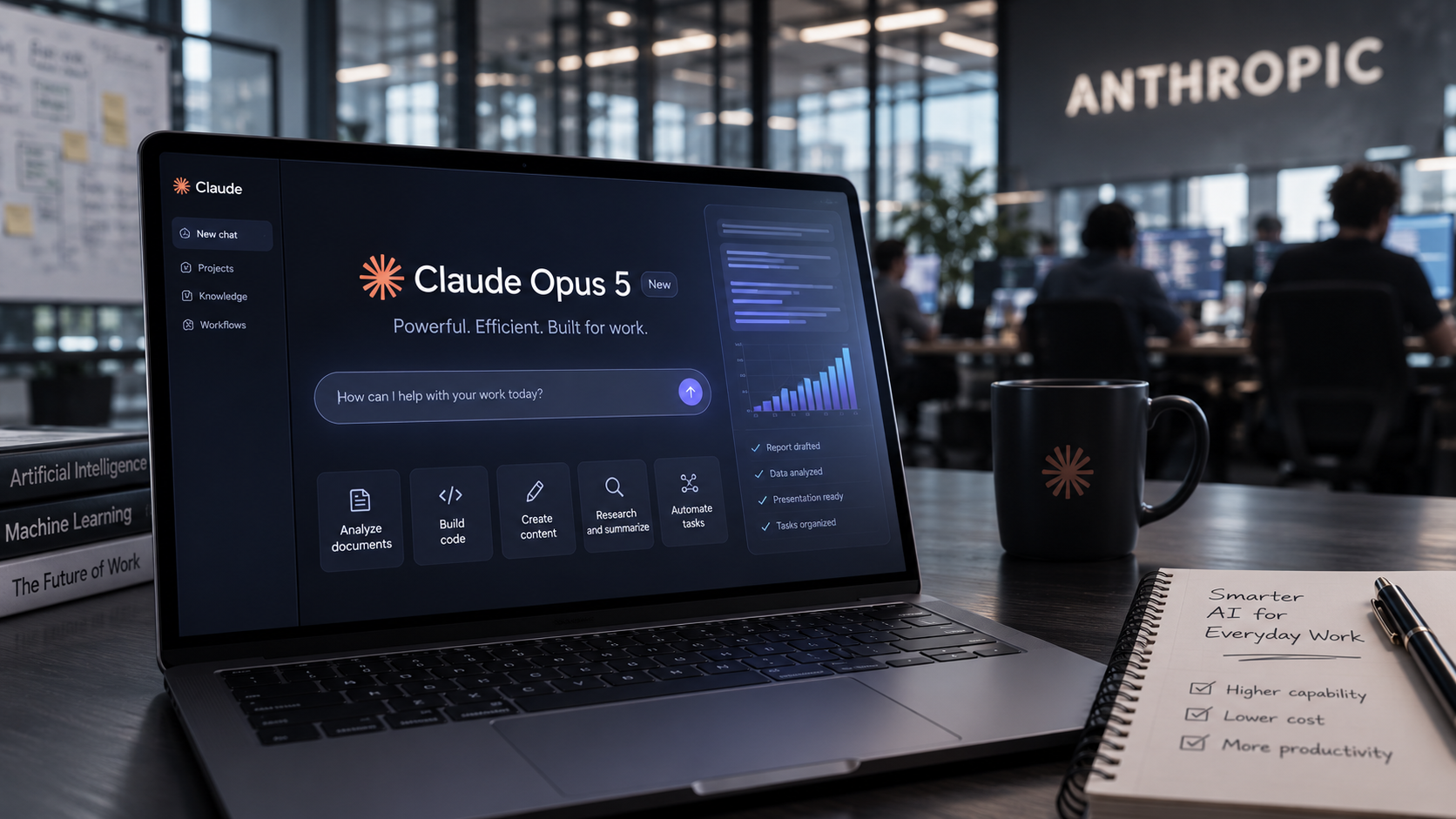
Claude Opus 5 gives Anthropic a lower-cost workplace AI model as businesses tighten budgets and Chinese developers press on price.
Half-price pitch for office users
Anthropic PBC unveiled the model on Friday, presenting it as a practical option for routine business work rather than only high-end AI experimentation. The company said Claude Opus 5 reaches near the performance of Fable 5, its top widely available product, across many categories while costing 50% less.
Anthropic said it expects the new model to become the standard choice for many everyday office tasks. That framing matters because enterprise buyers are no longer measuring AI tools only by benchmark gains; they are asking whether each query, coding task or research workflow justifies the bill.
Dianne Penn, head of research product management at Anthropic, tied the release directly to customer pressure. “We’re very much responding to this feedback from enterprises about, ‘How do I generate more value?’” Penn said.
Enterprise budgets meet China pressure
The launch comes as AI developers including OpenAI, Meta Platforms Inc. and SpaceXAI compete to offer more efficient models for corporate users. Some customers have recently tightened internal usage limits after finding that broad employee access can produce larger-than-expected costs.
China has added another layer of pressure to that pricing fight. Last week, Moonshot released Kimi K3, which it described as a more advanced open-weight model that beat all competitors except Fable 5 and OpenAI’s GPT-5.6 on overall capability.
Other Chinese developers, including DeepSeek, have also pressed US rivals by offering lower-priced alternatives. For Anthropic, Opus 5 is therefore not only a product refresh; it is a response to a market in which buyers can compare closed, premium systems with cheaper or more open options.
Coding and cyber claims draw focus
Anthropic described Opus 5 as a general-purpose model with stronger abilities to check its own work, handle scientific research and streamline coding. Coding remains one of the more valuable enterprise uses for AI because it can fit directly into software development, testing and documentation workflows.
The company also said Opus 5 is nearly as capable as Mythos 5 at finding cybersecurity vulnerabilities, but “remains substantially behind” in exploiting them. That distinction gives Anthropic a way to market defensive security use cases while limiting concern that a cheaper model will sharply expand offensive cyber capabilities.
The central bet is that companies will accept a model that is not always the most powerful if it is strong enough for common work at a lower price. In software, research and administrative tasks, that trade-off can be more important than a narrow edge on the hardest prompts.
Three paths for Opus 5 adoption
If Anthropic’s half-price pitch converts pilot projects into wider office use, global AI spending could shift toward higher volume at lower unit cost. Anthropic would gain a stronger default product for enterprise accounts, while the wider sector would face pressure to separate premium frontier models from everyday workhorses.
If Chinese open-weight systems keep improving while undercutting US pricing, corporate buyers gain more leverage in contract talks. Anthropic may need to prove that reliability, safety controls and integration support justify its pricing, while the industry moves closer to a commodity fight in mainstream business AI.
If companies remain cautious because of usage controls, budget limits or cyber risk, adoption may stay concentrated among approved teams rather than spreading across entire workforces. In that case, Anthropic’s gains would depend less on raw volume and more on governance, measurable productivity and trust in model behavior.