

Citadel Securities warns on AI trade risk with Brent above $117
AI-linked equities face pressure from profit concerns, energy risks, and financing. Meta’s Q3 results highlight why investors scrutinize AI spend.
Citadel Securities said in an Oct. 26 macro note that the AI equity trade offers a thin margin for disappointment, citing Brent crude above $117 a barrel and rising financing risks.
Citadel Securities said investors are demanding stronger evidence that AI spending can turn into profits, after Meta’s Q3 capital expenditure of about $35 billion exceeded operating cash flow of about $33 billion.
Returns under scrutiny
The firm’s call frames the recent equity decline as a reassessment of a market heavily tied to AI. The note says investors are looking harder at whether companies buying AI tools are achieving productivity gains, whether model developers can defend pricing, and whether infrastructure owners can cover financing and depreciation costs.
That matters because capital expenditure, or long-term investment in assets such as chips and data centres, can support growth but also consume cash before returns are visible. Free cash flow, the cash left after operating needs and capital spending, turned negative at Meta in Q3 under the figures cited by the note.
Citadel Securities cited Q3 capex of about $35 billion against operating cash flow of about $33 billion, with full-year guidance implying roughly $49 billion to $59 billion of additional capex in Q4.
The note said capital spending creates a two-sided risk for the AI theme. A slowdown in spending could weaken confidence in the investment cycle, while further increases may deepen concern about funding costs and future returns.
Citadel Securities did not reject the demand side of the AI story. It pointed to Ramp data showing business AI token spending, a measure of usage of AI processing units, reached a new high in early October. The firm also said falling prices mean dollar spending can understate actual usage growth.
Cheaper inference, the process of running AI models after they are trained, helps customers. For suppliers, the profit question depends on whether their costs fall as quickly as the prices they charge. The note said diversified platforms with established cash flows are better placed than heavy spenders with thin or negative free cash flow.
Politics and credit
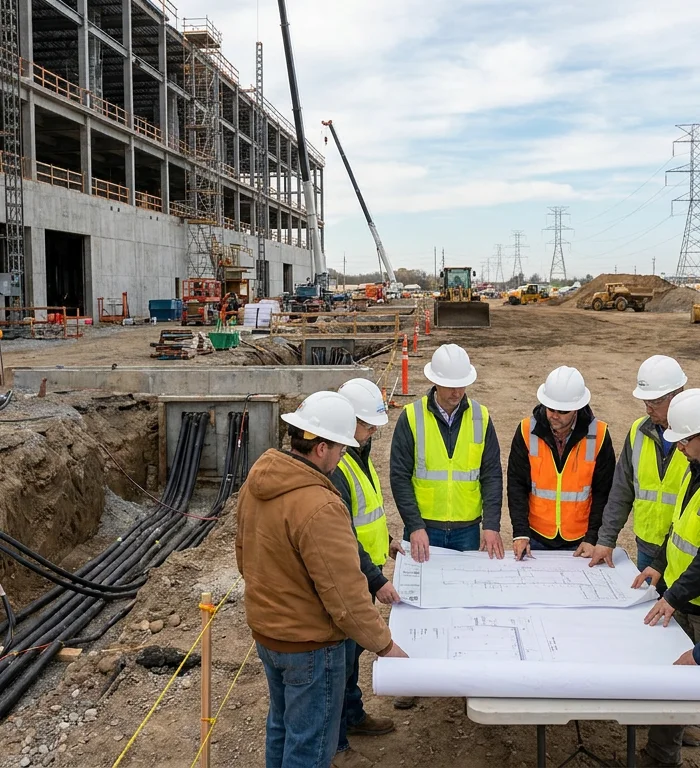
The second pressure point is the politics of data centres, the buildings that house computing equipment and power much of the AI buildout. Citadel Securities cited a Reuters/Ipsos poll showing 69% of Democratic voters and 43% of Republican voters support limits on data-centre construction.
The note also cited Pew Research Center data showing 50% of US adults viewed data centres as mostly bad for home energy costs in August, compared with 38% in January. That shift gives investors a reason to focus on permitting and local opposition, not only chip supply or model performance.
Permitting delays can raise interest costs for leveraged data-centre projects, especially when developers borrow to finance construction. Credit spreads, the extra yield borrowers pay above safer government debt, are the channel Citadel Securities highlighted: wider spreads could keep financing expensive even if Treasury yields fall.
The wider macro risk is energy. Citadel Securities said Brent crude traded above $117 a barrel this week and cited reports of possible renewed strikes on Iran after the midterms. The note linked that risk to a difficult backdrop for the Federal Reserve, which it said is already facing sticky inflation.
Fiscal easing and tariffs have also raised the cost of financing and operating the economy, according to the note. If AI investment slows while energy costs stay elevated, Citadel Securities said the Fed would face weaker growth alongside inflation pressure.
Investors will have several channels to monitor from the note’s framework. Citadel Securities cited Meta’s full-year guidance as implying roughly $49 billion to $59 billion of additional capex in Q4, reports of possible renewed strikes on Iran after the midterms, and credit spreads as a possible source of higher financing costs for leveraged data-centre projects.
Source: macro note, Citadel Securities; Forexlive, Oct. 26, 2026
More stories
- Kinross Gold faces Q3 test after 2%-3% output cut
- Private equity firms face scrutiny over third of methadone clinics
- Private equity puts $18.4bn into US healthtech deals
- JSW Cement shares fall 1.2% despite 33% revenue gain
- InstallatørGruppen Q3 revenue rises 42.8%
- Microsoft offers 60,000 workers buyouts as AI costs rise
- Anthropic revenue hits $16.29 billion before planned IPO
- Amazon faces AI funding scrutiny before $202.2bn Q3 sales
- Loop Capital cuts Apple target to $330 on iPhone forecast
- Damen challenges Rheinmetall's Mangalia deal at 75% of start
Latest news
- Ruto seeks Russian investment in Kenya's $380m trade push
- Sudan teachers seek 20% budget share with 8m children outside school
- Spain rail network faces scrutiny after 64 killed near Toledo
- Spain reports at least 30 dead in high-speed train crash
- TCM faces uncertainty under Paramount Skydance's $80bn debt
- Villa Vie disembarks 203 passengers in Cambodia over fuel costs
- NEITI faces methane data questions over 18 incomplete records