China oil throughput rises as fuel exports recover in August
China oil throughput climbed to 13.91 million bpd in August as export curbs eased, though runs remained below year-earlier levels.
Atlas Newsdesk ·
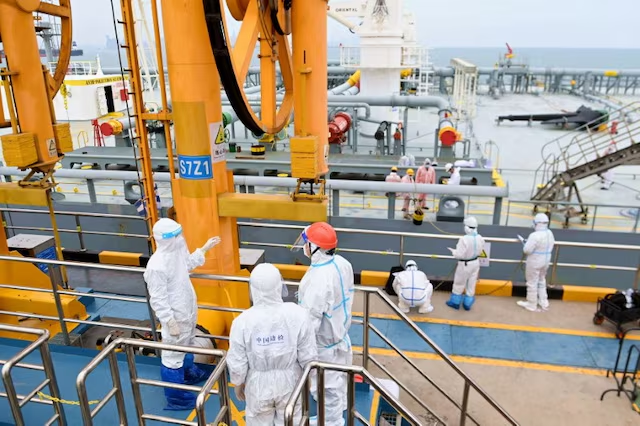
China oil throughput rose to 13.91 million barrels per day in August as fuel exports recovered after Beijing eased restrictions in mid-July.
The National Bureau of Statistics said refiners processed 59.07 million metric tons of crude in August, up 11.2% from July but down 6.9% from a year earlier. The increase marked a second straight monthly gain after June runs fell to levels last seen during the COVID period.
Export quotas revive refinery runs
Analysts linked the August rebound to stronger refined fuel shipments after Beijing relaxed export limits that had been used to protect domestic supply. Higher oil prices during the Iran war and tighter product export controls had weighed on domestic consumption before the policy easing.
Emma Li, an analyst at Vortexa, said export demand is still doing much of the work for refiners. "Crude processing is being supported by exports and will likely remain so in the coming months, as higher oil prices will only curb domestic demand," Li said.
Inventory drawdown limits the cushion
China's domestic crude production rose 0.8% from a year earlier to 18.43 million metric tons in August, equal to 4.34 million bpd, the official data showed. For the first eight months, crude output reached 146.39 million metric tons, up 0.9% from the same period last year.
Throughput over January to August totaled 456.12 million metric tons, or 13.7 million bpd, down 6.6% from a year earlier, according to the statistics bureau. Natural gas production rose 0.8% in August to 21.4 billion cubic meters, while year-to-date output increased 1.1% to 175.7 billion cubic meters.
Beijing does not disclose reserve levels. A calculation using official crude imports, domestic production and refinery throughput indicated a 639,000 bpd stock draw in August, compared with 936,000 bpd in June, the largest draw since the Iran war began.
Seaborne supply tests policy
Vortexa said China's seaborne crude arrivals are expected to keep recovering in September and October, reaching about 8 million bpd if no further disruptions occur. Arrivals for November and December remain less clear, though the firm said refiners have enough onshore crude inventories to absorb a disruption in seaborne flows.
Li said inventory use can protect the domestic market, but export-led refining needs fresh crude purchases if margins remain favorable. "Using inventories to ensure domestic supply is not a problem, but relying on them to boost exports is not sustainable. State-owned refiners are therefore still trying to buy crude to support higher exports, as export margins remain strong," Li said.
October risk narrows export room
Vortexa said inventories built since 2025 would likely last until around year-end if state-run plants raise stock draws to 1 million bpd. Ye Lin, vice president at Rystad Energy, tied the policy risk to attacks on the Saudi East-West pipeline and further escalation around the Strait.
"Following attacks on the Saudi (East-West) pipeline and the risk of further escalation in the Strait, fuel-export restrictions could be reimposed at any time after October," Ye said. "If the government prioritises energy security, it should halt exports. But if refining margins and the economy still matter, exports should continue," Ye said.
If Beijing keeps export flows open, state-owned refiners can run harder and sell more fuel into regional markets, adding product supply at the margin and easing pressure on buyers exposed to Asian cargoes. That path would support refinery utilization, but it would also require continued crude procurement or faster stock draws.
If restrictions return after October, refiners would have more incentive to reserve fuel for the domestic market and reduce export-oriented runs. The industry risk is a squeeze in regional product supply, while the macro channel would run through fuel prices and import bills in economies dependent on seaborne refined products.