China industrial output rises as consumers pull back again
China industrial output beat forecasts in August, but weaker retail sales and falling investment showed manufacturing strength is not lifting household demand.
Atlas Newsdesk ·
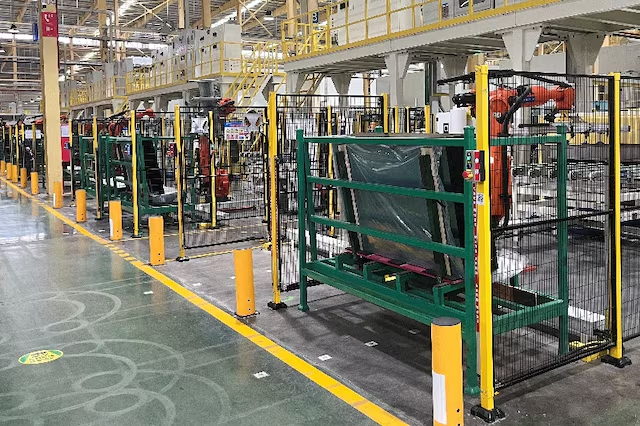
China industrial output rose 5.2% in August, beating forecasts while tech manufacturing strengthened. Retail sales slowed, exposing a weaker domestic engine.
Figures from the National Bureau of Statistics showed industrial production quickened from 4.5% in July and topped expectations for a 4.8% gain. The split kept pressure on Beijing to support demand without leaning further on factories and exports.
Factories beat August forecasts
Equipment producers and high-tech manufacturers led the August output gain, according to the statistics bureau. The performance extended a pattern in which advanced manufacturing has carried more of China’s growth while household spending remains restrained.
Retail sales rose 0.4% from a year earlier, slowing from 0.6% in July and falling short of expectations for a 0.8% increase. For policymakers, the gap is narrow but important: production is expanding faster than the domestic demand needed to absorb it.
The August data followed second-quarter GDP growth of 4.3%, the slowest pace in more than three years and below the lower end of China’s 4.5% to 5.0% annual target. Lynn Song, ING’s Greater China chief economist, said third-quarter growth would probably remain subdued without an unexpectedly strong September.
Property slide deepens investment drag
Fixed-asset investment, which covers infrastructure and property spending, fell 7.2% in the first eight months of the year. The decline was the steepest since April 2020, the statistics bureau’s data showed.
Property investment dropped 19.9% in January to August from the same period a year earlier. New home prices also extended their month-to-month declines, adding to evidence that the housing correction is still weighing on confidence and balance sheets.
The property strain feeds through several channels: developers cut projects, households delay purchases, and local governments receive less support from land sales. Oxford Economics lowered its 2026 growth forecast by 0.1 percentage point to 4.7% and cut next year’s view to 4.3% from 4.6%, citing a longer property downturn despite stronger public investment.
High-tech investment offered a counterweight, rising 5.2% in the first eight months from a year earlier. Output of lithium-ion batteries increased 57.2% year on year, while industrial robot production climbed 34.6%, in line with demand linked to AI infrastructure and automation.
Measured support shapes scenarios
Markets showed limited reaction after the release. Mainland stock benchmarks including the .SSEC and .CSI300 were roughly 0.3% lower, while the yuan weakened slightly against the dollar following data that showed manufacturing resilience and soft domestic demand.
Fu Linghui, a spokesperson for the statistics bureau, said external conditions remained complex while domestic structural adjustment pressures persisted. Four typhoons made landfall in August, disrupting parts of the east-coast manufacturing and logistics corridor, according to the official data briefing.
Beijing has accelerated government bond issuance and expanded loan interest subsidies for small private firms and consumers. The central bank has pledged additional policy support, though it has not signaled specific cuts to policy rates or banks’ reserve-requirement ratio.
If high-tech demand holds and September activity improves, China could stay closer to its annual growth target, easing pressure on global manufacturers tied to electronics and capital goods. That path would favor advanced equipment producers, but it would not by itself repair household demand.
If the property downturn deepens instead, the drag would run through construction, local government finance and consumer confidence. That would leave China more dependent on exports, intensify price pressure in global goods markets and slow the recovery in housing-linked industries.
If Beijing shifts toward stronger household support, consumption could take a larger role in growth while reducing reliance on factory output. The main open question is whether policymakers are willing to direct more stimulus to households rather than infrastructure and industrial investment.