

China expands Yaogan 51 satellite fleet to 9 spacecraft
Analysts cited by TechTimes said the added triplet may move the constellation toward persistent passive surveillance over contested Indo-Pacific waters.
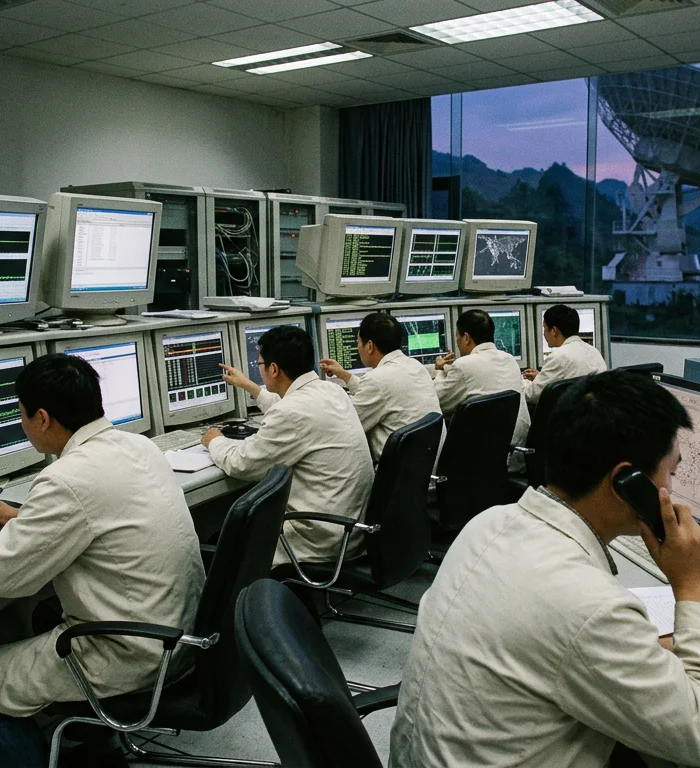
China launched three Yaogan 51 satellites on Thursday, November 5, expanding the sub-series to nine spacecraft, TechTimes reported in a trade-press article published that day.
Analysts cited by TechTimes said nine satellites may allow near-persistent passive surveillance in the Indo-Pacific, while a US Defense Intelligence Agency report released October 26 counted more than 510 Chinese intelligence, surveillance and reconnaissance satellites as of July. That DIA figure was more than triple the 2018 level.
The spacecraft, designated Yaogan 51-07, Yaogan 51-08 and Yaogan 51-09, lifted off at 15:58 UTC from the Xichang Satellite Launch Center in Sichuan Province aboard a Long March 2C rocket. Chinese authorities declared the mission successful after separation, TechTimes reported.
Beijing officially characterizes Yaogan spacecraft as civilian remote-sensing assets for land surveys, crop estimates and disaster response. TechTimes said Western defense analysts and the DIA assess the electronic-intelligence triplet sub-series as part of a military reconnaissance network.
TechTimes described the surveillance method as time-difference-of-arrival geolocation. Three satellites receive emissions from ship radar, communications or navigation systems at slightly different times, allowing analysts to calculate an emitter's position without the satellites transmitting signals themselves.
A single triplet has limited persistence over a fixed point, TechTimes reported. At nine satellites, potentially arranged as three triplets in separate orbital planes, the constellation may provide near-continuous radio-frequency coverage, according to the article. The regions identified were the South China Sea, Philippine Sea and western Pacific approaches tied to Taiwan or the Korean Peninsula.
The DIA's October report said China had surpassed 510 operational ISR satellites by July. TechTimes also cited analysts who argue that figure may not capture all surveillance data available to the People's Liberation Army because China's military-civil fusion framework can draw on commercial Earth-observation operators.
Beijing's public description of Yaogan satellites differs from the Western military assessment cited by TechTimes. The article linked the analysts' argument on commercial access to China's 2017 National Intelligence Law and 2021 Data Security Law.
Thursday's mission was the 89th flight of the Long March 2C and the fifth by that rocket in 2026, TechTimes reported. It was also China's 78th orbital launch of 2026, according to the article.
More stories
- Poland starts 2 days of mourning over 6 Krakow deaths
- Home Office faces suit over almost 1,500 EU residency cases
- Uganda ties construction push to $500bn economy target
- Armenia faces EU democracy test over opposition cases
- Cambodia freezes more than $300m in scam crackdown
- Kyiv energy strikes disrupt utilities before peace talks
- Israel faces UN warning over 70% Gaza deployment aim
- RSA Facts chatbot generates false R1,500 grant notice