Blackstone Kuwait office plan deepens Gulf capital push
Blackstone plans a Kuwait office in the third quarter, extending its Gulf presence as private capital competition rises.
Atlas Newsdesk ·
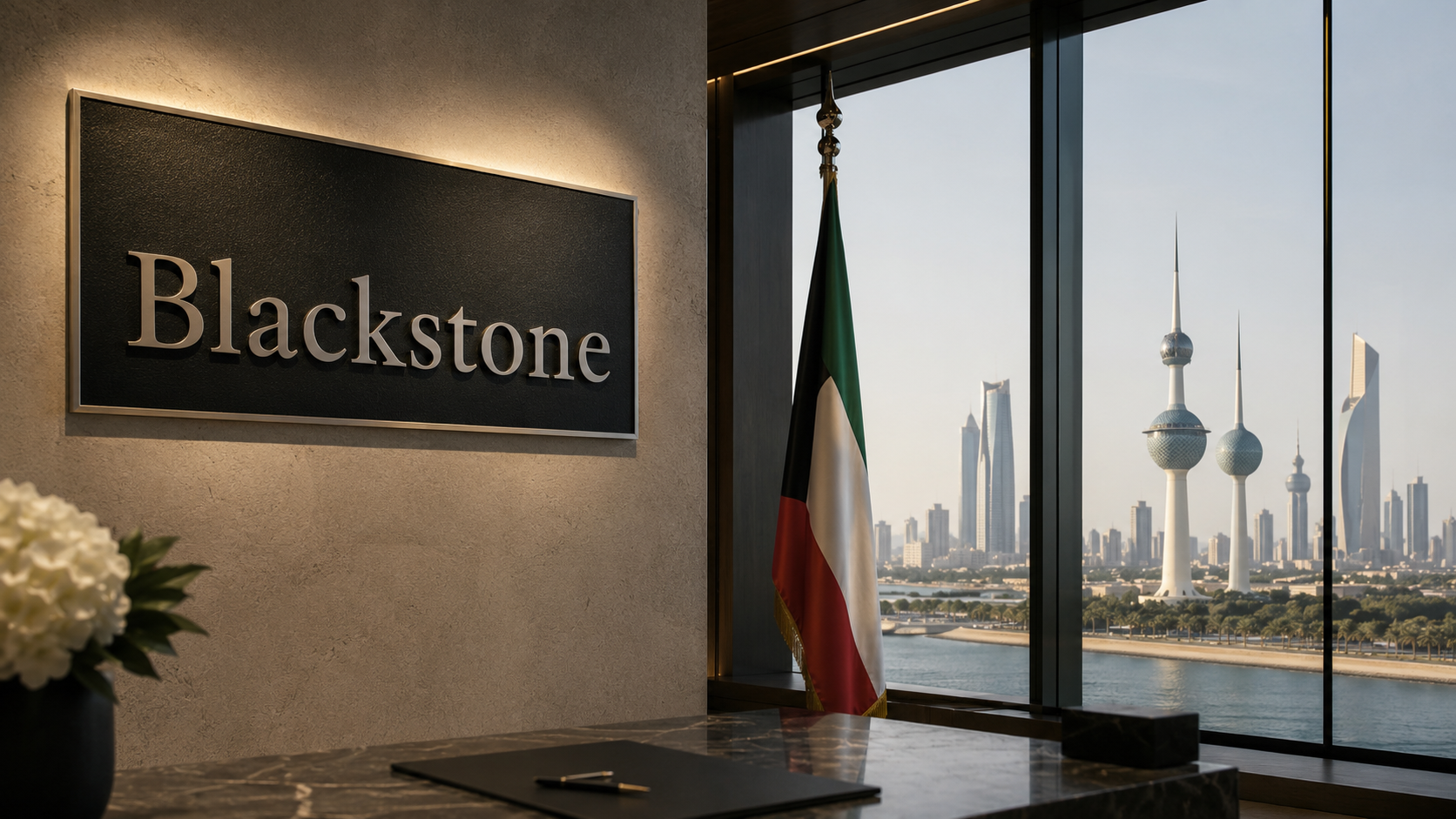
Blackstone Kuwait office plans put the asset manager closer to Gulf capital as Kuwait courts private investment despite regional tensions. The New York-based alternatives group said Monday it expects to open the office in the third quarter through the Kuwait Direct Investment Promotion Authority.
The move would give Blackstone its second office in the six-country Gulf Cooperation Council after Abu Dhabi. The firm, which said it manages $1.35 trillion in alternative assets, also said it intends to add more offices across the GCC over the next year.
Kuwait gets Blackstone’s second GCC base
Blackstone is positioning the Kuwait office as part of a longer commercial relationship rather than a one-off expansion. President Jon Gray said Kuwait has “the resources, vision and leadership to be a key commercial and financial hub in the region.”
Gray also tied the office to Kuwait’s economic reform agenda, saying: “Private capital can play an important role to support the country’s long-term economic diversification efforts and we look forward to deepening a partnership that spans nearly four decades.” The statement did not disclose staffing levels, investment targets or the exact opening date.
The Kuwait Direct Investment Promotion Authority route matters because it gives the office a formal local entry point in a market where relationships with public institutions carry unusual weight. For global asset managers, a local base can shorten the distance between investment teams and large pools of sovereign and institutional capital.
$16 billion pipeline deal sets context
The office plan follows a separate $16 billion infrastructure partnership involving Blackstone, Brookfield Asset Management Ltd. and KKR & Co. tied to Kuwait’s oil-export pipelines. The transaction has been described as the largest foreign direct investment in Kuwait’s history, making it a clear backdrop to Blackstone’s decision to build a local presence.
Kuwait is becoming a more contested market for private equity, private credit and infrastructure managers. The competition is centered on mandates from the Kuwait Investment Authority and other major institutions, rather than serving the country only from established regional bases such as Dubai or Abu Dhabi.
Other large investment firms have been moving in the same direction. Partners Group and Carlyle Group Inc. have announced Kuwait office plans, while BlackRock has named a country head and opened a local office, according to the source material.
Gulf capital race intensifies
The deeper industry shift is the effort by alternative asset managers to move nearer to Gulf sovereign wealth funds as they expand overseas allocations. A physical office can help firms source infrastructure, credit and private equity deals while competing for long-term capital commitments.
For Kuwait, the attraction is different: foreign managers can bring deal structuring, global networks and co-investment capacity to a diversification strategy still linked closely to oil wealth. The pipeline partnership shows how energy infrastructure can become a bridge between Kuwait’s hydrocarbon base and broader private capital participation.
The risk is that the regional security backdrop complicates investment timing. The source text describes a pause in U.S. strikes against Iran, Iranian restraint from retaliation and talks involving Oman over the Strait of Hormuz, a waterway central to Gulf energy flows.
If the current lull holds, the global macro effect would likely be lower pressure on energy-risk premiums, while Blackstone could open the Kuwait office into a more stable fundraising and dealmaking environment. The wider alternatives industry would then face a faster race to localize teams and win mandates before rivals lock in institutional relationships.
If tensions around Iran or the Strait of Hormuz flare again, the macro channel would run through shipping risk, oil-market volatility and investor caution toward Gulf exposure. For Blackstone, that could slow office buildout or deal execution, while private capital competitors may place greater emphasis on defensive infrastructure, credit protections and country-risk pricing.
The main open questions are practical rather than symbolic: how quickly Blackstone staffs the office, whether the pipeline partnership leads to further Kuwait mandates, and how Gulf security conditions affect cross-border capital flows. Those answers will determine whether the Kuwait office becomes a regional anchor or a smaller relationship platform.