

U.S. faces loss of measles elimination status after 5,412 cases
PAHO is expected to announce its decision Nov. 17 after reviewing sustained transmission from a West Texas outbreak that began in January 2025.
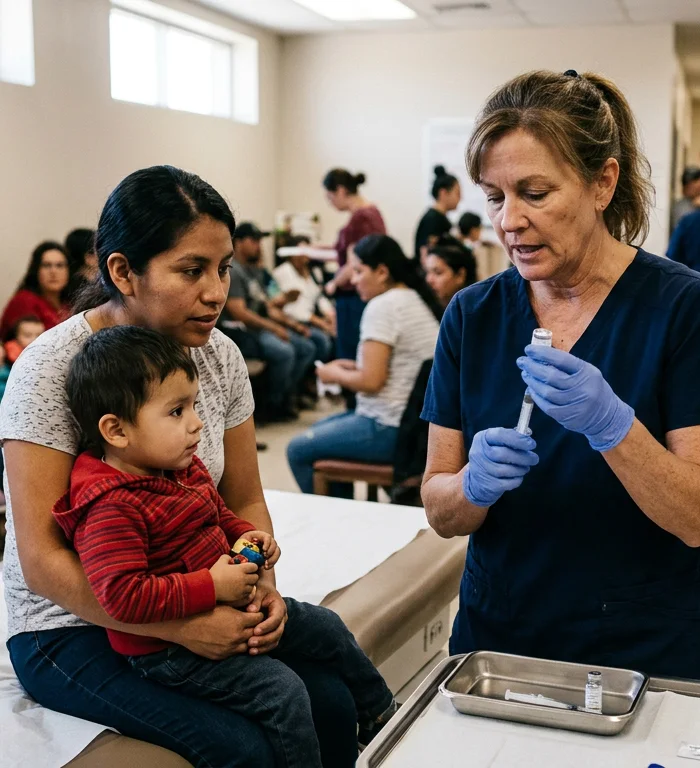
The U.S. is expected to lose measles elimination status after 26 years, with 5,412 confirmed cases in 2026 as of Nov. 12, Healthline News reported on Nov. 16.
The expected decision by the Pan American Health Organization matters because CDC data show the highest annual U.S. measles total since 1991, more than double the 2,289 cases recorded in 2025.
Researchers familiar with the discussions told KFF Health News that PAHO, the World Health Organization’s regional office for the Americas, determined this week that measles has again spread through sustained U.S. transmission. PAHO is expected to make an official announcement on Nov. 17.
The review examined spread beginning Jan. 20, 2025, when the first person became ill in a large West Texas outbreak, according to CDC information cited by Healthline. A country loses elimination status when the same virus genotype and lineage circulate without interruption for at least 12 months, according to PAHO.
Andi Shane, chief of pediatric infectious diseases at Children’s Healthcare of Atlanta, called the expected loss “a public health alarm that we are not being effective and we’re not controlling measles as well.” She said, “For the past 12 months in the United States, we’ve had ongoing circulation of the measles virus and person-to-person transmission is occurring.”
William Moss, a professor of epidemiology at the Johns Hopkins Bloomberg School of Public Health, told Healthline: “There’s really been very little measles in the United States over the past 25 years until January 2025.” He said losing the designation itself would not change much day to day for most Americans, but called the outbreaks, hospitalizations and deaths behind it “a big red flag.”
Measles spreads through the air when an infected person coughs or sneezes, and people can be infected in a room for up to two hours after an infected person has left, according to the CDC. Two doses of the measles, mumps and rubella vaccine are about 97% effective, the CDC says.
Vaccination patterns are central to the public-health concern. About 96% of U.S. measles cases this year were in people who were unvaccinated or whose vaccination status was unknown, up from 93% in 2025, according to CDC data cited by Healthline.
CDC figures also show kindergarten MMR coverage falling from 95.2% in the 2019-2020 school year to 92.4% in 2025-2026. About 280,000 kindergartners began the 2025-2026 school year without records showing completion of the MMR series, the CDC reported.
Before vaccination, measles infected an estimated 3 million to 4 million people in the U.S. each year, according to the CDC. Among reported cases, about 400 to 500 people died annually, 48,000 were hospitalized and 1,000 developed encephalitis, or brain swelling.
The U.S. can regain elimination status. Brazil lost the designation in 2019 and regained it in November 2024, while Venezuela lost it in 2018 and regained it in 2023, according to PAHO. Canada lost its status in November 2025, and the U.K. and five European countries lost theirs earlier in 2026.
Source: Healthline News article, Nov. 16, 2026.
Atlas360 reports health research and does not provide medical advice.
More stories
- Tumaini trial to test 2 Bundibugyo Ebola vaccines in DRC
- GSK wins FDA approval for Nelkarmi after 49% response rate
- Europe faces 35,000 drug-resistance deaths a year
- Congo Ebola outbreak spreads to 8 provinces
- Daily iron tablets cut anaemia risk in children across 114 studies
- Americans face health concerns from 6-8 daily sitting hours
Latest news
- 30-year mortgage APR falls 8bp to 7.19%
- Vehicle service contracts can cost several thousand dollars a year
- South Africa recycles 301,000 tonnes of plastic waste
- Iran caps subsidized bread at 8kg a month in three provinces
- Jeff Buckley track tops 500,000 TikTok uses this year
- Iraq hits suspected ISIS sites with 2 strikes after US exit
- Singapore charges 2 men over 19 deregistered vehicles
- Kenya construction regulators face scrutiny after 84 collapses