

Congo Ebola outbreak spreads to 8 provinces
Africa CDC cited more than 11,200 infections, 5,500 deaths and $1.6 billion in unreleased aid as containment efforts struggle.
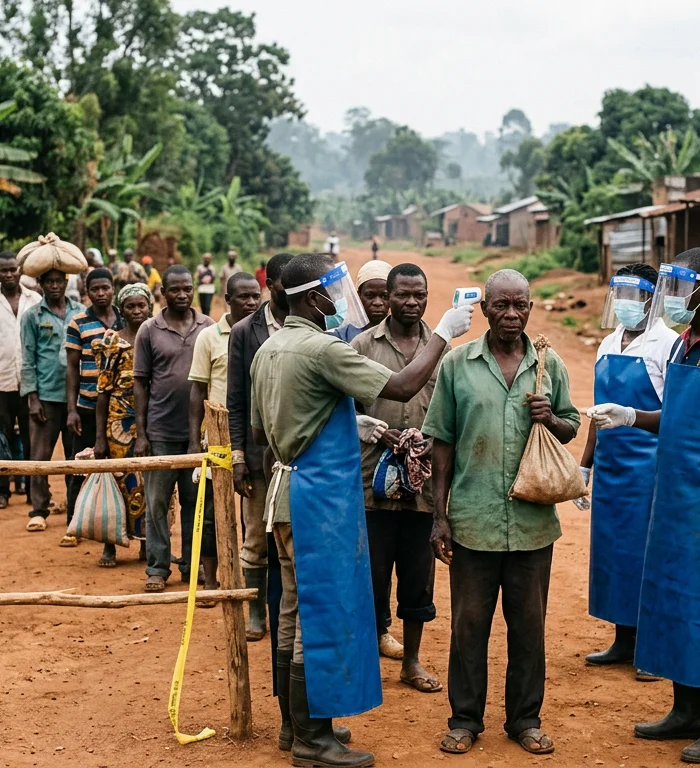
Africa CDC said on Sunday the Ebola outbreak in the Democratic Republic of Congo remains uncontrolled six months after its May 15 declaration, with the virus now reported in eight provinces, RFI reported.
The warning raises the regional stakes around an epidemic that government data put at more than 11,200 infections and 5,500 deaths, making it the second-largest Ebola outbreak on record after West Africa in 2014-2016.
Jean Kaseya, director-general of the Africa Centres for Disease Control and Prevention, told RFI the outbreak was still expanding despite containment work by Congolese authorities and international partners.
“We are all in agreement today to say that this outbreak is still serious, and is still not under control,” Kaseya said on Sunday. In the same interview, he called the outbreak “extremely serious.”
The outbreak began in Ituri and is driven by the Bundibugyo species of Ebola, a rarer form of the virus. More than 80% of new cases are being found in people who were not on contact-tracing lists, while more than 65% of deaths are taking place in communities rather than health facilities, Kaseya said.
Those indicators point to weak surveillance and delayed isolation of patients. Ebola is most contagious in the late stages of illness, making deaths outside treatment centres a major obstacle for response teams.
Kaseya warned that the outbreak could become the world’s largest if containment fails. The 2014-2016 West Africa epidemic infected more than 28,600 people and killed more than 11,000, according to the RFI report.
The outbreak has also crossed borders during the past six months, reaching Uganda, Kenya and Nigeria. Kaseya said Uganda had brought the epidemic under control, Kenya’s situation had improved after the last monitored patient was discharged, and Nigeria’s position also appeared contained.
The Africa CDC chief said he remained concerned about further spread from the DRC, naming the Central African Republic and South Sudan as major concerns. He also cited possible risks to Rwanda and Burundi if transmission moves from the Beni-Butembo area toward Goma and Bukavu.
A central scientific gap is the absence of an effective vaccine against the Bundibugyo strain. Kaseya said such a vaccine “should have been available for the past 19 years, given that the Bundibugyo strain has been known for that long.”
Research is under way, according to RFI’s Kinshasa correspondent. The Tumaini clinical trial is focused on vaccine development, while a World Health Organization expert group has recommended adding two vaccine candidates designed for the Bundibugyo virus. A separate Ebo-Pep trial is testing whether the oral antiviral obeldesivir can prevent disease in exposed people.
The response is also constrained by insecurity in eastern Congo, population movements and weaknesses in health systems and disease surveillance. Around $2.9 billion has been pledged internationally, but Kaseya called on donors to release about $1.6 billion in pledged aid and coordinate more closely with Kinshasa.
Médecins Sans Frontières warned last week that assistance was not reaching some of the worst-hit areas, citing shortages of trained staff, ambulances without fuel and gaps in surveillance teams. Kaseya said some health workers had not been paid for months and that the Congolese government was working to digitise its payroll system.
“We are not pointing fingers,” Kaseya said. “We are saying it’s a collective failure.”
Source: RFI interview distributed by AllAfrica, Nov. 17, 2026
More stories
- Tumaini trial to test 2 Bundibugyo Ebola vaccines in DRC
- GSK wins FDA approval for Nelkarmi after 49% response rate
- Europe faces 35,000 drug-resistance deaths a year
- U.S. faces loss of measles elimination status after 5,412 cases
- Daily iron tablets cut anaemia risk in children across 114 studies
- Americans face health concerns from 6-8 daily sitting hours
Latest news
- 30-year mortgage APR falls 8bp to 7.19%
- Vehicle service contracts can cost several thousand dollars a year
- South Africa recycles 301,000 tonnes of plastic waste
- Iran caps subsidized bread at 8kg a month in three provinces
- Jeff Buckley track tops 500,000 TikTok uses this year
- Iraq hits suspected ISIS sites with 2 strikes after US exit
- Singapore charges 2 men over 19 deregistered vehicles
- Kenya construction regulators face scrutiny after 84 collapses