UK auto industry faces EU threat on Chinese tariff row
The UK car industry faces a China-EU tariff dilemma as Chinese brands lift sales while Brussels weighs barriers on British exports.
Matteo Ricci ·
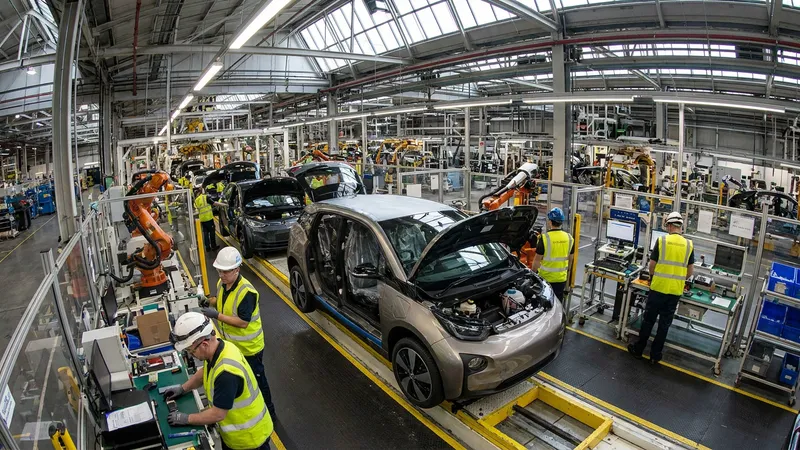
The UK car industry faces a China-EU tariff squeeze, with Europe taking 58% of exports and Brussels weighing barriers. Tariffs are the fault line.
Brussels presses tariff choice
Britain has avoided import duties on Chinese vehicles, leaving it apart from the US, which has largely shut them out, and the EU, which applies duties of up to 45%. Ministers are now balancing access to cheaper cars and Chinese investment against the risk that Brussels limits UK-built vehicles in their largest export market.
EU officials are reported to have warned Andy Burnham last month that Britain should tax low-cost Chinese vehicles or face protectionist "made in Europe" barriers on exports to the bloc. Jonathan Reynolds, the business secretary, has resisted that approach, arguing that UK levies would "probably be reciprocated" and could cost British manufacturers sales in China.
The European Commission’s rules restrict subsidies, tax breaks and public procurement contracts to vehicles made inside the EU. The Society of Motor Manufacturers and Traders said the EU took 58% of UK car exports in the first half of the year, compared with about 4% for China.
Chinese brands lift sales
Chinese carmakers have become more visible in Britain as buyers seek lower-priced electric and hybrid models. Industry figures show BYD, Omoda and Jaecoo more than tripled their combined share of the UK new-car market in the first eight months of 2026, reaching 12% of sales.
Preliminary figures from the Society of Motor Manufacturers and Traders showed new car registrations rose 12% in the year to September, the strongest annual growth for that month since 2017. The trade body said electric vehicles and Chinese brands powered the increase, with the Jaecoo 7 and BYD Sealion 7 among the top sellers.
Ian Plummer, commercial director at Autotrader, said competition from Chinese brands had made cars more affordable and "is encouraging more people to go and buy a new car". That consumer benefit is part of the government’s tariff problem: duties could protect factories, but they would also raise the entry price for some buyers.
Sunderland talks sharpen stakes
Chery, which owns the Jaecoo and Omoda brands, is in talks to build cars at Nissan’s Sunderland plant. Victor Zhang, Chery’s deputy UK chief, rejected the idea that the UK could be used as a back door into Europe, saying: "Most of what we sell are super-hybrids, not the cars that those tariffs are about, and the cars we sell here stay here."
Nissan’s European chair, Massimiliano Messina, put the opposite case last month. "Europe cannot have a Trojan horse where the Chinese are going to flood the market through the UK," he said, framing the UK’s open stance as a risk for European policymakers.
The industry is also divided inside Britain. Tim Tozer, a former chair of Vauxhall, said tariffs were "vital" to stop Britain’s car sector "atrophying", while Emily Sawicz of RSM UK said the UK "cannot afford to drift between the two indefinitely".
Two paths for ministers
If ministers add tariffs, the immediate mechanism would be price support for UK and European producers, with higher costs for British buyers and a possible check on Chery’s Sunderland talks. At the macro level, Britain would move closer to the EU’s managed-trade line; for the sector, it could reduce the risk of EU exclusion while increasing the risk of Chinese retaliation.
If ministers keep tariffs off, cheaper Chinese models could continue lifting UK registrations and making Britain more attractive to Chinese investors. The trade-off is that Brussels may harden "made in Europe" barriers, which would hit UK manufacturers through the market that still accounts for 58% of their exports.