

Turkey's science medals give Washington a new NATO tech problem
Turkey says its students won a record 78 medals in international science olympiads in 2026.
Turkey's science medals give Washington a new NATO tech problem
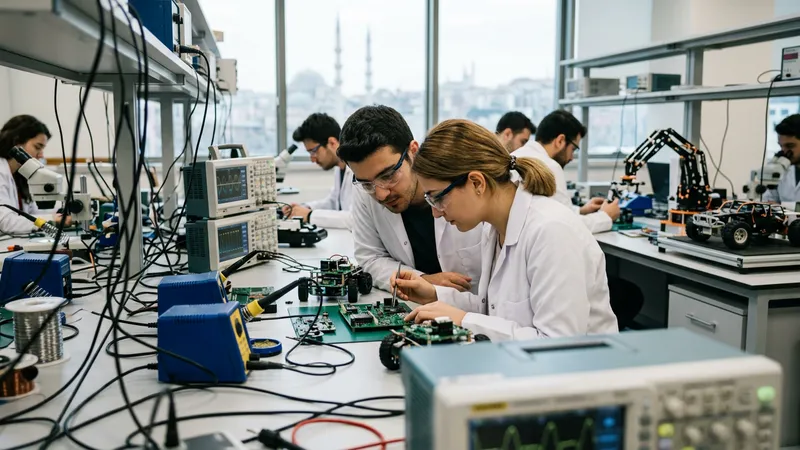
Turkey's government said on March 29, 2026, that its students won a record 78 medals in international science olympiads, giving Washington another data point in a larger argument over technology, sovereignty and leverage inside NATO.
Industry and Technology Minister Mehmet Fatih Kacır presented the medal total as the highest in Turkey's history, according to the announcement. For US officials, the immediate issue is not the contests themselves; it is whether Ankara's expanding pool of science and engineering talent reduces American influence over a NATO ally already pursuing a more independent defense-industrial path.
Turkey has spent years framing technology policy as a strategic project rather than a narrow education or industrial agenda. Ankara's national technology push, widely associated with the phrase Milli Teknoloji Hamlesi, aims to build domestic capacity in areas that can feed both civilian industry and defense production.
That matters in Washington because Turkey is not just another emerging technology market. It is a NATO ally, a major regional military actor and a country whose defense choices have repeatedly tested US assumptions about alliance discipline, procurement dependence and export-control leverage.
Technology Minister Mehmet Fatih
The 78-medal figure is a soft metric, not a direct measure of industrial output. Science olympiads do not produce missile engines, drone software or secure chips on their own. But they can signal a deeper pipeline: students who later enter engineering programs, research labs, defense contractors and state-backed technology ventures.
Washington's Turkey file usually runs through several institutions at once. The State Department handles arms sales and diplomacy; the Pentagon weighs military interoperability and alliance planning; the Commerce Department oversees many dual-use export controls; Congress can block or condition sensitive transfers. The National Security Council often has to reconcile those channels when Turkey policy crosses from diplomacy into defense technology.
That bureaucracy has tended to focus on hard disputes: air-defense systems, fighter aircraft, sanctions exposure, Syria policy and the future of NATO interoperability. A record medal count will not displace those questions. It may, however, sharpen the policy problem beneath them: Turkey is trying to become less dependent on foreign suppliers in precisely the fields where Washington has traditionally held influence.
The distinction matters. A country that depends on imported platforms and foreign-certified upgrades has to negotiate around supplier approval. A country that can train more engineers, absorb more research and build more domestic subsystems has more room to bargain, delay, substitute or walk away.
That is why human capital belongs in the same conversation as export licenses. Controls on sensitive technology work best when the controlled item is scarce, hard to reproduce and embedded in supplier relationships. They become less decisive when a partner can assemble alternative supply chains, develop domestic substitutes or use civilian research capacity for defense-adjacent purposes.
Turkey's science olympiad result does not prove that transition has happened. It does suggest Ankara wants outsiders to see technical education as part of national power. Kacır's decision to highlight the medal tally through the industry and technology portfolio, rather than only as a schools story, fits that message.
For the White House, the policy choice is awkward. Treating Turkey only as a difficult arms customer risks missing the longer shift in its technology base. Treating Turkey as an emerging peer in sensitive defense technology would overstate the evidence and could harden political positions before US agencies have agreed on a framework.
The middle ground is more likely: Washington watches whether Turkey's student and research pipeline begins to appear in bilateral agendas that used to center on weapons platforms, basing access and regional crises. That would mark a change in how US officials define leverage.
The immediate company-level effect is less clear because Kacır's announcement did not name a single contractor as the beneficiary of the 78 medals. In practical terms, the firms most likely to care are Turkish defense, aerospace, software and advanced manufacturing groups competing for engineers who can work across mathematics, coding, electronics and materials science.
The sector effect could be broader. If Turkey keeps presenting youth science performance as part of its technology sovereignty strategy, domestic universities, research councils and defense-linked companies may face pressure to convert student success into funded laboratories, internships and procurement pathways. The mechanism is political as much as economic: a medal count becomes evidence for more state support.
For the global macro picture, the medals sit inside a wider fragmentation of technology supply chains. US policy increasingly treats advanced chips, artificial intelligence, aerospace systems and dual-use components as strategic assets. Countries that can train more technical workers can push for a larger share of those supply chains, or build national alternatives when access is restricted.
For Washington, the risk is miscalibration. If US officials underestimate Turkey's domestic technical capacity, export controls may deliver less leverage than expected. If they overestimate it, they may restrict cooperation unnecessarily and push Ankara toward less transparent networks of suppliers and research partners.
The falsifiable test is whether US officials place Turkey's emerging technology workforce on the formal bilateral agenda by June 15, 2026. If a US-Turkey Defense Industrial Cooperation Group meeting, Joint Economic Commission agenda or senior State Department or Pentagon statement explicitly links Turkey's domestic talent base to defense trade, export controls or dual-use research cooperation, the Washington view will have shifted from transactional arms management toward a broader technology-sovereignty file.
If the agenda remains confined to legacy sales, including fighter upgrades and routine defense-industrial disputes, the medal count will have stayed in Ankara's political narrative rather than becoming a driver of US policy.
More stories
- Trump claims Ukraine-Russia energy ceasefire agreement
- Zelensky condemns US-Russia diesel deal as Putin gift
- Lebanon seizes 500 kg explosives tied by officials to Hezbollah
- ODM power-sharing demand tests Ruto as Washington watches Kenya stability
- France condemns Houthi attack on Riyadh airport
- Riyadh airport attack kills 12, Saudi aviation body says
- Israeli army strikes southern Lebanon despite ceasefire
- UAE Classifies Cockpit Axe Attack as Terrorism, Citing Co-Pilot's Extremist Views
Latest news
- Trump announces Russia-Ukraine energy ceasefire as fuel prices climb
- HCW Biologics leads Cardio Diagnostics on 9 of 14 measures
- Rwanda to Host Formula 1 Grand Prix by 2030, Bypassing South Africa
- Audi Invests in Swiss Campus for Formula 1 Team
- F1 Teams Divided Over Spending Rule Changes Amid Talent Drain Warning
- FIA Addresses F1 Power Unit Glitch After Malaysia Grand Prix
- Nintendo Life polls 673 readers on Ocarina pronunciation