Trump hosts Xi at White House dinner as Washington tests China reset
President Trump’s White House dinner for Xi Jinping gives Washington a visible opening for renewed high-level diplomacy with Beijing.
Lauren Collins ·
Trump hosts Xi at White House dinner as Washington tests China reset
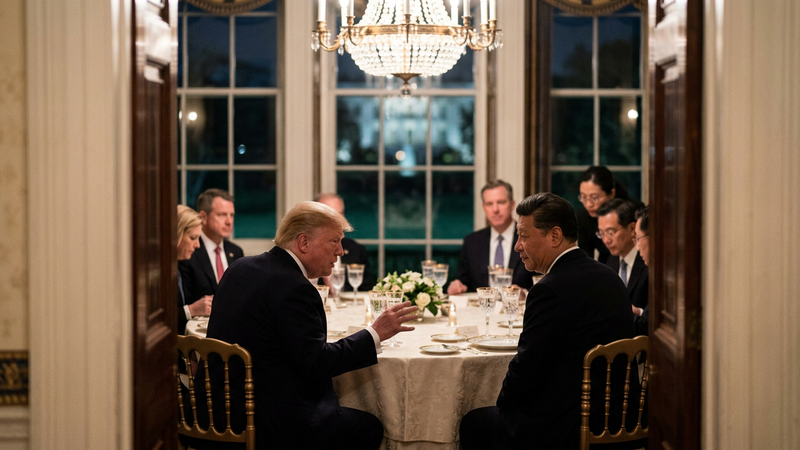
President Trump hosted Chinese President Xi Jinping and Peng Liyuan at a White House state dinner on Thursday evening, giving Washington its most visible stage for testing whether personal diplomacy can reopen guarded channels with Beijing. The two leaders and their spouses, Melania Trump and Peng, posed for photographs and met guests, according to the account of the event.
White House
The dinner does not by itself change the strategic rivalry between the world’s two largest economies. In Washington, its value lies in whether the White House can turn controlled optics into a working process on the issues that have kept the relationship under strain: Taiwan, advanced technology, military-to-military contact and economic coercion.
State dinners are ceremonial events, but in Washington they are also instruments of signaling. They show that the president is willing to invest political capital in a foreign leader, even when the relationship remains contested. For Beijing, the White House setting offers status. For Trump, the event gives him a leader-to-leader channel that fits his preference for personal dealmaking.
The hard policy terrain remains narrow. The White House, National Security Council and State Department can use a visit to define diplomatic follow-up, but the Pentagon watches the same engagement through the lens of deterrence in the Indo-Pacific. Any shift in tone toward Beijing is likely to be measured against US commitments to Taiwan, freedom of navigation, export controls and alliance coordination with Japan, South Korea, Australia and the Philippines.
That means any diplomatic reset that appears to Congress also limits the room for maneuver. China policy is one of the few areas in Washington where suspicion of Beijing crosses party lines. Lawmakers have backed restrictions on sensitive technology transfers, scrutiny of Chinese investment and stronger defense ties with Taiwan. That means any diplomatic reset that appears to trade away leverage would face quick resistance on Capitol Hill.
Taiwan remains the most sensitive flashpoint because each side treats it as a core test of resolve. Washington does not recognize Taiwan as a sovereign state, but it maintains unofficial ties and supplies defensive arms under US law. Beijing claims Taiwan as its territory and objects to steps it views as foreign support for permanent separation. A dinner can lower the temperature, but it cannot remove that structural conflict.
Technology is the second constraint. US controls on advanced semiconductors and chipmaking equipment are designed to slow China’s access to capabilities that Washington believes could strengthen Beijing’s military and surveillance systems. China views those measures as containment. Any serious follow-on diplomacy would have to clarify whether the two sides are discussing guardrails, exemptions or simply managing retaliation.
The Pentagon’s concern is more immediate: crisis management. US and Chinese forces operate in proximity in the Taiwan Strait, the South China Sea and the wider western Pacific. When political relations sour, military communication channels can become harder to use. Washington’s practical goal after a high-level encounter is often modest but important: keep commanders talking before an accident becomes a confrontation.
The White House also has an economic incentive to preserve some room for engagement. US companies with exposure to China want predictability on tariffs, licensing, supply chains and market access. Trump’s advisers can use the dinner to explore whether Beijing is prepared to offer discrete concessions, but business pressure cuts both ways: firms want access, while national security officials want tighter controls on sensitive sectors.
Beijing’s interests are equally clear. Xi benefits from being received at the White House as an equal counterpart to the US president. China also wants to prevent a tightening of US technology restrictions, slow deeper US coordination with Asian allies and discourage new moves on Taiwan. The dinner gives Xi a platform, but Washington will judge its value by what follows in writing or in scheduled talks.
No fresh named expert quotation was available in the provided research material, and the article does not include unsupported outside commentary. The main Washington reading is therefore based on the event itself and the policy machinery around it: ceremony creates an opening, while bureaucracy and Congress decide whether that opening becomes policy.
The falsifiable test is whether the White House, State Department or Beijing announces by December 31, 2026, a concrete follow-on framework: a joint statement, a scheduled leaders’ or ministers’ meeting, new bilateral working groups, or a defined channel on Taiwan risk, technology controls or military communications. If that happens, the dinner will look like the first step in a limited reset that reduces near-term macro uncertainty, gives US companies a clearer policy path and lowers some risk premiums across technology and defense supply chains. If no discrete timeline or mechanism appears, the event will remain mostly ceremonial: global markets will continue to price US-China rivalry as a standing risk, the Trump administration will retain leverage without a new process, and the wider security and semiconductor sectors will keep planning around friction rather than accommodation.